Categories
All in the Mind Power Dynamics

It’s one big club

... but you're not in it.

Connecting the dots of the wider Davos Class.

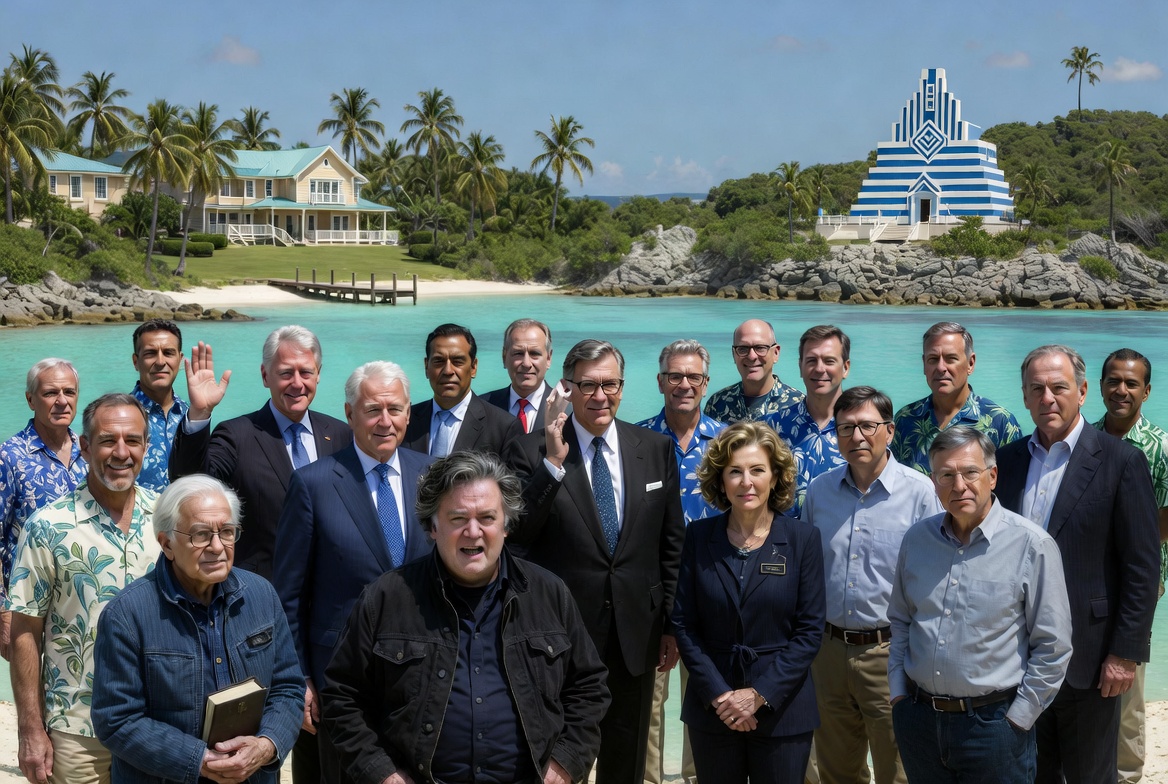
We're supposed to believe Jeffrey Epstein was an outlier, a playboy financier with a penchant for underage girls and a large network of easily corruptible politicians, entrepreneurs and luminaries. He also purportedly acted alone without the invisible hand of a much larger criminal syndicate that had, to paraphrase Klaus Schwab, embedded itself in governments and boardrooms around the world. How could Bill Gates have guessed that Jeffrey Epstein's interests may have extended beyond helping to reduce infant mortality through public health campaigns in Africa and India? Is it a mere coincidence that both shared an interest in overpopulation and biotechnology?

Bill may deny any involvement in Jeffrey's sex games, but that misses the point. Kevin Bass has dissected the Epstein files. The key relationships are all in one way or another linked to the covid psyop that unfolded six months after Epstein's alleged suicide.

The Gates Circle

Boris Nikolic: a Croatian-born, Harvard-trained immunologist who became a biotech venture capitalist, co-founding Biomatics Capital. He served as chief scientific adviser to Bill Gates and the Gates Foundation. Most strikingly, Epstein named him as successor executor in his will detailing nearly $600 million in assets. The recently released DOJ files paint a much more textured picture of their relationship than Nikolic's professed surprise would suggest. In December 2009, just six months after Epstein's release from his Florida incarceration, Nikolic was helping him navigate Davos, offering to set up one-on-one meetings and describing his own "virtual currency" as access to powerful people. Epstein's response was characteristically revealing. He wrote back that they should first decide whether any of the waitresses or staff were attractive, adding not to forget priorities.

Other key players around the Gates orbit include:

  • Larry Cohen, who served as the CEO of Gates Ventures and before that as Microsoft's Corporate Vice President of Marketing, having joined the tech giant in 1995.
  • Larry Summers, who served as Chief Economist at the World Bank, as Clinton's Treasury Secretary from 1999 to 2001 and as Harvard's president from 2001 to 2006. His first known flight on Epstein's aircraft was in 1998, when he was deputy Treasury Secretary. In 2007, Summers joined the Gates Foundation's Global Development Program Advisory Panel, alongside figures such as former Mexican President Ernesto Zedillo and former McKinsey managing director Rajat Gupta.
  • Kathryn Ruemmler, a former White House counsel under Clinton who later became a Gates attorney before joining Goldman Sachs.
  • Melanie Walker, who maintained an address in an Epstein-owned New York apartment building. In 1998, Epstein hired her as his science adviser at Caltech, using her access to meet faculty there. After moving to Seattle with Microsoft executive Steven Sinofsky, Walker met Gates at a company barbecue and joined the Gates Foundation in 2006. There, she introduced Epstein to Gates' science adviser Boris Nikolic, ultimately facilitating the first Gates–Epstein meeting in 2010.
  • Connie Collingsworth, Gates Foundation General Counsel.
  • Thorbjørn Jagland, who served as Norwegian PM, as Nobel Committee chair and as Council of Europe Secretary General. He maintained a close relationship with Epstein from 2011 to 2019, receiving gifts, travel and stays at the financier's properties. Epstein privately called him "not bright" but valued his positions. In February 2026, Jagland was charged with aggravated corruption by Norwegian authorities and subsequently hospitalised.

The Epstein–Israel Nexus

Much more evidence points to Epstein's support for the Greater Israel Project, which also aligns with his views on eugenics as a member of the chosen people. DOJ-released tax filings show Epstein's foundations donated $25,000 to Friends of the Israel Defense Forces (FIDF) in 2005 and $15,000 to the Jewish National Fund (which funds West Bank settlement activities), and gave heavily to Jewish organisations including $500,000 to the Ramaz school, plus contributions to Hillel International, YIVO and multiple yeshivas over a 20-year period. In 2008, while facing US charges, Epstein personally toured Israeli military bases with FIDF.

His most significant Israeli connection was a close, long-running relationship with former PM Ehud Barak. Epstein invested in Barak-linked tech startup Carbyne, which had ties to Israeli security sectors, and advised Barak on firms including Palantir.

An FBI informant's account, documented in released files, claimed Epstein "belonged to both US and allied intelligence services" and was "trained as a spy" under Barak, though these claims remain unverified. Epstein also referenced Ghislaine Maxwell's father Robert Maxwell's alleged Mossad ties in a 2018 email and stated in 2012 correspondence that "Palestine has never historically existed."

Palantir

The Epstein connection here is significant: he was advising former Israeli PM Ehud Barak on Palantir, placing the company at the intersection of the intelligence, military and financial networks Epstein moved within.

Founded in 2003 with $2 million from the CIA's venture capital arm In-Q-Tel, Palantir opened a Tel Aviv office in 2015, after which co-founders Peter Thiel and Alex Karp met with Israeli military leaders regularly. They were keen on building targeting databases capable of converting data extracted from the occupied Palestinian territories (emails, call logs, mobile phone address books, WhatsApp messages, social media profiles and location stamps) into predictive targeting systems. Palantir had been providing tools to Israeli security agencies as early as 2014.

In January 2024, Palantir agreed a formal strategic partnership with the Israeli Ministry of Defence following a meeting between Israeli officials and co-founders Thiel and Karp in Tel Aviv. Under this agreement, Israel was set to buy an AI-based system called AIP, designed to assist decision-making on the basis of intelligence and capable of analysing enemy targets and proposing combat moves, with Palantir expecting revenue in the tens of millions of dollars.

Palantir also powers the Gaza Civil-Military Coordination Center, the US military compound in Kiryat Gat set up in October 2025 to execute the Trump administration's plan for Gaza. Israel reportedly used Palantir tools during multiple raids in the Gaza Strip and also relied on the company in its September 2024 attacks in Lebanon using exploding electronic pagers and radio devices.

More broadly, the company has secured contracts including an initial $480 million for Project Maven (the Pentagon's AI drone targeting system), now expanded to nearly $1.3 billion. CEO Alex Karp said in February 2026 that their "weapons software is in every combat situation I'm aware of."

Palantir has also secured at least 24 contracts across key UK public institutions and is now working with both the Israeli and British military. Its UK boss Louis Mosley, grandson of Oswald Mosley, head of the erstwhile British Union of Fascists, told BBC Newsnight the company was "proud of the work we do in Israel."

Norwegian fund Storebrand divested from Palantir over its Israeli military role. In July 2025, nearly 100 activists from Jewish Voice for Peace occupied Palantir's Seattle offices, carrying banners reading "First Palantir Surveils, then IDF Kills," with simultaneous protests at offices in New York, Washington DC, Palo Alto and Denver.

From Wexner to the Blair Administration

Epstein leveraged his position at Bear Stearns to build a network of wealthy and influential clients. Through his work, he met and formed relationships with billionaires like Leslie Wexner and Leon Black, closely associated with the Rockefeller and Rothschild dynasties.

The fake-progressive mainstream media has been quick to stress the well-publicised friendship between Epstein and Donald Trump, although the latter only appeared on flight logs on Epstein's private jet from New York City to Palm Beach, Florida, and not his infamous private island, Little St. James.

Peter Mandelson, however, the lead architect of the New Labour project, arranged for his friend Jeffrey Epstein to meet Tony Blair at 10 Downing Street in July 2001 and visited his private island on several occasions. Epstein's 2008 conviction for child prostitution did little to weaken their friendship. In the same year, after a four-year stint as EU Commissioner for Trade, Gordon Brown brought Mandelson back into government as Secretary of State for Business and Trade, sitting in the House of Lords. Although the Prince of Darkness had struggled to shake off his public image as a scandal-prone, devious backroom dealer, his 2010 book, The Third Man, not only earned him £500,000 in royalties but attracted much more interest among political analysts than the bland recollections of Gordon Brown and Tony Blair.

In just over two years Mandelson resigned twice: first for an undisclosed interest-free home loan from affluent Labour MP Geoffrey Robinson and then for fast-tracking Srichand Hinduja's passport application in exchange for £1 million for the Millennium Dome. Yet this was just the tip of the iceberg. Mandelson also promoted the Horizon IT system developed by Fujitsu that would over the next 15 years lead to countless bankruptcies of small post offices and at least thirteen suicides.

As Business Secretary he attended the secretive Bilderberg Meeting and let Epstein convince him to lobby Alistair Darling to change Labour's new policy on bankers' bonuses, and helped Epstein broker a deal for the £1 billion US-negotiated sale of a UK taxpayer-owned banking business. The following year he messaged Epstein that he had finally persuaded Gordon Brown to stand down and leave No. 10, five hours before it was announced.

Meanwhile, media commentators across the conventional political spectrum jumped on the bandwagon to condemn not only the sex offender's heinous acts but a handful of bad apples who had succumbed to the lure of his generosity and sexual philanthropy, bringing an abrupt end to the last vestiges of the neoliberal era. The rhetorical left highlighted Donald Trump's well-known friendship with Epstein, while the patriotic right pointed to his close links with Chomsky, Clinton and Mandelson. Most absurdly, some commentators tried to reframe Epstein as a Russian agent because of a few contacts he had with Russian oligarchs and his vain attempts to meet Vladimir Putin.

Big Tech Connections

The recent document releases reveal Epstein had remarkably deep ties throughout Silicon Valley.

Microsoft

  • Emails show Epstein was in contact with at least 20 prominent tech executives, investors and researchers.
  • An official from Gates' private office (Gates Ventures/bgC3) emailed Gates about a business plan which he then forwarded to Epstein, listing projects including one titled "Follow-up recommendations and/or technical specifications for Strain pandemic simulation."
  • Emails showed Gates informed Epstein of his most confidential projects, including in areas like biological defence and neurotechnology.

Google

  • Google co-founder Sergey Brin emailed Ghislaine Maxwell about meeting up with Epstein during a trip to New York in 2003.
  • Larry Page, Google's co-founder, appears in the files, including in a 2010 email where Page's personal pilot wanted to use Epstein's helicopter for a Caribbean holiday.
  • Epstein introduced JPMorgan executives to Brin to help the bank secure the billionaire as a customer.

Tech Investment Activity

  • Peter Thiel advised Epstein on potential investments in Palantir.
  • Epstein invested $40 million in Valar Ventures, a venture capital firm founded by Peter Thiel, in 2015 and 2016.
  • Epstein invested $5 million in Jawbone in 2012, increasing his holdings to $11.25 million by 2017.
  • Epstein became an early investor in Coinbase in 2014, investing $3 million when the company was still a two-year-old startup.
  • Epstein's financial adviser was pitched on backing Elon Musk's SpaceX.

Biotech Connections

Epstein had particularly strong connections to biotech, longevity research and eugenics-adjacent fields, positioning himself at the intersection of Big Tech wealth and cutting-edge biotech research. These connections continued well after his 2008 conviction, suggesting his network valued his connections and investment opportunities enough to overlook his criminal background.

Investments and Relationships

  • Boris Nikolic invited Epstein to join him for a Breakthrough Prize event at investor Yuri Milner's home in Silicon Valley in 2013.
  • Masha Bucher connected Bryan Johnson with Epstein in 2017 to discuss Kernel, Johnson's brain interface company.
  • Epstein proposed to fund Harvard's Personal Genome Project to discover if "beauty resides in DNA."

Transhumanism and Anti-Ageing

  • Jeff Bezos, who dined with a fresh-out-of-prison Epstein, made significant investments in the anti-ageing startup Altos Labs, developing "reprogramming technology" to rejuvenate cells.
  • Sergey Brin founded Calico, a secretive biotech outfit focused on solving the problem of ageing.
  • Recent emails unveiled by Bloomberg illuminate Epstein's interest in transhumanism, or neo-eugenics, a philosophy that has become commonplace among Big Tech oligarchs and ruling-class elites.

Academic and Research Funding

  • Epstein corresponded with Antonio Damasio, director of USC's Brain and Creativity Institute. In 2013, Damasio asked Epstein to fund a new line of robotics and neuroscience research.
  • Epstein provided patronage to German AI scientist and executive Joscha Bach.

Epstein could only act as a philanthropic wheeler-dealer as part of a much larger global network of the high and mighty with very different public and private opinions. One faction poses on the progressive woke left and the other as the new anti-woke but tech-savvy right. In February 2025 Jordan Peterson, Douglas Murray, Ayaan Hirsi Ali, historian Niall Ferguson; journalist and author David Brooks and Peter Thiel, and Louis Mosley joined Kemi Badenoch and Nigel Farage at the ARC (Alliance for Responsible Citizenship) conference at ExCeL London. They’re all staunch Zionists and in bed with Palantir while posing as free speech champions and protectors of conservative family values. It’s the same wolf in sheep’s clothing, endlessly reinventing itself to engineer public consent for the next phase of the Great Reset.

Global Oligarchs

Yet some will still shrug their shoulders and point out that many tech superbillionaires are conspicuously or only mentioned in passing the Epstein files. Let us consider Tony Blair's best mate and leading benefactor, Larry Ellison.

He only appears appears in 22 documents in the Epstein case files, but has zero flight log appearances and zero email references, no known direct connections in the files themselves. The indirect overlap comes through Ehud Barak, around the time Epstein and Barak were corresponding and Barak's intelligence aide was living at Epstein's house, Barak was separately holding meetings with Larry Ellison, not brokered by Epstein, but running in parallel.

His operation served several overlapping functions, as an intelligence-adjacent fixer, a social broker connecting people who couldn't easily reach each other through official channels, and most infamously, a kompromat collection system, with exclusive vacations and adult entertainment services as bribes. Ellison simply doesn't need any of that. He bought the entire island of Lanai. He has multiple superyachts. He funds his own racing teams. He can host heads of state, defence ministers and tech executives on his own terms, with no intermediary and no strings attached, or rather, no strings he didn't put there himself. The hospitality Epstein monetised as leverage, Ellison can provide as straightforward patronage.

The Israeli government connection is illustrative: Oracle's Safra Catz was directly embedded in Israeli political networks, emailing Israeli officials with phrases like "we believe that we have to embed the love and respect for Israel in the American culture," and personally setting up meetings between Israeli diplomats and US senators. Ellison didn't need a disgraced financier with a massage table to broker those introductions. He had his own executive doing it from within Oracle's C-suite.

This points to something structurally important about Epstein's actual role in the network. He was primarily useful to people who needed access they couldn't otherwise command, whether that was Ehud Barak needing a backchannel to Putin, or ambitious but not-yet-powerful figures needing introductions. The truly sovereign actors in these networks, with their own private islands, infrastructure contracts and close government relationships, have no need of Epstein's particular services. They're already upstream of where he operated. It comes as little surprise that Bill Gates and Larry Fink casually dropped into 10 Downing Street in October 2024. While Fink seems more aligned with the financial gerontocracy alongside Warren Buffett and Jamie Dimon. in contrast with Thiel's libertarian techno-accelerationism, BlackRock is deeply entangled with Thiel's empire. BlackRock held over 158 million shares, or about 7.4%, of Palantir as of late 2024 and was a direct investor even before its IPO, when the company provided software to ICE for immigration enforcement. Thiel's surveillance infrastructure and Fink's asset management are structurally intertwined regardless of their public ideological posturing.

The Epstein files are geared, as a mapping exercise of power, towards catching those in the middle tiers of the network. The Ellisons of this world are the kind of figures Epstein was trying to serve not accommodate.

The TikTok footnote is quietly revealing in this context: shortly after Oracle's Ellison-led consortium took over TikTok's US operations, users found themselves unable to send the word "Epstein" in direct messages NPR, a coincidence that generated considerable online attention. It was apparently a technical glitch, but the optics around a Trump-aligned billionaire now controlling a major social platform while Epstein adjacency swirls around the administration are hard to ignore.

The real nexus is emerging around AI data centre infrastructure. BlackRock formed the AI Infrastructure Partnership with Microsoft, Nvidia, and Abu Dhabi sovereign wealth fund MGX and its first major deal was a $40 billion acquisition of Aligned Data Centers. Elon Musk's xAI also joined as a participant. Meanwhile, the Stargate Initiative, the joint venture between OpenAI, SoftBank, Oracle and Microsoft, committed $100 billion scaling to $500 billion with BlackRock acting as the major capital provider.

While Epstein's depravity may shock us, the mainstream media has turned a blind eye to his oligarch handlers, who are still very much in power and consider over 90% of humanity as superfluous to their needs.

Categories
Iran Power Dynamics War Crimes

From Humanitarian Bombing to Imperial Implosion

If anyone had any lingering doubts about who’s really calling shots at the White House, on 28th February 2026 Donald Trump shattered any ambiguity by authorising the US Air Force to help Israel bomb the hell out of Iran. It pains me to admit that the conspiracy nutters have once again got it spot on: Benjamin Netanyahu and the NeoCon Deep State run the show. The Israeli Prime Minister has been making wild claims about Iran’s nuclear weapons programme for the best part of thirty years. He has stood before the UN Assembly with maps and charts to persuade gullible delegates that if we, as in Israel’s allies, do not stop Iran now, it will nuke Israel. Meanwhile the western MSM has been busy recycling the myth that the Iranian security forces killed tens of thousands of peaceful protesters unprovoked. The reality on the ground was very different. While hundreds of thousands peacefully took to the streets in January to protest the cost-of-living crisis in the wake of the steep devaluation of Iran’s currency, the rial, much smaller group of militants ran rampage setting fire to buildings, attacking vehicles and firing automatic weapons at police. These are the classic hallmarks of colour revolutions, instigated by foreign actors for the sole purpose of destabilisation before an impending invasion. In the days before Israel launched operation Roaring Lion, millions of Iranians from all walks of life and political allegiances lined the streets to oppose foreign intervention.

Some of us remember the propaganda that led to the invasion of Iraq and the destabilisation of Syria. The US supported Iraq for most of Iran-Iraq war and turned a blind eye to the infamous 1988 Halabja massacre of Kurdish peshmerga and Iranian Revolutionary Guards (aka Islamic Revolutionary Guard Corps or IRGC), while Iran flew in journalists to document and film the carnage before losing control. While this incident did not play a role in the propaganda for the first Gulf War, over the Iraqi invasion of Kuwait, it featured prominently in the progressive media after 9/11.

Yet the violent repression narrative served to justify the onset of a war that could kill millions of innocent civilians and plunge the global economy into a deep depression with spiralling fuel prices affecting critical supply chains. Worse still, it could well go nuclear. In less than a week the whole politico-rhetorical climate has shifted dramatically. To put things into perspective, unless the US backs out immediately, which given Trump's recent pronouncements seems unlikely, they will be in it for the long haul and it will much harder to conquer 93 million Iranians with as much as 7000 years of shared history and an unforgiving mountainous terrain than occupying Iraq or Afghanistan.

In the Punch and Judy show that it is British politics, Reform have ceased to play the good guys with the best interests of the native British working classes at heart. They have gone full ZioNeoCon. You could not put a cigarette paper between Lindsay Graham and Nigel Farage. Yet In 2014, Farage observed: "In almost every country in which the West has intervened or even implied support for regime change, the situation has been made worse and not better. This is true of Libya, Syria and of course Iraq." (Declassified UK). Trump, of course, made many similar claims about draining the swamp and bringing an end to forever wars to win over his MAGA base. Alas Kemi Badenoch’s Tories are singing from the hymn sheet condemning Sir Keir Starmer for failing to join the Israeli-American military offensive. For a few short days, I began to loathe Keir Starmer less than the leaders of the alleged opposition parties. But what are they opposing, the UK government’s failure to follow Benjamin Netanyahu’s orders? Can anyone now seriously doubt that our political leaders are not in charge at all. They’re little more than teenagers in a high-school debating society recycling talking points about the dangers of antisemitism, while the people they purportedly serve face economic ruin as a result of reckless military interventionism. The closure of the Strait of Hormuz and the bombing of oil facilities across the Middle East and Iran only exacerbate the existing economic challenges of a small densely populated island over-reliant on imported resources. Gas and oil prices are already surging. The Gulf States, home to many affluent British expats, will become environmentally unviable with the destruction of their desalination plants.

The situation is very fluid, but I can already hear rumblings of boots on the ground from the usual suspects. With Peter Mandelson disgraced, Tony Blair has predictably come out in favour of Israeli foreign policy. We’re being primed for the prospect of a ground war, but I don’t see many youngsters volunteering, however bleak the prospect of life on the dole at home may seem. I don’t have any answers, but it’s little consolation to have one’s worst fears of societal collapse come true.

Categories
Power Dynamics War Crimes

One, two, three, four… What are we fighting for?

Saturday, 3 January 2026, marked the definitive end of the US-led World Order. The US President evoked the Monroe Doctrine of hemispheric dominance to justify intervening militarily in Venezuela to capture its elected president, Nicolás Maduro, under trumped-up charges of narco-trafficking. While some may doubt the integrity of the country’s 2024 presidential election, it is worth noting that corporate and state actors have long manipulated elections in allegedly liberal democracies. The Donald himself has cast doubt on the outcome of the 2020 US general election, which saw an uninspiring, senile candidate attract a landslide with over 15 million more votes than Hillary Clinton received in 2016.

The attempted oil grab came only a few weeks after Donald Trump had pardoned former Honduran President Juan Orlando Hernandez, convicted of helping drug traffickers import more than 400 tons of cocaine into the United States while accepting bribes to fuel his political career and protecting violent drug cartel leaders from prosecution.

Some may wonder if the Donroe Doctrine, as the Orange Man wants us to call it, is the first move in the repartition of the world into American, Russian and Chinese spheres of influence. Will China feel emboldened to annex Taiwan? Will NATO survive if the US annexes Greenland?

Among the first to congratulate Trump on his regime change operation was Benjamin Netanyahu, with hawkish allies embedded in the Departments of War and State eager to invade Iran on Israel’s behalf. It comes as little surprise that all of Trump’s closest allies in Latin America, from Javier Milei of Argentina to Nayib Bukele of El Salvador, are staunchly pro-Israel. By contrast, Maduro sided with the Palestinian cause. A week earlier, the Commander-in-Chief had authorised the USAF to bomb Islamic insurgents in the Bauni forest of Sokoto State, Northern Nigeria. This may be far from the oil-rich Niger Delta region, but it is conspicuously close to Niger and large phosphate, coal, gold and uranium reserves.

We now have a split between European and North American Neo-Cons. Both groups want war but cannot agree on the targets of their aggression. The Americans seem to prioritise control of strategic resources, and Venezuela has the world's largest oil reserves, around 17% of the world’s total, or over 300 billion barrels. They know they cannot defeat Russia without triggering WW3, rely on Saudi Arabia, or occupy Iran. On the other side of the Atlantic, the elites pursue the WEF’s Agenda 2030 with a much greater zeal to the detriment of their home-bred working classes. By seeking confrontation with Russia, they have denied European industry easy access to essential raw materials and cheap energy sources, just as Africa falls increasingly within China’s and Russia’s orbit, especially for new transport infrastructure and lucrative strategic minerals mining deals.

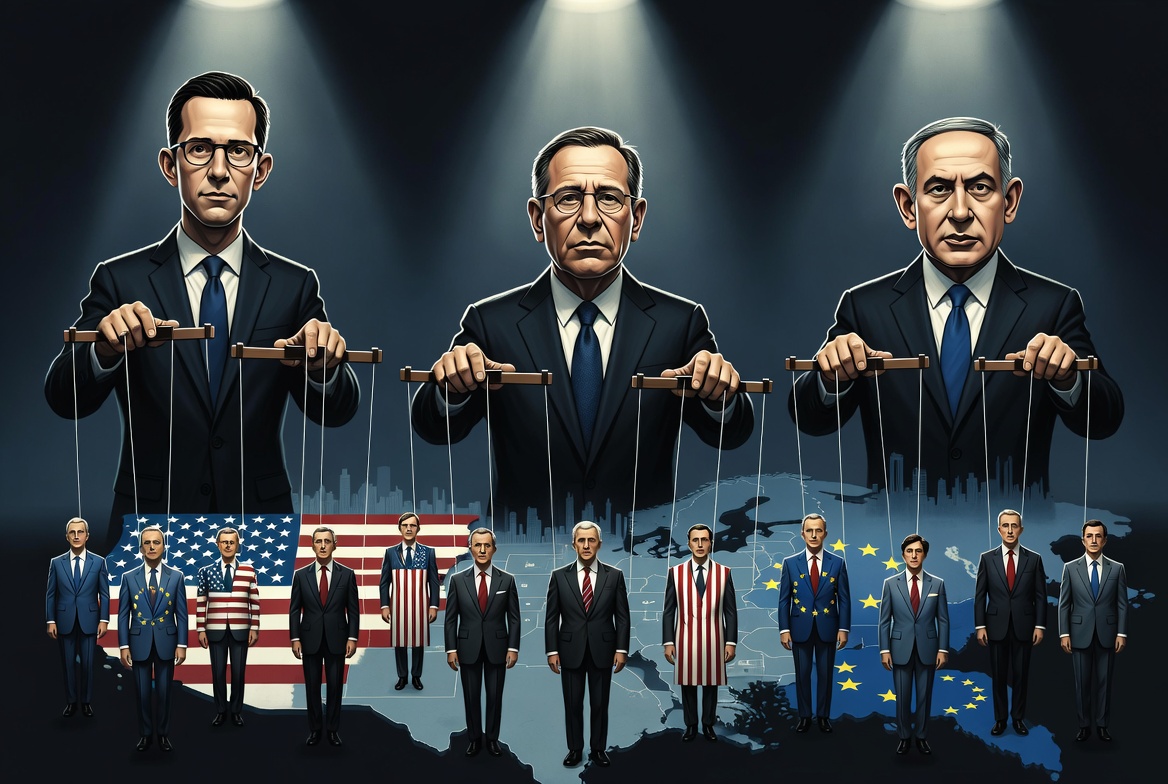
However, what if neither European nor American Deep State actors have the best interests of their citizens at heart? What if our leaders are well aware that their reckless military adventurism will destabilise their countries? Indeed, what if both Biden and Trump were mere puppets overseeing the demise of the American dream, alienating NATO allies on purpose and triggering uprisings against US commercial interests around the world? That is not as far-fetched as it seems. US oil companies have already demanded serious guarantees from the US administration before investing in Venezuela because they fear guerrilla warfare on a scale much larger than the Vietnam quagmire. Senior American oil analysts have described Venezuela as uninvestable, i.e. only feasible with a massive US military presence that could bankrupt North America’s biggest economy. The flamboyant POTUS is now calling for a massive boost to military spending in 2027 from $901 billion to $1.5 trillion.

While Chavistas, loyal to Hugo Chavez’s Modern Bolivarian Movement, may only be a minority of Venezuelans, they form a large enough critical mass to bring down any imposed administration through coordinated civil disobedience and greatly outnumber the still-wealthy comprador class, who are likely to benefit most from lucrative deals with American multinationals. In the middle are ordinary Venezuelans who are both patriotic and socially conservative. Despite suffering from harsh US sanctions for the best part of fifteen years, Venezuela has recently turned the corner and begun striking lucrative oil and mineral export deals with China. In short, US corporations need Venezuelan oil more than Venezuelans need US investment and oversight.

Some may believe that either the Donald has made a big miscalculation or that Americans think they own the world and all of its resources. There are two flaws in that analysis. First, I doubt the Donald is calling the shots. The alternation of Obama, Trump 1, Biden and Trump 2 looks increasingly stage-managed. Nobody has ever won the presidency unless they acquiesced to the demands of key lobbies in the Biotech-Military Industrial Complex. The second reason is that the same lobbies are indifferent to the plight of their compatriots. They owe their allegiance only to a tiny club that excludes 99.9% of us in any country.

The end of abundance

While annexing Canada, Greenland and Venezuela may theoretically provide plentiful resources to power shameless mass consumerism and revive the American Dream, that ain’t going to happen. The elites pulling Trump’s strings, pretty much the same oligarchs who controlled Obama and Biden, do not care about ordinary US citizens. That’s why they’ve been outsourcing skilled jobs for decades. They seem quite happy to engineer a low-level civil war over identity politics as we’ve seen on the streets on Minneapolis since immigration officers shot dead a middle class woke woman, whose car blocked their operations. If you support peaceful coexistence and self-determination, you may regulate migratory flows to maintain socio-economic stability. However, if your rulers ransack the rest of world for raw materials and destabilise their societies, you can hardly complain if millions flock to your country to get their share of wealth generated by exploiting remote resources. The point is our rulers do not want stability or the kind of widespread prosperity we’ve been accustomed to in the West over the last six or seven decades. It may once have seemed that everyone wanted to converge on the western way of life with a well-equipped house in a safe neighbourhood, one car per adult, holidays abroad, exciting career opportunities and generationally rising living standards. Life became a soap opera, but the illusion of plenty was built on debt. The bubble first burst in 2008 and ever since the billionaire and banking classes have been getting richer with government bailouts and oligopolistic practices to the detriment of the skilled working classes. Now our rulers no longer need most of us,. They want war as a as the only means to justify planned societal destruction, but who will fight it?

Honestly, I do not see many British, French, German or even American youngsters volunteering to fight for the likes of BlackRock, Haliburton, ExxonMobile, Microsoft or Pfizer. Why should we fight for governance teams that hate us? AI-enabled drones will fight the next and we will be mere bystanders locked down in our humble abodes checking social media for updates on power outages and nearby food banks.

Categories
All in the Mind Power Dynamics

Choreographed Chaos

Choreographed Chaos

Could establishment fearmongering about ethno-fascism usher in technofascism?

Honestly, I’m done with bombastic clowns in the mould of Donald Trump, Nigel Farage and Geert Wilders. They play to the patriotic family values of the disenfranchised Western working classes who feel let down by their faux-progressive mainstream politicians, obsessed with the WEF’s lofty sustainable development goals and overseeing cultural convergence on a global scale. The mask is off. In country after country, vast swathes of the electorate have finally cottoned onto the deceptive nature of counterproductive woke ideology that far from emancipating the underclasses delegates all power to a technocratic master race.

However, after seeing public spending splurges on lockdowns, war games, gender bending, social engineering and hair-brained net-zero initiatives, many will now switch their allegiance to another bunch of neocon-artists. But to whom do the new Thatcherite kids on the block calling themselves Reform owe their allegiance? They may parrot all the right soundbites about controlling borders and making the country great again, but they’re in bed with many of the same tech billionaires and lobby groups.

Don’t get me wrong. I’ve not suddenly swung back to the infantile left of my teenage years dreaming of a worldwide revolution against greedy capitalists, tearing down all borders and replacing families with communes. That’s what Aaron Bastani might call Fully Automated Luxury Communism. The book basically puts a neo-Marxian spin on Klaus Schwab’s vision of a Great Reset to accommodate the fourth industrial revolution.

The old left-right paradigm makes little sense when many establishment figures pose on the radical left and decry the working classes for being reactionary malcontents. But some factions within the global elites can pose on the faux-nationalist right too. The Donald’s focus has shifted from MAGA to MIGA (Make Israel Gruesome Again), while his associates plan new wars over control of Venezuelan and Nigerian oil reserves.

My main bone of contention has always been with the extreme concentration of power that undermines the self-determination of communities and families. With New Labour, we get collusion with BlackRock, Bill Gates and Larry Ellison for the construction of huge new AI data centres, new mRNA jab manufacturing plants and more clinical trials of dodgy therapeutics. With Reform we will probably see sweet deals with Elon Musk, the cultural left’s new bête noire.

In September we saw probably the largest politically incorrect demonstration this decade as a sea of flags from all four corners of the United Kingdom filled the streets of Central London, but they were ominously interspersed with Israeli Stars of David. While the mainstream media estimated only 150,000, aerial footage suggested a much larger number although the organisers’ claim of 3 million may be wide of the mark. It competes with the November 2023 Armistice Day march against the bombing of Gaza where the police estimated an attendance of around 300,000 and the organisers around 800,000.

More interesting was the reaction from left-branded TV talking heads concerned about foreign tech moguls like Elon Musk exerting undue influence on British politics, while turning a blind eye to the banksters and oligarchs closely aligned with the World Economic Forum and its plans to reimagine humanity in the fourth industrial revolution.

Hardly a day passes without an outburst of self-righteous indignation about the latest gaffe by a Reform or Tory MP, sometimes for merely stating the obvious about Britain’s rapidly changing demographics. The latest example saw a social media pile-on against Reform’s goody-two-shoes MP, Sarah Pochin, who claimed to be sick and tired of seeing so many black and brown actors in TV commercials. The context was the over-representation of darker-skinned people in British TV ads, as corroborated by a recent Channel 4 survey. Despite record levels of immigration in recent years, over 80% in the UK are still white, but this proportion is much lower in school-age children, often cited as around two thirds but declining. Numerous studies have also identified white working-class school leavers as the most disadvantaged group in terms of academic performance and earnings in early adulthood. This leads to the widespread perception that the ruling elites now discriminate against the direct descendants of the indigenous peoples of the British Isles in favour of newcomers, pitting rival ethnic communities against each other.

Local elections and opinion polls continue to show stronger support for Reform among the settled working classes with the LibDems and Greens doing best in the leafy suburbs, gentrified inner city neighbourhoods and market towns favoured by the affluent professional classes, while Labour struggles to hold onto its new strongholds in areas with large BAME communities and falls back on its army of public service professionals and high-profile opinion leaders favoured by the establishment media.

Politics has descended into spectacle with emotive rhetoric that serves only to name and shame rivals rather than speak truth to power and hold the decision-makers to account. A new brand of radical chic parliamentarians such as Zarah Sultana may boldly accuse the government of complicity in Israel’s genocidal war crimes in Gaza, sitting only a few yards away from Rupert Lowe MP who has repeatedly complained about anti-white racism, but it’s all theatre as neither will get anywhere near levers of power. Genocide is a highly emotive term. While Israel may have killed hundreds of thousands of Palestinians over the years, many millions more survive in the West Bank, Gaza, Jordan and a wider global diaspora, in part thanks to a high fertility rate. By contrast, the ethnic displacement of English natives from many urban areas is just as significant statistically but has happened peacefully as many inner-city dwellers moved to the suburbs in an endogenous process that later morphed into white flight. Differential fertility rates also have played a key role in Britain’s changing demographics. Yet in different ways Ms Sultana and Mr Lowe may have more in common than meets the eye. For a start, they both oppose Digital ID as favoured by the Blairite centre.

Although Zarah has succumbed to chameleonic compliance in her performative advocacy of faux-progressive causes such as transgender rights, deep down she cares mainly about her Muslim community and the Palestinian cause. Likewise, Rupert is probably just an old-school Tory concerned about Great Britain’s rapid moral and cultural decline, trying to defend his people and finding himself increasingly at odds with the new globalist establishment. That makes both Rupert and Zarah critical thinkers, prepared to speak their minds, in a chamber chock-a-block with unquestioning conformists who like to parrot well-rehearsed lines about countering Russian disinformation or saving our BBC or our NHS from Big Bad Trump.

Who’s really in charge?

When the economy fails, the ruling classes resort to war. Opposition to imperialism has historically come from socialists and libertarians alike. Adam Smith once opined: “War and imperialism are detrimental to economic prosperity and undermine the principles of liberty and prosperity”. Historically in the West, the biggest warmongers have always posed as moderates. The likes of Macron, Starmer and Merz all serve the interests of the most powerful lobbies on earth. They provide temporary public faces for policies decided behind closed doors and sold to the general population under false pretences. Just like the covid psyop, the prospect of war with Russia, Iran or Venezuela empowers the state to rush through emergency legislation in the same vein as the infamous Coronavirus Act 2020 with 300 pages of special measures restricting the basic freedoms of assembly, family life and bodily autonomy we had cherished for centuries. Only the pretext changes. If the authorities can suspend civil liberties and stifle dissent in the name of public health, they can do the same to fight perceived threats to our freedom and democracy, a catchphrase that has become as hollow in the public mind as safe and effective.

As the American Empire crumbles, we may be witnessing growing rifts within the Western World. The unpopular Starmer administration is distancing itself from the US-Israeli axis, just as American grassroots liberals and conservatives, from Candace Owens, Tucker Carlson, Marjorie Taylor-Greene and Thomas Massie are now openly condemning Israeli interference in American politics and NYC elected a Muslim Mayor who has turned down offers to visit Jerusalem. However, many failed to notice Zohran Mamdani’s close relationship with Alexander Soros. One way or another, the tide is turning against the kingpins of US foreign policies. As political alliances shift, new divides emerge between regime loyalists and critical thinkers as well as between the European and American wings of the Western Alliance

Categories
All in the Mind

Rebranding Eugenics

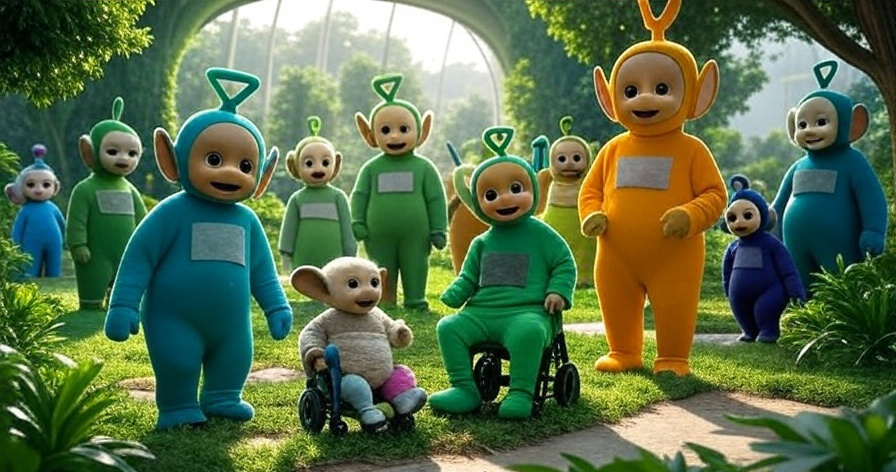
Brave New World of happy teletubbies with a diverse range of disabilities

The Dark Roots of the Autism Industrial Complex

The modern concept of mental health, particularly the screening of deviant or noncompliant behaviours, took shape in the 19th-century expansion of universal schooling. As industrial economies came to rely more on brainpower and social capital than unskilled manual labour alone, businesses turned to the state, churches and charities to help cultivate a new social order. This fostered growing interest in child psychology and the classification of personality disorders with the aim of weeding out perceived bad apples from the future pool of human resources.

Early psychiatric screening helped reclassify people as biological liabilities, fuelling eugenic sterilisation in North America and Scandinavia and most notoriously the Nazi T4 euthanasia programme, where human beings were dissected, classified and discarded in the name of systemic optimisation. The same dehumanising logic has now resurfaced in the AI age treating commoners as data inputs or guinea pigs, ripe for experimentation, rather than autonomous participants with agency and consent.

Comparisons with mid 20th century National Socialism rarely bode well, as they risk trivialising the scale of systematic murder the ideology enabled and may invite accusations of hyperbole. However, we need only connect the dots between the Rockefeller Foundation, the British Eugenics Society, John Hopkins University and most ominously the Kaiser Wilhelm Institutes for Anthropology and Psychiatry (KWI-A and KWI-P) to understand the scientific basis for later sterilisation and euthanasia programmes that targeted the mentally retarded and clinically insane before the Second World War had even started.

Austrian-American psychiatrist, Leo Kanner, has long been credited with identifying infantile autism as a distinct disorder. This contrasted with his Swiss colleague Eugen Bleuler’s definition of autism as a symptom of extreme isolation observed in some schizophrenic patients. Although a social activist of Jewish heritage, Dr Kanner worked at the Rockefeller-funded John Hopkins Hospital and had initially supported the sterilisation of the feeble-minded, a view he would change in 1942 as the full horror of Nazi experiments came to light.

In 1981 Lorna Wing introduced the concept of high-functioning autism, which she named after the previously little-known Austrian psychiatrist, Hans Asperger. Prof. Simon Baron Cohen later popularised this as the extreme male brain (The Essential Difference: Men, Women and the Extreme Male Brain, 2003). However, Dr Wing brushed over Asperger’s collaboration with the euthanasia programme at the Spiegelgrund clinic. Edith Sheffer argued in her book The Origins of Autism in Nazi Vienna (2018) that Hans Asperger was not the heroic pioneer shielding vulnerable children, as Lorna Wing portrayed him, but rather a participant in a system that selected who was worthy to live based on productivity, conformity and social value. Autism, as a diagnostic category, arose within this bureaucratic, medicalised framework of surveillance, selection and ultimately disposal.

Before the rise to power of the Fatherland Front in 1934, Red Vienna under Social Democratic rule pursued a progressive eugenics agenda, in which the state aimed to improve public health, hygiene and child welfare through a mix of carrot and stick tactics. Special needs practitioners, known locally as Heilpädagogen or healing educationalists, would identify gifted children and target the unfit for sterilisation. This kind of positive eugenics overlapped with the modern ideas of child development, early education and psychological screening, but often carried implicit assumptions about heritable fitness. Later under more authoritarian administrations, this pre-existing welfare infrastructure was co-opted into a far more coercive system of negative eugenics. The psychiatric system, especially at the Spiegelgrund clinic, played a central role in the Aktion T4 child euthanasia programme. Doctors had to classify children as educable or not. Those deemed unfit were sent to euthanasia clinics. Sheffer argues that autism, particularly the notion of a socially detached child, was shaped by this broader ideological context. That is, autism was pathologised precisely because non-conforming children were seen as a threat to the Volksgemeinschaft (the racially and socially unified community).

Eugenics and psychiatry evolved symbiotically in the early 20th century with substantial funding from the Rockefeller Foundation on both sides of the Atlantic, the Harriman family and the Kellogg Foundation among others. Charles Darwin’s cousin, Sir Francis Galton founded modern psychometrics and coined the term eugenics as the scientific basis both for racial discrimination and the later technocracy movement. German neuropathologist, Emil Kraeplin is often viewed as the father of modern scientific or biological psychiatry. In 1917, German-American banker, James Loeb, a former patient of Kraeplin’s, helped fund the German Institute for Psychiatric Research, which later became part of the Rockefeller-funded Kaiser Wilhelm Society for the Advancement of Science.

Echoes of eugenics in the Swinging 60s

Despite his contempt for National Socialism, German-born psychologist, Hans Jürgen Eysenck, played a leading role the post-war promotion of psychometric testing and hereditarian theories. Along with his second wife, Sybil, Eysenck worked at the Institute of Psychiatry, King's College, where he developed a distinctive dimensional model of personality structure based on biogenetic variation. Through his prolific writing in scientific journals and broadsheet newspapers and his regular public speaking engagements, HJ Eysenck kept alive soft eugenics in the egalitarian interlude from the swinging sixties to the end of the cold war. Throughout this era, environmental determinism prevailed in psychology. Universal psychometric testing fell out of favour in Western Europe, often limited to occupational aptitude tests (civil service, military etc.), while it remained pervasive in the USA. Americans are more likely to know, discuss and treat IQ as part of personal identity. Western Europeans may undergo similar cognitive assessments but without the label, score or social meaning attached.

Marketing Deviance

In the 1980s, we began to see the proactive marketing of common emotional challenges, often through celebrity endorsement, such as depression, obsessive behaviour and social anxiety. These subjective labels would not have hitherto qualified as psychiatric conditions. American films, soap operas and sitcoms helped normalise not only psychotherapy as a rite of passage but also psychoactive medications for successful young professionals. This shift marked a significant turning point in how society perceived and addressed mental health issues.

The mainstreaming of these conditions was not merely a commercial venture but a reflection of a broader societal trend. The term mental health has become a catch-all for a wide range of behaviours and emotions that were once considered normal variations of the human experience.

Managing Noncompliance

Soviet scientists and public health officials initially embraced the Fabian approach to progressive eugenics to improve society collectively. This contrasted with Western race or class-based approaches by focusing on social and environmental conditions, rather than hereditary determinism, through family planning. Yuri Filipchenko, Alexander Serebrovsky and Nikolai Koltsov played pivotal roles in aligning genetics with socialism, founding the Russian Eugenics Society in 1920.

However, tensions soon emerged between Mendelian geneticists and Marxist ideologues, especially those wedded to socio-environmental determination of human traits. In the late 1920s Stalin cracked down on Western-influenced science and denounced Serebrovsky’s work. Soviet journals began publishing attacks on eugenics as a bourgeois science and in 1936 Eugenics was formally banned as a scientific field.

By the late 1930s, genetics itself came under fire, culminating in the rise of Trofim Lysenko, who promoted Lamarckian biology and rejected Mendelian inheritance. In the 1930s, American geneticist, Hermann J Muller, promoted a vision of soft eugenics rooted in Mendelian genetics, arguing that informed reproductive choices could reduce hereditary disease. He shared many ideals with Julian Huxley, who had invited Muller to join him at the recently founded William Marsh Rice Institute of Rice University in 1912. After accepting a short-term research post at the Kaiser Wilhem Institute in Berlin in 1932, Muller worked in the Soviet Union between 1933 and 1937. He opposed both racially motivated eugenics and Trofim Lysenko’s Neo-Lamarckian denial of genetics in the USSR, positioning himself as a scientific advocate for genetic determinism tempered by ethics.

Into the Abyss

The key players of the Nazi eugenics programmes received direct or indirect funding from American philanthropic organisations with oversight from the IFEO, International Federation of Eugenics Organizations, headed by American eugenicist Charles Davenport.

  • Ernst Rüdin spearheaded psychiatric genetics, helping to draft the 1933 Sterilisation Law and providing the intellectual foundation for sterilisation and euthanasia (Aktion T4). In 1930, Rüdin argued for eugenics at the First International Congress for Mental Hygiene, held in Washington DC and two years later became President of IFEO.
  • Hans Luxenburger pioneered the use of twin studies to investigate the heritability of psychiatric and neurological disorders alongside Ernst Rüdin and Franz Kallmann. The latter of Jewish descent, was purged under new racial laws In 1936. However, his colleague and the Rockefeller Foundation help him relocate to the United States where he continued research into neurological disorders via twin adoption studies.
  • Otmar von Verschuer advanced racial hygiene through hereditary research, mentored Josef Mengele, and promoted sterilisation of mixed-race children and the mentally ill.
  • Eugen Fischer contributed anthropological theories on race mixing and heritability that legitimised sterilisation and racial laws. He chaired the IFEO’s  Commission on Bastardization and Miscegenation.
  • Karl Brandt and Philipp Bouhler led the implementation of Aktion T4, coordinating mass murder of the disabled and mentally ill in gas chambers and via lethal injections. While not direct recipients of foreign funding, their actions relied on Rockefeller-funded pseudoscience that legitimised their work.

The Rockefeller Foundation played a major role in financing German eugenics research, largely through grants to the Kaiser Wilhelm Institute for Anthropology, Human Heredity and Eugenics (KWI-A) and the Kaiser Wilhelm Institute for Psychiatry (KWI-P). Between 1925 and 1935, the foundation provided nearly $3 million to German researchers, including Rüdin, Verschuer and Fischer, with specific grants such as a donation to the KWI-A in 1936 of $655,000, which would have been over 1000 times the average annual salary in Germany at the time. These funds supported studies on heredity and racial hygiene, which were later misused by the Nazis to justify sterilisation and euthanasia programs. The Foundation continued funding even after the 1933 Nuremberg Laws, though it withdrew support in 1939 when the misuse became undeniable. Only in 2021 did the Rockefeller Foundation acknowledge its historical involvement in eugenics and issued a statement supporting anti-eugenics efforts. Though the Foundation later distanced itself, it had enabled much of the scientific groundwork.

Rüdin and Verschuer developed diagnostic criteria for schizophrenia, feeblemindedness and racial purity, leading to sterilisation or euthanasia of hundreds of thousands. Fischer’s work justified the sterilisation of over 400,000 people and the targeting of mixed-race children. Beginning in 1939, Brandt and Bouhler co-led the infamous T4 euthanasia programme, responsible for the organised killing of 250,000 to 300,000 people through institutions like Hadamar, Hartheim and Brandenburg.

After the war Brandt was tried and executed at the 1947 Nuremberg Doctors’ Trial for crimes against humanity, while his colleague, Bouhler, committed suicide in 1945. However, the most influential figures, Rüdin, Verschuer and Fischer, escaped serious postwar punishment. Verschuer resumed academic work in West Germany and contributed to ongoing postwar genetics research.

While secret, news about state-sanctioned mass murder leaked out as families noticed suspicious deaths. By 1940–41 growing awareness sparked public protests, especially from the Catholic Church. Bishop Clemens August Graf von Galen (Münster, 1941) gave a famous sermon denouncing the euthanasia of the disabled. While the official programme was paused, decentralised killings continued until 1945.

In the aftermath of the Nuremberg Trials with the condemnation of coercive medical experimentation, the Universal Declaration of Human Rights affirmed that "everyone has the right to life, liberty and security of person." In the coming decades, these noble concepts would be endlessly redefined.

Shift to Behaviourism

By the mid 1930s the Soviet Union had abandoned eugenics in favour of Pavlovian behaviourism. Nobel Laureate Ivan Pavlov believed many mental disorders were malfunctions of the higher nervous activity affecting the brain’s balance between excitation and inhibition. He saw neuroses as learned maladaptations caused by excessive or contradictory stimuli or what we might now call environmental stress.

His famous experimental neuroses in dogs, created by overloading them with conflicting signals, were designed to mimic human breakdowns such as hysteria or anxiety.

Pavlov acknowledged that temperament had a physiological basis and could make an individual vulnerable to stress. However, he believed any temperament could be strengthened or weakened by the right conditioning, in contrast with hard genetic determinism common among early 20th-century eugenicists.

Unlike psychiatrists who still used moral or degeneracy theories, Pavlov framed illness in mechanistic, reversible terms. In principle, a maladaptive reflex pattern could be extinguished and replaced, meaning the person could be cured by reconditioning.

After the death of Joseph Stalin in 1953, Alexander Luria and Boris Teplov solidified Pavlov's theories on conditioned reflexes and higher nervous activity as the official paradigm for psychiatry and psychology in the USSR with the abolition of psychoanalysis and a focus on physiological mechanisms. The nomenklatura denounced psychoanalysis as a bourgeois pseudoscience and replaced it with a purely physiological model of the mind.

This new paradigm emphasised the biological and physiological underpinnings of mental illness. Soviet psychiatrists in this era viewed mental disorders not as psychological conflicts but as disturbances in the brain's higher nervous activity. This led to a rise in research on the brain's role in behaviour, emotion and cognition.

Andrei Snezhnevsky, a leading figure at the Moscow School of Psychiatry, coined the term sluggish schizophrenia (вялотекущая шизофрения  or vyalotekushchaya shizofreniya) in the 1960s.

Sluggish schizophrenia could not be framed in purely Pavlovian terms. Instead, it was billed as a biological brain disorder, in keeping with Soviet claims that psychiatry was a medical science, not social policing. Symptoms included pathological reformism, perseverance in defending one’s opinion and suspiciousness toward the authorities. Progression was said to be extremely slow, sometimes over decades, which made it convenient for indefinite confinement. We could almost describe as an adult form of oppositional defiant disorder.

Although Pavlov’s reflex theory was still officially revered, by the 1960s Soviet psychiatry had moved towards biological determinism in mental illness, at least rhetorically, while quietly applying ideological criteria. Sluggish schizophrenia worked politically because it allowed the state to present dissenters as biologically ill, not criminal and framed nonconformity as a medical risk to society rather than a legitimate political stance.

In the West, John B Watson pioneered our understanding of behaviourism. He believed that psychology should focus only on observable behaviour, not internal mental states. Watson famously claimed he could shape any infant into any kind of adult purely via conditioning, given control of their environment. Although active during the height of the American eugenics’ movement (1900s–1930s), Watson preferred environmental explanations. While eugenicists promoted sterilisation to eliminate defective genes, Watson’s emphasis on environmental control implied that upbringing could override biology, making sterilisation less central from his perspective. However, behaviourism’s blank slate rhetoric could co-exist with eugenics in policy circles: one could argue for “improving” the environment and removing genetic defects simultaneously.

B.F. Skinner (1904–1990) developed the concept of operant conditioning as behaviour shaped by reinforcement and punishment with applications education, social engineering, psychiatric treatment and even utopian communities such as Walden Two.

Skinner did not outright deny genetic influence, but like Watson, he prioritised environmental control as the main lever for shaping society. He was less politically engaged in eugenics debates than some contemporaries, focusing instead on behavioural technology for improving the human condition. Skinner’s framework allowed policymakers to imagine behaviour as infinitely malleable, potentially reducing the scientific rationale for sterilisation. But in practice, both approaches could operate in parallel, eugenics targeting the “unfit” biologically, behaviourism reforming those deemed socially deviant. In the U.S., compulsory sterilisation laws (e.g., Buck v. Bell, 1927) targeted the “feebleminded,” mentally ill, epileptic and criminal. Many eugenicists saw mental illness as heritable; sterilisation was framed as preventive public health. Behaviourism did not drive these laws, inspired by hereditarian psychiatry and social Darwinism, but it could be used alongside eugenics to manage those who remained. Skinner marked a shift from conditioning reflexes to operant shaping of complex behaviours. Both contributed to a vision of society as modifiable through controlled stimuli and reinforcement schedules.

While behaviourism offered an alternative to purely genetic determinism, in authoritarian settings it could blend seamlessly with policies aimed at eliminating or re-engineering undesirable traits.

Going Underground

A belief in genetic determinism, that intelligence, personality and social potential are largely hereditary, underpinned much of pre-1945 racial eugenics and continues to feed into some strands of modern genetic engineering discourse. But such determinism is not a necessarily prerequisite for psychiatric abuse. In the Soviet model, the suppression of dissent through psychiatry relied less on heredity than on identifying and neutralising politically unsound tendencies, regardless of genetic origin. By contrast, progressive eugenics retains the selective impulse of its racial counterpart but redefines its ideal population: discrimination is not based on skin colour or ethnicity, but on perceived educability and ideological alignment. In their utopian vision, progressive eugenicists envisage a society as a network of university campuses, with the uneducable or stubbornly traditional relegated to controlled reservations, vestiges of the past preserved only for heritage value.

In their 1994 book, The Bell Curve, Richard Herrnstein and Charles Murray marked a big shift away from the intellectual egalitarianism of the boomer decades. It had once again become politically correct to affirm that some people are more intellectually gifted than others. The Overton window shifted further eight years later when Steven Pinker, a self-declared liberal, wrote a scathing critique of behaviourism in his best-seller, the Blank Slate. While the new generation of evolutionary psychologists steered clear of endorsing eugenics or distanced themselves from racial sociobiology, they cleared the way for a more radical departure from the existentialism of the 1960s with its emphasis on personal agency. Both radical behaviourism, as favoured by Soviet psychologists, and hard genetic determinism, as favoured by neoliberal sociobiologists, reduce human beings to mere programmable machines with only the illusion of free will. They share a mechanistic view of humanity and differ mainly in their focus on our hardware, as in our genetic inheritance, versus software, as in our environment in determining divergent intellectual and behavioural outcomes. While academics debated the relative importances of genes and memes, both concepts could be invoked to justify a more stratified society with greater surveillance and restrictions on personal freedom.

Groupthink

The infamous Asch and Milgram experiments illustrate the dynamics of group conformity and obedience, revealing how individuals often prioritise social acceptance over critical thinking. Solomon Asch's studies demonstrated that people would conform to a group's incorrect answers, while Stanley Milgram's research on the early 1960s highlighted the extent to which individuals would obey authority figures, even to the point of inflicting harm on others. Participants played the role of teachers instructed to administer increasingly severe electric shocks to learners, in reality actors, if they gave incorrect answers. In this framework, human actions are seen as responses to social pressures rather than autonomous choices. However, Asch maintained a belief in the potential for critical thinking and free will, even in the face of conformity. By  contrast, Milgram's findings suggested that obedience to authority could diminish individual moral agency, indicating that emotions and situational pressures might often override critical thinking. Together, their work illustrates the complex interplay between group behaviour, individual agency and the factors that influence our actions.

On the one hand, the reductionist camp views humans as deterministic systems, whether biological or environmental, leading to greater social control and via psychiatry, education, sterilisation, while on the other hand the voluntarist camp sees humans as moral agents, capable of genuine choice, favouring the ethics of responsibility, dignity and personal liberty.

Free Will and Mind-Body Dualism

Philosophers have long wrestled with free will and its implications for self-determination, personal responsibility and informed consent. From a hard determinist standpoint that views the world through a materialist lens, our desires and needs are mere products of a complex maze of interweaving biological processes and environmental stimuli. We would have no greater intrinsic worth than the bacteria swimming in a petri dish with only the illusion of freedom. Compatibilists try to reconcile material determinism, as in the belief that nothing exists outside the physical realm, with personal agency and independence of mind. Arguably, true free will, at least within our physiological constraints, relies on mind-body dualism, that has long been out of favour with mainstream neuroscientists. In his book “Free Agents, How Evolution Gave Us Free Will”, Kevin J. Mitchell provides a compelling case that we are not mere machines responding to physical forces but purposeful agents. Nevertheless, he rejects the kind of magical dualism associated with René Descartes. This physicalist outlook stands in stark contrast to John C. Eccles’ and Karl Popper’s thinking in their 1977 book, The Self and its Brain, which lays out the case for scientific dualism that maintains the mind (self) is not reducible to the brain and conscious will can affect the probabilities of synaptic events through quantum indeterminacy. Roger Penrose, a mathematical physicist and philosopher of science, argues that computation cannot emulate consciousness. In his 1989 book The Emperors’ New Mind he hypothesised quantum mechanics may give rise to human consciousness. Penrose later teamed up with Stuart Hameroff to develop the orchestrated objective reduction theory (Orch-OR), that sees consciousness arise from non-computable quantum processes in the brain’s microtubules. If Penrose is correct, then our minds cannot be reduced to algorithms and replicated in machines, placing a hard ceiling on artificial general intelligence (AGI). The implication is profound. It affirms a unique worthiness of human beings, not just as complex information processors but as conscious agents in a way machines can never be. Conversely, if the reductionist models favoured by mainstream science prevail, the ruling classes may come to see most of humanity as expendable zoo animals. Human rights only make sense if we value people’s inner selves and not merely their utility in terms of their physical or mental dexterity.

The Equality Delusion

In the boomer decades, we assumed that most adults could participate fully in society as respected workers, parents, neighbours and engaged citizens. Schools strove to provide equal opportunities rather than lifetime guardianship. The mentally handicapped accounted for a tiny minority with rare and profound impairments. Everyone else was assumed to be accountable for their actions. Parents and extended kin bore the moral and practical duty of raising children. State agencies intervened only in extreme cases of neglect and abuse. We have since experienced thirty to forty years of managed stratification by personality and intelligence profiles with the growing demonisation of the unenlightened underclasses. Ironically in the same period, the child welfare system has become increasingly obsessed with equality, diversity and inclusion, while on the ground the wealth gap continues to grow and a global superculture supresses a rich tapestry of rooted cultural traditions.

Many still assume the progressive managerial classes seek to redress inequality and promote cultural diversity as an antidote to global homogenisation. Yet nothing could be further from the truth.

The mental health mantra focuses on our adaptability to a socially re-engineered world. It medicalises incompatibility with the system. While most professionals in the extended social care sector believe they are helping to improve livelihoods, their superiors have other thinly veiled plans for an intellectually tiered society.

Categories
All in the Mind Power Dynamics

Your Life in their Hands

How progressive middle managers want you to place your trust in official experts

The Labour-dominated Westminster parliament approved the third reading of The Terminally Ill Adults Bill (commonly known as the Assisted Dying Bill) by only 314 to 291 votes after defeating amendments that could have offered some minimal safeguards, such as forbidding doctors from pre-emptively presenting assisted suicide as a care pathway, which could be dangerous with patients in a deep state of melancholy or suffering from mild dementia. Only the unelected House of Lords may now revise the legislation before it becomes law. It comes as little surprise the French Parliament also recently passed analogous legislation. Contrary to media portrayals, the policy does not come from a large grassroots movement, but straight out of the World Economic Forum playbook via a spider’s web of NGOs and charities. Just as the technophile professional classes look forward to extending their lives through AI-guided medicine, epigenome reprogramming, somatic and cognitive augmentation, they seem happy to relieve plebeians of their suffering through end-of-life ceremonies.

Some may argue that we already have euthanasia in all but name, leaving millions of atomised commoners to while their time on a cocktail of audiovisual entertainment, comfort food and risky medications, which in combination often have undisclosed side effects. With a reduced quality of life and limited personal independence, especially with long-term medical conditions such as obesity, diabetes, hypertension, angina, atrial fibrillation and most ominously dementia, sooner or later we’ll end up in hospital at the mercy of medics who may decide whether to keep us alive or give us life-shortening palliative care.

As early as the 1990s the Liverpool Care Pathway provided a framework for the triage of worthy and unworthy patients, by prioritising different approaches depending on the perceived quality of a patient’s remaining life, which in the case of lonely dementia patients is likely to be very diminished. While a public outcry led health authorities to phase out the Liverpool Care Pathway in 2013, only seven years later, tens of thousands of covid patients were given high doses of midazolam, which Dr Luke Evan MP described as essential to a good death and asked the then Secretary of State for Health, Matt Hancock, to check if supplies would suffice.

Groupthink

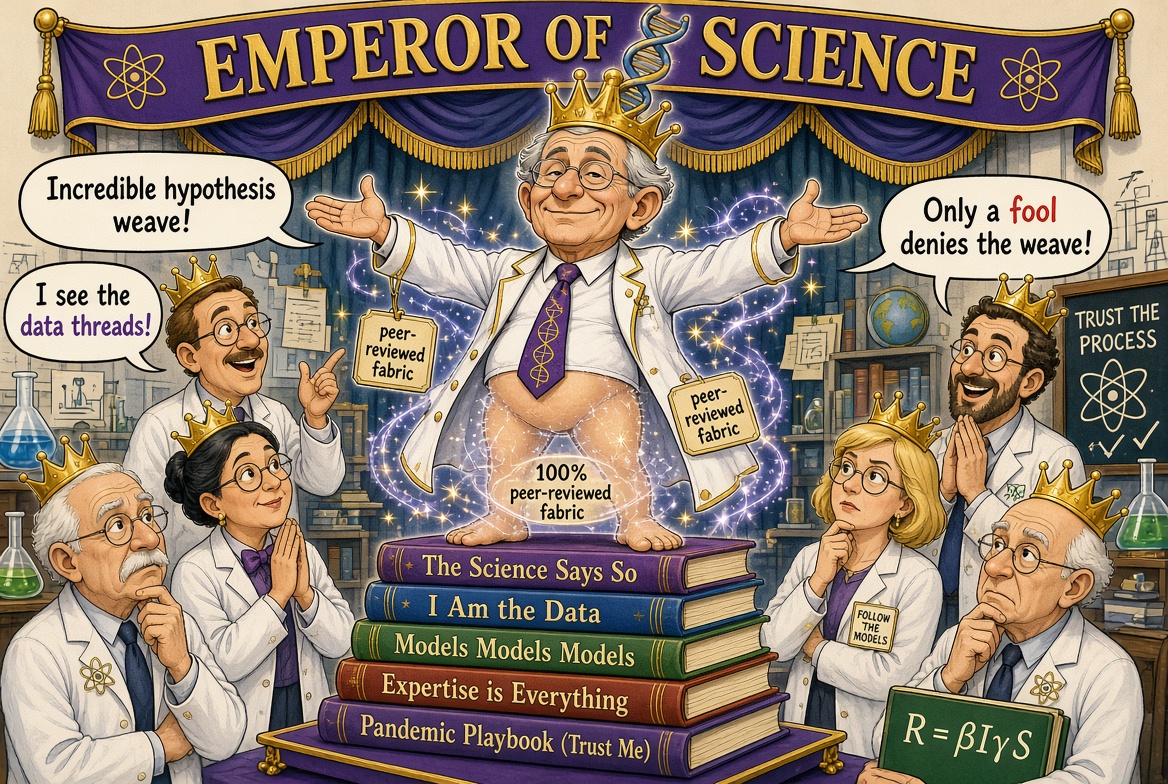
In her many prime-time TV appearances promoting her Assisted Dying Bill, Kim Leadbeater MP exuded her complete deference to the medical establishment. While Labour politicians often like to appeal to our compassion for the weakest in society, their underlying assumption is that we all share the same belief system, espoused by the progressive mainstream media. They look on the experts behind the covid lockdowns as tech deities whose conflicting logic must never be questioned. They worship the likes of Anthony Fauci and Chris Whitty with a quasi-religious zeal. To question these messianic figures provokes not just unease, but accusations of betrayal, as though one has violated a moral or spiritual covenant. I know from dealing with my extended family of past and present Labour activists which subjects and celebrities to avoid in polite conversation. It’s seldom a good idea to question Greta Thunberg’s saintliness. However, judging from books I’ve seen on prominent display in the houses of Labour-activist relatives, the likes of Bill Gates are also held in great esteem, despite his obsession with overpopulation. Unlike many on the cultural left, I’ve swung from a position of population pessimism in the early 2000s, when I believed the expansion of consumer affluence could not scale to the projected peak population of 10 billion human beings, to a more optimistic stance. Yet the peak oil event came and went in 2008 as living standards, by common metrics such as access to electricity, clean water and life-expectancy, continued to improve across the former third world. Not only did obesity become a bigger health challenge than undernourishment, but policymakers began to worry more about an ageing population with fertility rates dropping way below replacement level.

Sacred Cows

Nothing compares with the biggest sacred cow of them all, the NHS. Labour activists will typically blame all its failings on Tory cuts and creeping privatisation, while turning a blind eye to its one-size-fits-all attitude to healthcare as well as its growing obsession with mental health surveillance. While we once hoped our public health service could save us, the onus is now on us to save the NHS through our compliance with public health edicts, namely to put the common good before narrow self-interest.

It does not take a huge leap of imagination to see how public health groupthink could persuade civic-minded but atomised individuals to make the ultimate sacrifice for the common good of younger generations. Online influencers and soap opera storylines could subtly lionise assisted dying volunteers as symbols of virtue doing their bit to help combat climate change or free up valuable healthcare resources.

End of Life Ceremonies

Once planned life termination is normalised, funeral companies or social services could organise celebration-of-life events to let relatives and old friends say their last goodbyes. While farewell ceremonies may seem a good way to end your life if you’re a well-connected high-achiever suffering from a terminal illness, other prospects loom for the lonely with limited financial means and whose only social life is online, a cohort that’s likely to grow over the coming years.

Is it completely beyond the realms of possibility that community care coordinators, with a little help from AI agents, could first identify lonely individuals with decreased autonomy and then invite them to a celebration-of-life event with all their favourite music and food as well as long lost friends and distant relatives contacted after trawling through social media. In their absence, creative community care coordinates could recruit people from a similar cultural background or reach out to occasional online acquaintances to wish farewell to someone about to transition to the next world. The scary bit is that the prospect of one last party with old and new friends could persuade many to agree to high-tech euthanasia.

Categories
All in the Mind Power Dynamics Uncategorized

Turning Nasty

Killing you softly with condescending compassion

The good old days of universal love for all human beings irrespective of colour, creed or caste are coming to an end with a cruel twist. The new breed of eugenicists, allied with the world’s tech giants, like to appeal to an illusory kind of environmentally friendly boutique progressivism that delivers a carefree green utopia for the chosen few and planned obsolescence for everyone else. Deceptive advertising entertains us with visions of shiny happy multicoloured people sharing a post-industrial paradise of luxuriant college campuses and theme parks, interspersed with pristine nature reserves, solar and wind farms powering hyperactive underground data-centres connecting and monitoring all sentient human beings. It lures the trendy professional classes into a false sense of moral superiority over the reactionary great unwashed whose failure to adapt will quietly consign them to the history books.

In the meantime, the managerial classes have resorted to time-honoured divide-and-rule tactics by guilt-tripping the settled working classes for their intolerance of newfangled rival underclasses, whether defined by ethnicity, migration status, sexual identity or disability. In times of plenty with opportunities galore for most resourceful citizens to thrive as valued members of cohesive communities, there was no need to obsess with diversity, equality and inclusion, only to care for the unlucky few who fell by the wayside owing to significant social and physiological handicaps. As the current debt-driven economic model becomes more unsustainable by the day with diminishing returns on unfunded government expenditure, something will have to give way with the weakest inevitably bearing the brunt as more and more workers fail to find a niche in the era of smart automation. If you cannot grasp the logic behind AI-assisted solutions, your paid job may soon become superfluous, further raising the IQ bar in the cognitive professions. You may stay in the new Garden of Eden the techno-patrician class has planned for you on universal basic income, but only if you know your place and do not rock the boat. It’s very much a case of one rule for thee and one rule for me.

The priorities of regional governance teams only make sense once you realise their end goal is to phase most of us out with plausible deniability over the next two natural generations, which explains the authorities’ focus on shaping young minds. While Sir Keir Starmer grandstands on the world stage striking deals with his Davos chums, at home his team neutralises discontent by throwing shiny baubles or cheap gimmicks to the masses while failing dismally to provide the infrastructure and social framework people need. He trades fishing rights for faster passport checks for British citizens at European airports because policy advisors think the plebs care more about inexpensive holidays in the Sun than keeping alive rooted multigenerational concerns. Likewise, his team believe you care more about getting new subsidised obesity injections on the overrated NHS than keeping family farms safe from predatory investment bankers, biotech multinationals, renewable energy giants and property developers. They want obedient consumers with limited autonomy or critical thinking skills, but happy to receive social credits in the form of universal welfare in exchange for their acquiescence with a new form of digital feudalism.

Engineered Hostilities

As the world as we knew it falls apart, different sets of opinion leaders can stir up trouble by scapegoating rival groups of commoners for heinous crimes and degeneracy. The liberal intelligentsia may take pride in their tolerance of ethnic diversity, but they openly belittle the native working classes with accusations of intolerance, lack of education and bigotry, blaming some of the most underprivileged in society for their own misery. By contrast, another set of populist influencers both on the fringes of the mainstream media like Fox News in the States or GB News on his side of the Big Pond as well as well-funded alternative media outlets like Rebel News, tap into growing nativist resentment by highlighting the criminality, incompatible customs and corruption of identifiable ethno-religious groups. The narrow focus on Muslims endears the captive audience of Western malcontents to the Israeli cause for an Arab-free Jewish homeland. Yet behind the scenes we see many of the same movers and shakers pulling the strings of political actors on both sides of the Palestinian and mass migration debates.

In late 2023, Benjamin Netanyahu reportedly expressed intentions to facilitate the voluntary migration of Gazans, stating, "Our problem is [finding] countries that are willing to absorb Gazans, and we are working on it." Other Knesset members urged Western nations to accept Gazan refugees, drawing parallels to Europe's acceptance of refugees during the Yugoslav and Syrian civil wars. Finance Minister, Bezalel Smotrich, supported this idea, describing it as a humanitarian solution for Gaza's residents. In short, Netanyahu wants to offload his country’s Arab problem on Europe despite fostering alliances with critics of mass immigrations such as Viktor Orbán. The plot thickens further when we look at the close collaboration between the various Soros foundations, championing both open borders and the Palestinian cause, and refugee charities. David Miliband had few qualms about supporting the 2003 UK/US occupation of Iraq, largely an extension of Israeli foreign policy objectives, as junior minister and later as Foreign Secretary before accepting a job as CEO of the International Rescue Committee. This well-funded NGO came later into the public eye at the height of Syrian refugee crisis, triggered by a civil war between allies of Al Qaeda and ISIS and the Syrian government. Israel, the US, UK and other Western administrations were not neutral this conflict. They armed and trained the head-chopping rebels via their spurious rescue workers, the White Helmets. Indeed in 2018, Israel helped evacuate fleeing ISIS-allied militants. This seems a very odd move from a government that wants to protect its citizens from the excesses of Islamic fundamentalism, unless you believe depopulation through endless fragmented proxy wars is in the long-term interests of the chosen few or rather your survival strategy is to let your adversaries kill each other.

Many may prefer to believe in a rift between the pro-Palestinian left, supported by the likes of George Soros, and the pro-Israel right. In reality, the Israel lobby practically owns nearly all key Democrat and Republican politicians in the US, but outside North America and guilt-ridden Germany, Israel has lost the battle of hearts and minds. The aim was never to create a secure Jewish homeland living in peace with its neighbours, but to trigger a series of destabilising proxy wars and unsustainable migratory flows, raising tensions on the ground among indigenous Europeans and newcomers and requiring higher levels of surveillance.

It comes as little surprise that the Tony Blair Institute has finally got its way with digital ID in the form of the proposed BritCard mobile app.  It aims to integrate various identifiers such as passports, driving licenses, biometric data and national insurance numbers, allowing users to prove their identity for government services, work, renting and accessing benefits. It is already being marketed as a tool to clamp down on illegal immigration and unauthorised workers. In all likelihood, while not initially mandatory for UK citizens, banks, public venues and online services will require it.

The authorities may often seem incompetent, but they know how to play on contradictory fears to justify greater surveillance for the common good.

Categories
All in the Mind Power Dynamics

On the Brink of Civil War?

Social unrest in an age of hyper-surveillance and hypersensitivity

The Labour-branded government has announced sweeping cutbacks in social welfare and core public services at a time of rising unemployment and on the cusp of an artificial intelligence revolution. You could hardly choose a worse time to wean the most vulnerable in society off welfare dependence. With hundreds of billions squandered in recent years on lockdowns, military misadventures, hairbrained energy transition schemes and accommodating record levels of net immigration, something had to give. One week the government announces cuts in winter fuel payments with savings of up to £1.5 billion, but the next it announces £3 billion more to help Ukraine’s war effort. After years of championing the disabled, the Labour administration is telling a million incapacity benefit claimants to get a job, inadvertently admitting that the UK’s watered-down definition of disability has hidden the true scale of worklessness. No wonder, many Labour supporters are angry, but the pipe dream of endless state generosity could not go on forever. The old arguments that Keynesian economics can boost growth and equality no longer holds sway when many WEF-endorsed policies aim to fast-track the transition away from the carefree mass consumerism of 1990s and early 2000s to the new virtual economy offering abstract services we never used to need.

On the surface, away from overseas conflict zones and inner-city crime blackspots, all seems quiet in the suburbs and small towns where most British people live. The homicide rate has declined since its postwar peak around the turn of the millennium. People have by and large retreated to their humble abodes, preferring to binge-watch Netflix movies than head out for a night on the town. More people die through substance abuse and personal neglect at home than in pub brawls or street fights. In Scotland alone deaths attributed to alcohol or recreational drugs has hovered around 2500 since 2020, while the total homicide rate for 2023-24 was just 57 with 36 outside the home. The lockdowns of 2020 and 21 only accelerated this trend. Yet emotional insecurity and underlying internecine tensions may have hit an all-time high, at least since records began, due to a breakdown in trust and social cohesion. Low-level crime remains rampant among the Island’s diverse communities. The police have given up trying to stop burglars, drug-dealers, grooming gangs and money-launderers. They also apply very different standards to different parallel communities, but always seem to have time to monitor social media activity and arrest critical thinkers for daring to contradict official narratives. In 2023 over 3,300 UK residents were arrested for social media posts alone and that was before the infamous Online Safety Act had time to kick in.

Just in case you were under the mistaken impression that laws against alleged hate speech and misinformation only affected xenophobes, antivaxxers and transphobes, London’s Metropolitan Police dispatched 20 armed officers to handcuff and arrest six women at a Quaker meeting house in London during a peaceful gathering on the ongoing slaughter in Gaza, because they were planning  non-violent direct action against fossil fuel companies and arms manufacturers. This comes after Hertfordshire Police dispatched 6 officers to arrest a couple for daring to criticise the appointment of a new head teacher at their daughter’s primary school.

Slowly but surely, the post-millennial social contract between the self-styled progressive managerial classes and the atomised consumer classes is coming apart. The sheer hypocrisy of the condescending illiberal intelligentsia has never been more undeniable. The exact details hardly matter, but affluent trendy lefties are now blaming the selfish misbehaviour and perceived ignorance of the settled working classes for all our societal and environmental problems. A toxic mix of woke identity politics and green zealotry has succeeded only in sowing the seeds of distrust and widening the gap between haves and have-nots by creating rival groups of impoverished strivers and welfare dependents.

One week the prime minister affirms his support for Israel’s counter-insurgency operations as it resumes bombing civilian targets in Gaza. The next week the deputy PM, Angela Rayner, joins public celebrations of Ramadan and promises stronger laws against Islamophobia. Come June, woke officialdom will be promoting Pride Month again and yet schools and businesses are busy downgrading Easter for fear of offending non-Christians. Meanwhile much parliamentary time is devoted to Kim Leadbeater’s Assisted Dying Bill, despite the opposition of all traditional religions. The sanctity of life is the one thing Christian, Muslim and Jewish clerics could agree on. Nobody dare mention that these policies conspire mainly to destabilise social cohesion and empower the surveillance state to suppress rational critique, inviting us only to express our emotions.

In a complex world with competing demands, it’s almost impossible to keep everyone happy. One person’s concept of emancipation or self-expression may harm someone else’s privacy, dignity, safety and livelihood. As a victim of teenage bullying myself, I can empathise with confused adolescent boys identifying as girls because they fail to meet classic male stereotypes. I had a different kind of identity crisis, which thankfully did not lead me to believe I may have been born in the body, but I can understand how gullible troubled teenagers can succumb to the trans cult and blame their alienation on reactionary transphobes. But what about shy teenage girls who feel threatened by the presence of a biological male undressing next to them in the changing rooms?

In times of plenty with boundless opportunities for expansion, it may be easy to open your heart to the plight of refugees fleeing extreme poverty or tyranny and welcome them into your land. It’s not so easy when newcomers not only compete with the settled population over access to services, affordable housing and jobs, but transform the cultural landscape limiting everyone’s freedom. Numerous social attitudes surveys across Europe have found a distinct pattern, the more affluent you are, the more relaxed you are about the consequences of rapid demographic change. However, among the lower classes, settled communities tend to be more critical of mass migration and ethnic minorities more socially conservative on family issues.

Fear of Islamic or Zionist Fundamentalism

Two divergent critiques of global imperialism compete to explain the growing powerless of the working classes. One blames radical Islam and the other blames Israel for the destabilisation of viable societies. Nigel Farage’s Reform in the UK and Marine Le Pen’s Rassemblement National (National Rally) in France are both fiercely pro-Israel. GBNews talking heads, with the honourable exception of Neil Oliver relegated to weekly online videos, regularly conflate the Muslim role in the grooming gang scandal with animated protests featuring Hamas flags against Israeli war crimes with sporadic reports of antisemitic hate crimes. Pro-Israel lobbies have succeeded in winning over much of the European nationalist right, with Netanyahu receiving a warm welcome from Hungarian leader, Viktor Orban, amid calls from other European leaders for his arrest. Yet Israel would never gotten away with such a scale of death and destruction in Gaza without the logistical support of the United States and EU and our collective wilful blindness to a grotesque imbalance of power. In theory, a truly independent European superstate could break ranks with the US and demand an immediate ceasefire, enforced by a naval blockade and trade sanctions. However, they did no such thing. Frightened politicians, wary of the Muslim vote, distanced themselves from the excesses of Israeli military operations, but were powerless to stop the slaughter.

Hundreds of thousands of mainly white working-class girls would not have fallen prey to mainly Pakistani and Bangladeshi grooming gangs if they had grown up in stable two parent families in tight-knit communities able to defend themselves against predators who could easily take advantage of vulnerable and lure gullible girls with flashy cars, drugs and booze. While many victims could recount vile ordeals with unspeakable levels of depravity, it’s easy to fall into the trap of blaming a literal interpretation of ancient Quranic teachings, such as "...who guard their chastity except with their wives or those whom their right hands possess..." (Quran 23:5–6 and 70:29–30) for the behaviour of sexually frustrated men from South Asian communities transposed to the British Isles. Most Islamic scholars condemn concubinage today. More scandalous were the coordinated efforts by the police, social workers and local councils to suppress crimes committed against one atomised group to placate another community, setting the stage for a turf war with one community screaming rape and the other playing the race card, usually in the guise of Islamophobia. In this spat, the morally superior managerial and media classes have tended to downplay the scale of the grooming gang phenomenon either to further their careers or signal their repudiation of xenophobia. Often, they rely on counter-narratives to blame the settled working classes for their own demise. In recent weeks Labour politicians and their allies in the establishment media have been at pains to promote the Netflix series, Adolescence, about a white teenager, Jamie Miller, from a stable family obsessed with incel culture and the Tate brothers, charged with killing his female classmate, Katie Leonard. The only trouble is that it is complete fiction and was only inspired by a real world of an emotionally disturbed Ugandan-born Hassan Sentamu who killed 15-year-old, Elianne Andam, after his ex-girlfriend had dumped him. Sentamu stems largely from a chaotic upbringing marked by alleged abuse, family breakdown, time in foster care and fatherlessness from an early age. His violent behaviour appears rooted in personal trauma and instability rather than falling prey to online radicalisation or incel culture. If anything, the real-world teenage murder in Croydon, South London, highlights the challenges of cultural integration rather than its success.

Officialdom’s reaction to last July’s Southport stabbing spree followed a similar pattern of deflection. Rather than address people’s very real concerns about societal breakdown amid rapid demographic change and arrest the perpetrators of violence, the establishment doubled down by jailing social media activists and angry protesters. True to form, high-profile self-righteous opinion leaders kept pushing the line that the government needed to take swift and tough action against far-right rioters. Yet objective reality on the ground revealed a very different picture. As rival ethno-religious groups battled it out on the streets over unrelated grievances in Harehills, Leeds and Tower Hamlets, the police adopted a posture of strategic disengagement and stood by and watched, leading to accusations of two-tier policing.

Skewed Moral Compass

A form of subconscious identity-driven bias causes people to minimise or magnify wrongdoing based on the group affiliation of the perpetrators or victims, leading to a skewed moral compass. The antiwar left, often aligned with Jeremy Corbyn in Britain or Jean-Luc Melanchon in France, may have a clear conscience over their opposition to the ongoing slaughter in Gaza, but they downplay the high level of violent and sexual crime committed by immigrant communities. By the same token, working-class nationalists often side with Israel over Palestine, while blaming Islam as a whole for the destruction of Western civilisation. Their conscience may be clear over the victims of grooming gangs, but they choose to ignore the innocent victims of military adventurism in far-off lands.

Both groups often fail to see how different kinds of evil, whether perpetrated by state actors, manipulated militias or degenerate commoners, may all be side effects of global destabilisation orchestrated by powerful vested interest groups. Yet we are encouraged to discount such a possibility as a wild conspiracy theory, preferring instead the Punch and Judy spectacle of Trump versus Harris or Labour versus Tories or Reform. Many on the cultural left are up in arms about the Trump administration’s expulsion of foreign students who have protested Israeli war crimes because their actions allegedly intimidate Jewish Americans and lend support to Hamas, which the US considers a terrorist organisation. Yet they were dutifully silent about Big Tech’s censorship of social conservative and naturopathic (i.e. critical of Big Pharma) viewpoints. Indeed, many on the left gave the Biden administration a free pass on its unflinching financial, military and diplomatic support for Israeli war crimes, preferring to believe a Harris administration might set a different tone.

In the past the radical wing of the US Democratic Party, embodied by Senators Bernie Sanders (although not technically a party member) and Alexandria Ocasio-Cortez, have voiced passionate critiques of US foreign policy, but have always stopped short of calling for an end to US military aid to Israel, which averaged $3- to 5 billion in the decade before 2023 and has been estimated $17.9 billio36n since, in addition to other military adventures that serve Israeli interests much more than US priorities focused on national defence, world peace and trading relationships.

As elements within Big Tech, most notably Elon Musk and Peter Thiel, have shifted their support to the Trump team, Sanders and Cortez, both big lockdown cheerleaders, have started a campaign against the oligarchy, which fits the theme of Russian interference in American politics. The growing concentration of wealth in a tiny cabal of tech entrepreneurs and financiers is beyond dispute. Yet the radical corporate left turns a blind eye to the toxic influence of the likes of Bill Gates and Larry Fink of BlackRock, who cleverly steer clear of pronouncements on geopolitical controversies while working in close liaison with the US military industrial complex. At a rally at the Ford Idaho Center on 14 April this year, marshals acted swiftly to expel attendees who unfurled a large banner with the Palestinian flag and the words Free Palestine. Senator Sanders later reiterated his support for Israel’s right to defend itself, despite his critique of its excesses and the verifiable fact that Israel broke the January ceasefire deal.

Narrative Dissonance

Recent news viewership trends reveal a marked shift away from traditional TV news bulletins, often consumed passively, to a wider range of corporate and indie online channels. One way or another a large section of general population has lost all trust in official sources, often completely at odds with their lived experiences. In 2020 the Behavioural Insights Team, aka the Nudge Unit, worked alongside broadcasters, newspapers, advertisers and online influencers to change some of the most basic human behaviours and perceptions. Overnight neighbours and strangers alike became bio-hazards and previously low-key scientific functionaries became deities. Big Tech stepped in to suppress counternarratives. While YouTube still tolerated flat earthers and Israel firsters, it censored dissident scientists and medics who contradicted the official WHO line. While possibly only 10-15% of Westerners openly disputed the covid narrative, with most preferring to comply in the hope of getting back to normal, they sowed the seeds of doubt in many more. If the MSM can lie so brazenly over flu variants to drive hidden agendas, goodness knows what other mistruths it has told us over the years.

In periods of stability, media narratives go largely unquestioned by the public. But as lived experience begins to contradict official messaging, a growing number of critical observers, once limited to a small subset of the population, begin to seek out independent or dissenting sources of information. Alas such dissenting sources can be easily manipulated and lead critical thinkers to scapegoat the wrong people or place their trust in controlled opposition.

Millions of Americans voted Trump because they hoped his team would reign in the Deep State behind the Biden administration’s authoritarian overreach and lack of empathy with the plight of settled citizens outside their metropolitan bubbles, as expressed so passionately in Oliver Anthony’s Rich Men North of Richmond. Early on the Trump team reversed course on covid-era biotech tyranny and gender-bending with the appointment of Robert F Kennedy Junior, heralded the end of US involvement in the Ukrainian quagmire and tightened border controls with some well publicised deportations to win favour with his base. Yet within weeks, his administration threw its full weight behind the resumption of Israeli military operations in Gaza and started bombing Houthi targets directly in Yemen allegedly to defend traffic through the Gulf of Aden and Red Sea, while threatening war with Iran and simultaneously launching a tariff war against the US’s leading trading partners. The Western progressive media, outside the USA itself, is now overwhelmingly hostile to this shift in foreign and domestic policies, while Europeans are losing faith in the core institutions of the post-cold-war settlement. Some call this beginning of the end for globalism as an ideological goal, but others see it either as war by other means or as part of a coordinated implosion of mass consumerism in the next phase of the Great Reset. With high tariffs, China could lose a large chunk of its high-profit-margin exports while Americans would have to adapt to higher retail prices. In all likelihood, the move will only speed up the development of alternative high-tech hubs especially in nanotech and AI, boost bilateral trade relationships between China and other leading geopolitical blocks such as India, Russia, Africa and South America. Until recently, US-based companies had a monopoly on the development of operating systems, but this could end soon with the next generation of microkernel operating systems along the lines of Huawei’s new HarmonyOS. As the Chinese DeepSeek project proved, AI could accelerate the development of new computing ecosystems independent of US tech giants, stripping the American superpower of its last unassailable advantage following the collapse of the dollar as the world’s reserve currency. Combined with supply-chain disruption from the US-China trade war, this could have catastrophic consequences for the United Kingdom’s service-oriented economy, already suffering from high energy prices and the eclipse of its industrial legacy.

Will we descend into Urban Warfare?

David Betz, Professor of War at King’s College London, argues that the West, including the UK, is increasingly vulnerable to civil conflict due to collapsing social trust, rising economic hardship, extreme political polarisation, and fragmented national identities. He critiques the complacency of Western elites and notes that traditional assumptions, like wealth and democratic stability shielding nations from civil war, may no longer hold. Betz warns that civil strife may resemble past internecine wars, marked by factional violence and systemic decay, as ideologically radicalised groups on all sides exploit digital and societal fault lines in a struggle over identity, survival, and sovereignty.
The country that built its fortune on plentiful coal and gas reserves could soon experience rolling power cuts, as Spain and Portugal witnessed recently. While the chattering classes like to blame Brexit and ageing population for malfunctioning services, the working classes are increasingly blaming the mindboggling incompetence of the wishful thinking chattering classes. Why should commoners struggling to afford utility bills and essential groceries follow the advice of NetZero zealots who wasted countless billions of £ promoting transgenderism in schools? Sooner or later, when the shit hits the proverbial fan, the great unwashed may take the streets.

However, we may not see English skinheads running rampage through Muslim neighbourhoods seeking revenge for the rape of mainly white working-class girls, as a Netflix drama might portray. They are much more likely to target the posh neighbourhoods of the managerial classes only to discover the real decision makers have retreated to their secluded villas in the Mediterranean or Caribbean. While some urban blackspots may see street violence between rival ethnic communities, such as Pakistanis and Indians, a more general trend may be open defiance against incompetent law-enforcers seeking to criminalise dissent.

Categories
All in the Mind

The Mental Health Trap Revisited 

Everyone needs emotional wellbeing, a sense of purpose and belonging in this world. We may use different criteria to measure our success and rely on help and friendship from others to varying extents, but we all need some inner serenity to keep going in life. Mental health may superficially describe your psychic fitness, but the term nearly always implies its opposite as in mental illness. Mental health services are little more than rebranded psychiatric services, but with a vastly expanded remit to monitor the behaviour of anyone who fails to fall into line or is just a wee bit weird. The new catch-all moniker for socially awkward personalities has normalised proactive psychiatric screening from cradle to grave. 

Once you contextualise your challenges in terms of subjective psychobabble labels assigned to you from a checklist of observed mannerisms, others will view your trials and tribulations as neurological defects that need lifelong professional treatment. It’s the medicalisation of the human experience. To complicate matters, genuine physiological handicaps, alongside a whole host of environmental factors, may play a key role in shaping personality profiles. Childhood socialisation patterns evolve around play. If you’re not very good at ball games, you may well prefer more solitary pursuits like building Lego or Meccano models. With the advent of video games, smart phones and tablets, children now spend much less time engaged in unstructured outdoor play. Media reports and societal fears about child abductions have led to increased vigilance, reducing opportunities for spontaneous outdoor play. This is a self-reinforcing trend. It’s not much fun heading down the park with a ball, if there’s nobody else to play with. We’ve also seen a generational shift from a high-trust to a low-trust and more risk-averse society, leaving children little freedom outside the confines of their bedrooms immersed in a virtual reality beyond their parents’ sphere of influence.  

In traditional societies, these relative strengths and weaknesses tended to balance out as sooner or later we would meet others with similar interests. We did not diagnose young boys more interested in toy trains than football with autism and neither did we diagnose their hyperactive peers who could not concentrate long enough to learn their times tables with ADHD. In the modern age of mechanical wizardry and heavy industry we had plenty of space for a diverse range of skillsets, requiring a mix of physical dexterity, precise hand-eye coordination, fast mental arithmetic, analogical reasoning and extreme attention to detail, all tasks we are increasingly delegating to artificially intelligent machines. 

More formal social etiquette along the lines of “Good Morning, Mrs Green” with its simple conventions papered over the cracks that emerge in more nuanced postmodern communication styles encoded with neurolinguistic programming and personalised messaging. When London Underground stopped addressing passengers as ladies and gentlemen in favour of “Hello, everyone” lest they assume their gender or age, it confirmed that authorities considered the great unwashed plebs as little more than zoo animals who must be kept in a permanent state of puerile docility. The manufactured rage against the machine of my youth, expressed largely through pop music and choreographed countercultures, has now become the new normal. The transient identity groups of mods, rockers, hippies, metalheads, punks and goths of the 1960s, 70s and 80s would later morph into mental health labels, mass-marketed medical conditions and gender identities. At least we had a perception of independent creativity, but these days we subject our inner selves to trained professionals who often pander to our counter-cultural predilections to win favour with us.  

My main gripe with the mental health mantra is neither the importance of spiritual awareness nor the challenges of an increasingly atomised and hyper-surveilled society.  The problem is that it empowers the state, in close liaison with its corporate partners, to delve into every aspect of our private lives, and more disturbingly, to identify individuals who are, to put it mildly, more trouble than they’re worth

Clinical depression and personality disorders are now among the leading entitlements for long-term incapacity benefit, something that has risen sharply since the late 1980s and now accounts for 6 to 7% of the working age adults in the UK, but still around 3% in other comparable European countries owing to different eligibility criteria. However, in an apparent U-turn the Labour-branded government plans to reduce the current 2.6 million on ESA or UC (universal credit) by 1 million before 2030 at a time of rising unemployment, economic stagnation and smart automation. Sooner or later something will have to give. If governments prioritise pandemic planning, wars, refugees and climate change, they will logically have to make cuts elsewhere. Labour, more than any other party, has championed the welfare state. Its adversaries have accused Labour administrations of fostering a culture of workless welfare dependency. Now Labour is pulling the plug on some of the most vulnerable in society, while simultaneously fast-tracking the assisted dying bill with provisions to allow people with insurmountable mental illnesses to choose the easy way out. 

Many parents had their children diagnosed with one label or another to gain access to additional support at school. Others sought professional help as adults to deal with despondency or toxic relationships at work, often following the advice of mainstream media influencers or well-meaning acquaintances. The labels were at best only a means to get more help and I now believe that, without any neurophysiological causes such as brain damage, they have hindered more than helped us, often preventing us from identifying more immediate roadblocks to success in life. 

Throughout the 1950s and 60s, unemployment in the UK remained well below 2% with most teenagers leaving school at 15 or 16 and relatively few going on to higher education. If you could hold down a job into your mid 20s, chances are you could afford to move out of your parental home, get married and start a family. Councils would prioritise local families on low incomes and throughout the 1960s to late 1990s more and more families, often with only one income, could afford to buy a house with the average salary-to-house-price ratios well below 5. By the turn of the millennium, nearly 70% of households were owner-occupied. Then property prices sky-rocketed with a typical three-bedroom costing 10x or even 15x the average annual salary in many regions. Employers began to prefer ready-trained imported workers and failed to invest in local talent often complaining about bad attitudes among the products of British state schools and colleges.  

Unsurprisingly, a growing proportion of young men and women fail to reach the key milestones of early adulthood, settling down with a clear path ahead before they hit forty. Many remain in a permanent state of limbo with a tapestry of fragmented relationships and uninspiring short-term jobs. It is no surprise that with so much uncertainty about their future in a rapidly changing cultural landscape, more and more youngsters succumb to self-destructive behaviours, such as drug addiction or emotionally draining fixations with perceived bodily imperfections. We need to look at society rather than desperate expressions of discontent with a world that no longer makes any sense to many of us. 

Categories
Computing Power Dynamics War Crimes

Pawns on the Grand Chessboard 

 Arms manufacturers are the big winners of the tumultuous events in the public-facing citadels of power across the Western world over the last couple of weeks. Just as the new White House administration tried to broker a peace deal with Russia over the three-year old war over Eastern Ukraine, Ursula von der Leyen’s EU and Sir Keir Starmer’s UK have announced the biggest increase in military spending since the fall of the former Soviet Union. Their carefully choreographed pronouncements elicit disturbing levels of self-righteous groupthink that tolerate no dissent from unconditional support for Zelensky’s regime. 

 If you disagree with the transfer of hundreds of billions of € to the Military Industrial Complex, you are, in the closed minds of mainstream groupthinkers, a traitor to their warped vision of liberal democracy, which means compliance with the emerging corporate dictatorship of BlackRock, Vanguard, the ECB and insidious NGOs. Any divergence from the new party line, as promoted indefatigably by all the main media outlets around Europe, is predictably labelled either pro-Putin or far-right. 

 The same nefarious operators who had so successfully persuaded successive US administrations to squander trillions of dollars on disastrous regime-change wars had apparently moved shop to a more bellicose Europe. When it came to Iraq and Afghanistan, the gut feeling of most ordinary Europeans was to steer clear of foreign conflicts and limit any intervention to humanitarian aid and arms embargoes. The French and German governments both distanced themselves from the US/UK-led invasion of Iraq back in 2003. By contrast, Americans were much more receptive to the kind of blanket humanitarian war propaganda pumped out by CNN, Fox News, ABC, CBS and MSNBC, especially if the actions of a foreign regime posed a threat to Israel, evoking memories of the Holocaust. 

Since 9/11, the spectre of international terrorism has justified most military adventures. Alas, the Ukraine-Russia war evokes deep-seated emotions among millions of Europeans that stem from the tumult and troubled outcomes of the World Wars and 45 years of Soviet repression of national identities. The peoples of Poland, Lithuania, Latvia, Estonia and Finland have longstanding grudges against Russia for its past invasions of their countries before and after the 1917 Bolshevik Revolution, while the citizens of most other former Warsaw Pact countries looked west after the fall of the Iron Curtain. Elsewhere in Europe, while the Cold War shaped feelings toward Russia before 1991, tensions have only recently resurfaced with an intriguing twist. 

 For the best part of two decades in the absence of ideological clashes, it seemed Russia would eventually fully integrate with the rest of Europe, but rather than follow the West’s newfound love of postmodern woke ideology, Russia became a bastion of social conservatism. Back in the 1960s and 70s, left-wing radicals were much more likely to sympathise with the USSR than socially conservative Christians and the patriotic working classes. When the Labour Party under Michael Foot advocated unilateral nuclear disarmament in the 1983 general election, its vote plummeted to a post-war low, despite industrial decline, high unemployment and shoddy public services. 

Yet today’s most outspoken opponents of resurgent Russia under Vladimir Putin are affluent trendy lefties, including Germany’s outgoing Green foreign minister, Analena Baerbock, who's party campaigned in the 1980s against Pershing nuclear missiles on German soil, even at the expense of preventing their country’s reunification, which still seemed a distant prospect before the Peaceful Revolution (Friedliche Revolution) against Erich Honecker’s stubborn refusal to follow Gorbachev’s liberalisation process of greater openness and transparency known as Glasnost. 

This was in stark contrast to neighbouring Poland, where in 1981 around a million workers in the Solidarity movement went on strike, forcing General Wojciech Jaruzelski to declare martial law and send in tanks to suppress protests. Future historians will try to explain how an environmentalist organisation that opposed both mass consumerism and militarism in the 1980's could become one of the most fervent proponents of European rearmament and the Fourth Industrial Revolution in unison with the big banking cartels. 

 The only common thread that links the old Greens of the 1980's to the new global governance enthusiasts is their opposition to nuclear power, but that may well perfectly align with the World Economic Forum’s plans to shift manufacturing away from cars, household appliances and disposable gadgets to AI-enhanced drones, digital services and genetic engineering, leading us to a near future with well-paid jobs only for the best and brightest and everyone else on Universal Basic Income. 

Is the West at war with itself? 

The United States has been the guiding force behind the Western alliance since its inception in the aftermath of World War Two, accounting for 68-70% of NATO’s combined military expenditure. Its other member states would literally have to triple their defence budgets to make up in its absence. 

 Yet NATO lost on the battle ground despite a much larger military outlay as measured in euros. Russia’s military spending may have doubled, but it’s still lower in dollar terms than French and British defence budgets combined. They’re clearly getting much better value for their money and invested in the right technologies, such as drones and hypersonic missiles, to neutralise their opponents. 

 As long as Russia can defend its control of its vast mineral and fossil fuel resources, it holds all the trump cards with a growing market in India and China. Since the disastrous Yeltsin years of gangster capitalism opening up Siberia’s vast resources to Western multinationals enriching only a handful of oligarchs, the Russian government strategy has been to regain and retain control of its natural assets. The linguistic and religious rights of the inhabitants of the disputed territories is a sideshow and could have been easily accommodated within a neutral but independent Ukraine with regional autonomy. 

There are significant Russian-speaking minorities in Kazakhstan, Belarus, Kyrgyzstan, Uzbekistan, Latvia and Lithuania. Indeed, in Kazakhstan and Belarus, Russian is, de facto, the dominant lingua franca. Western sanctions ended up hurting the West more than Russia. They succeeded only in driving up energy prices in Europe, stemming Russia’s brain drain, boosting its domestic manufacturing capabilities and strengthening its economic ties with China. 

Meanwhile, Atlanticist Europeans like Guy Verhofstadt, Friedrich Merz and Emmanuel Macron appear to be at loggerheads with the Trump administration over Ukraine, while also strategically distancing themselves from the US State Department’s steadfast support for Israeli bombing raids over Gaza, the West Bank, Syria and Yemen. 

 Why is Ukraine so important for European elites, while the White House now seems much more concerned with Israeli security? How could senior advisors let the President suggest the annexation of Canada and Greenland, both allegedly close allies, while Canada’s new banker Prime Minister, Mark Carney, pivots to the European axis? May I suggest this is all a big charade to get the European wing of the Global Empire to rearm on a massive scale, while the much-maligned Trump/Musk/Netanyahu axis diverts all available military resources to fight Israel’s dirty wars. 

 The Ukraine quagmire may end with BlackRock controlling much of its prime farmland and copious mineral deposits, while Russia keeps Crimea and the breakaway Eastern regions. However, in a weird inversion of objective reality, more and more young Europeans will look east rather than west for the promise of personal freedom and democracy built around strong families and social cohesion. 

 It’s now becoming painfully obvious to all but the most dim-witted or intellectually dishonest observers, that the European elites personified by Starmer, Merz and Macron, hate their own people. Both the ideological left and the socially conservative right hate Starmer, but the rot started much earlier. 

As if squandering £450 billion on the covid psyop was not enough, Starmer has doubled down spending tens of billions more on military adventurism and global grandstanding. Millions placed their trust in Labour to save the welfare state, invest in education, cut the NHS waiting list and care for the most vulnerable in society, yet with rising unemployment and long-term worklessness, the government is about to slash disability benefits calling on over 1 million working age adults, mainly with ill-defined mental health issues, to get off their backbones and work. Successive administrations got people hooked on welfare and now they’re pulling the plug just as they fast-track the assisted dying bill with relaxed safeguards for sufferers of emotional distress. 

 With the government still spending upwards of £6 billion on temporary accommodation for undocumented immigrants, the stage is set for social unrest bordering on civil war.