Categories
All in the Mind Power Dynamics

Top-Down Collectivism and Groupthink

Two-tier technocracy

There have always been two contrasting visions of a kinder and fairer society, whether we call it communism, socialism, social democracy, communalism, anarcho-communism or libertarian socialism. One assumes a vanguard party will guide the underclasses towards a new civilisation, while the other believes only the oppressed classes can emancipate themselves through a grassroots struggle against the concentration of power. In other words, one seeks to replace the old oligarchy with a new progressive technocracy, while the other seeks to depose all elites. Both revolutionary Marxism and Fabianism take the Hobbesian view of humanity as mere savages without the oversight of the enlightened managerial classes. By contrast, grassroots socialists take the Rousseauvian view of humanity: that men and women will independently build fairer societies without class hierarchies or bureaucracy, if only the corrupting machinery of power is dismantled.

Both visions suffer from fatal oversights. The Rousseauvian dream ignores the fallen nature of man, imagining an inherent innocence that historical reality repeatedly shatters. The Hobbesian-managerial path leads directly to the totalitarian slaughterhouses of the twentieth century and the soft, suffocating technocracies of the twenty-first.

We are, by nature, a social species. We have evolved from the compact, face-to-face societies of our ancient forebears to the sprawling, hyper-complex systems we inhabit today, opening a vast accountability gap. Cultural evolution outpaced genetic adaptation through the development of language enabling us to share abstract ideas, codify duties and coordinate across kin networks, subduing the wilderness and building civilisations.

The human psyche through the ages

Small communities thrived because human scale kept power in check. Everyone knew everyone else. Social bonds, reputation and cooperative obligations were paramount. As anthropologist Christopher Boehm documented in his studies of egalitarian societies, survival depended on reciprocal generosity, shared hardship, physical courage and organic coalition-building. People earned prestige through tangible contributions: provision, defence, storytelling and wisdom. A close-knit community could easily hold to account, banish or bring to heel abusive or parasitic members.
As societies transitioned to agrarian settlements, communities expanded and surpluses accumulated. As political scientist James C. Scott observed in his research on early states, greater social stratification emerged alongside the rise of formal land tenure and serfdom. Redistribution and patron-client obligations served to legitimise rule by the few over the many, while religious rites, ancestral ties and dynastic alliances solidified social order. The trade-off was visible hierarchy, which created both dependence and resentment, yet preserved civilisational continuity across generations.

The rise of early states and feudal kingdoms formalised these hierarchies through legal codes, military oaths and spiritual authority. As historian Marc Bloch detailed in his classic work on feudal structures (La Societe feodale published in 1939, but only translated into English as Feudal Society in 1961), legitimacy rested on lineage, sacred duty and control of the means of force. While social mobility was constrained, traditional obligations were reciprocal: the aristocracy was bound to protect and administer justice to the people who worked the land to maintain social order.

Pre-industrial market towns and urban centres thrived on specialised skills, apprenticeship networks and the high-trust requirements of craftsmanship. As economic historian Karl Polanyi demonstrated in The Great Transformation, these communities operated on embedded trade ethics where social reputation and mutual accountability functioned as the primary regulators of conduct. In this era, the market was a local institution subordinate to the community. An artisan or merchant who cheated his neighbour risked more than a legal fine, he risked social and economic exile. The economy was tethered to the people who, in turn, were tethered to their place, their reputation and their duty.

This changed with the rise of early capitalism, which Polanyi famously described as the 'disembedding' of the economy. By reframing land, labour and money as 'fictitious commodities' to be traded on a global scale, the architects of the industrial era severed the economy from the social roots that once protected the vulnerable. This was not a natural development but a top-down rupture. It replaced the tangible, local ethics of the guild and the town square with the impersonal, distant logic of the corporation and the state. The result was a dramatic intensification of exploitation, as human life was increasingly treated as a mere ledger item to be liquidated for profit. This 'double movement' forced ordinary men and women to scramble for new ways to protect their communities from a market that no longer recognised their humanity.

However, we must strip away any romanticism about this era. While these local networks nurtured a skilled and productive population, they existed under the shadow of a predatory ruling class that viewed human beings as mere assets to be deployed. The same European powers that cultivated a sophisticated skills base were simultaneously building systems, often bankrolled by early financial cartels, that treated human life as expendable. The brutal reality of the slave trade and the ruthless exploitation of the domestic working class during the early industrial era reveal that the ruling elite never shared the moral constraints of the people they governed. They operated in a sphere of power where human capital was merely a ledger item to be liquidated for geopolitical and financial gain.

The historic success of European nations was not a product of this elite exploitation. Rather, it was a triumph of the common people, who built a thriving, resilient skills base in spite of these extractive forces. The wealth of these nations was generated by the generations of craftsmen, farmers and skilled labourers, without whom the mercantile classes could not have set sail to colonise new lands.

The tragic ongoing pattern is that the elite often leveraged the productivity and national cohesion of these populations to fund colonial, mercantile or financial projects that ultimately served to weaken the very foundations of their society. We are seeing this pattern reach its zenith today. The managerial classes do not just ignore the working class. They actively cannibalise the remnants of that productive base, replacing organic, skilled autonomy with a hollowed-out surveillance economy where the majority are expected to be passive and interchangeable components of a global grid.

The transition to the industrial era merely accelerated this divide. It stripped the working class of the ability to enforce local norms of fairness, replacing the personal patron or the master craftsman with the impersonal, distant logic of the corporation and the state. Today, that distance has become absolute. We are governed by a class that has fully immunised itself from the consequences of its own policies, preaching a form of enforced social equality to the populace while operating within a private, globalised sphere of influence that ignores all the traditional ethical boundaries that once kept power in check.

The Corporate Panopticon

The cybernetic platform economy transformed attention itself into the primary resource. Digital platforms could elevate a single voice into a mass event overnight, yet they also rationed visibility through opaque algorithms. The surest path to prominence was calculated outrage or weaponised vulnerability, pitched to populations stripped of genuine community and desperate for connection. Control remained in the hands of the algorithmic architects, leaving social trust hollowed out.

Today's surveillance economy has hardened these dynamics into systemic social control. It rewards behavioural predictability, compliance and digital conformity. Status now depends entirely on access to elite gatekeepers and fidelity to approved narratives, while individual autonomy, economic independence and genuine dissent are methodically erased.

In The Age of Surveillance Capitalism, Shoshana Zuboff accurately described how Big Tech monopolies transformed private human experience into a free raw material. By harvesting this behavioural surplus, algorithmic architects do not merely predict our actions, they actively intervene to nudge, tune and herd whole populations towards guaranteed commercial outcomes. Zuboff warned that this instrumentarian power seeks to replace democratic politics with automated computation, reducing sovereign citizens to mere behavioural aggregates.

Yet Zuboff falters where so many progressive academics do: she diagnoses the extraction as a rogue mutation of late capitalism, while looking to large governments as the cure. In practice, corporate cartels and state security apparatuses operate hand in glove. The sudden enthusiasm of oligarchs like Bill Gates for artificial intelligence regulation is not a defence of the public good. It is classic regulatory capture, designed to build an insurmountable moat around the digital panopticon and prevent independent developers or local communities from using the technology to loosen the elite's grip on our shared information ecosystem. What began as corporate data harvesting has thus matured into an administrative control grid, systematically erasing economic self-reliance and genuine dissent while demanding complete fidelity to approved institutional narratives.

Looking forward, this landscape demands a reckoning. The managerial elite promises safety, equity and liberation through digital IDs, corporate collectivism and managed decline. Many individuals respond by developing multiple personas, curating their digital footprints and learning algorithmic compliance simply to survive. Yet this fragmented existence exacts a devastating toll on human sanity and genuine fellowship.

What about the underclasses?

Collectivists have long tried to persuade the vulnerable and disadvantaged that only larger institutions can protect them from the injustices of an unbridled free market which, if left unregulated, supposedly amplifies deep-seated prejudices against the physically, mentally, or economically inferior.

Paradoxically, collectivism has historically fuelled the very kind of rigid stratification and atomisation that social progressives claim to oppose. Yet, as human nature demonstrates, social competitiveness is an inescapable reality, visible nowhere more clearly than in our mating and social bonding strategies. Fluid, deregulated sexual markets amplify this competition, driving a modern hypergamy where a vast majority of young women chase a small elite of high-status, affluent males, leaving a swelling underclass of sub-alpha men entirely sidelined. In the real world of the struggling household, domestic stability shatters not merely from abstract ideological disputes, but from the brutal pressure of financial inadequacy, when a man can no longer provide the lifestyle to which peer pressure and media role models have taught his partner to feel entitled, precipitating alienation, recrimination and the dissolution of the family unit.

Progressive technocracy exploits this natural Darwinian ruthlessness under the banner of egalitarianism. Many observers in the alternative media sphere, from anarchists to social conservatives, have long argued that this elite is committed to an immediate, radical depopulation agenda. But this view often relies on an ahistorical reading of population growth. We have been conditioned to view our current state, over 8 billion people, as a linear trajectory of modern medicine and industrial expansion. In reality, history shows a more checkered past: from the fluctuations of the agrarian ages to the more complex, higher-density reality of pre-colonial Africa, population has always been a reflection of social stability and environmental capacity.

The elite is not planning a single, sudden culling. That is a cinematic fantasy that ignores the inertia of the modern system. Instead, they are playing a generational long game. They intend to phase out the redundant masses gradually, corralling them into a digital control grid where the illusion of diversity and inclusion masks total administrative capture.

In this managed decline, psychiatrisation plays a critical role. Human friction, despair born of rootlessness and the natural resistance of freeborn men to subjugation are systematically pathologised. Dissidents or the malcontents are not punished politically. They are diagnosed, medicated and managed.

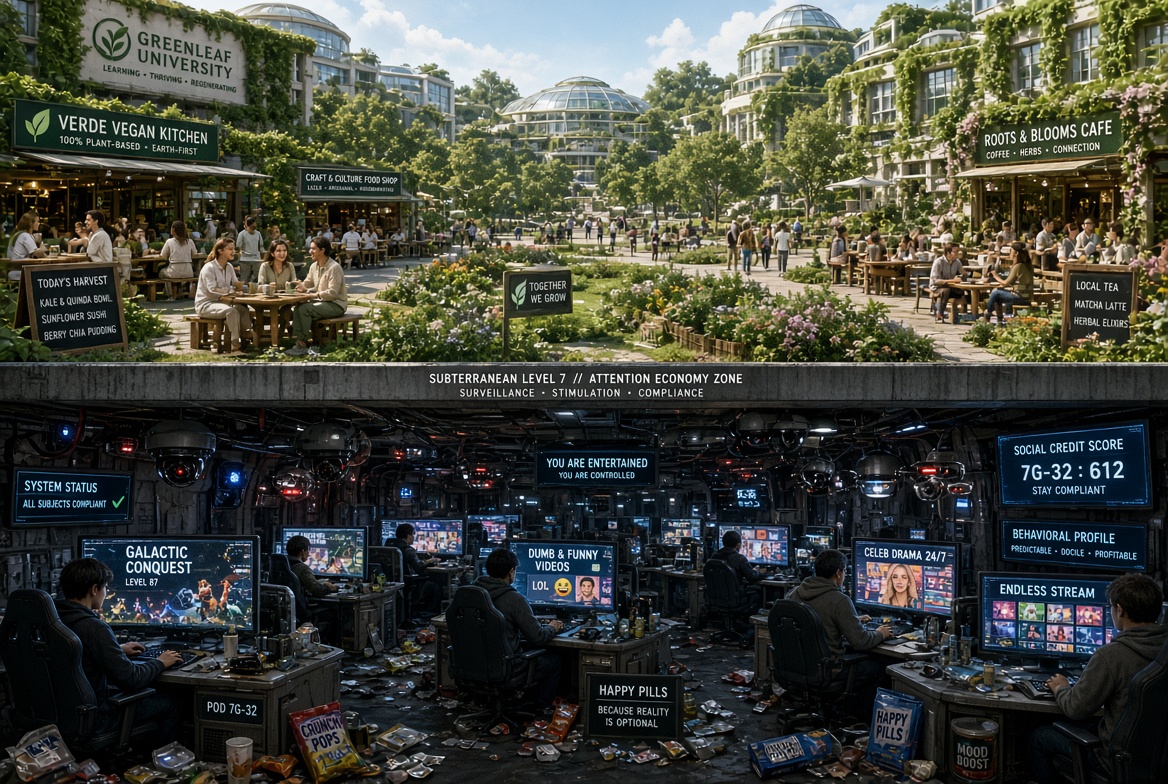
For the core populations of the West, the ultimate vision mirrors a twisted inversion of Aaron Bastani’s Fully Automated Luxury Communism: a two-tiered future. On one tier, the managerial and technocratic elite enjoy an abundance of automated luxury, personal robotics and boundless consumption, a lifestyle that is, in itself, a testament to the fact that our current debt-driven, high-consumption model is being transitioned, not destroyed. On the other tier, the disempowered precariat is warehoused in micro-apartments, pacified by digital soma in the form of streamed entertainment, video games and processed ready-meals and kept alive through corporate largesse and universal basic pittance. Stripped of bargaining power, property and purpose, they are endlessly monitored, categorised and micro-managed. Meanwhile, in regions deemed non-essential to the high-tech core, such as parts of Africa, the strategy shifts from containment to neglect and engineered internecine conflict, allowing regional demographic pressures to resolve themselves away from the gaze of the metropolitan centres.

Classless equality remains an impossible phantom because human beings are neither biologically identical nor infinitely malleable. The affluent managerial class cultivates a phantasy of a technocratic utopia: a borderless world of woke globe trotters and high-speed transit, all sustained by eco-friendly innovation and the boundless opportunities of globalisation. They imagine a future where the entire planet is a network of research campuses, plush enclaves and pristine nature reserves.

Yet this utopia has no room for the unassimilable. It requires that the angry natives and the disillusioned masses fade into the background. To keep the landscape orderly, the elite may preserve certain remnants of the past as living museums. They might cordon off a quaint 18th-century English village or a bustling 17th-century Hanseatic port to serve as cultural exhibits, much like the Maasai Mara in Kenya, where the descendants of once-sovereign peoples are turned into static features of a picturesque, managed environment.

Because simply discarding the masses runs counter to the hollowed-out legalism of liberal democracy, the system instead disempowers them. It reduces them to permanent dependants on welfare plantations and phases them out gradually. The goal is not the uplift of the common man, but his managed obsolescence within a world he is no longer permitted to shape. Under this regime, the only permitted form of heritage is the one that has been stripped of its lifeblood, neatly categorised and made safe for the masters of the fourth industrial revolution.

From a young idealist to a lifelong critical thinker

I grew up in a staunchly Labour family and as a teenager joined the Neo-Trotskyite Socialist Workers Party, in part to rebel against the condescending hypocrisy of the bourgeois managerial classes who dominated the establishment left. I had always been culturally of the left, at least as we understood the concept in the 1970s and 80s: the struggle of honest, hardworking men and women against predatory capital,and the defence of self-determination against imperial overreach. I had read the Communist Manifesto and Che Guevara’s Guerrilla Warfare by the age of sixteen.

Yet I was too independent a thinker to stay submerged in groupthink for long. I had naively imagined that a socialist revolution would liberate the eccentrics, the bullied and the alienated. It did not take long to realise that the petty psychological bullying, status-seeking and conformity enforced by party comrades were identical to the cruelties of the school playground, just cloaked in high-minded dialectical jargon.

The traditional left-right divide has been emptied of its historical meaning. The modern institutional left has long since abandoned the industrial working man. In Western nations, it has morphed into a managerial coalition of the ultra-wealthy, technocrats and credentialed professionals, backed by heavily subsidised client groups.

The elite relies on the psychology of the marginalised to exercises its control. An individual who feels rejected by traditional social structures, whether due to personal eccentricity, perceived inadequacy or social alienation, carries a deep grievance against the organic order. Recognising this, the managerial regime weaponises that grievance. It manufactures identity categories, convincing atomised individuals that their personal unhappiness stems from historical oppression, the nuclear family, the historic nation or even traditional faiths.

By defining identity through victimhood, the regime provides the wounded ego with two intoxicating drugs: moral superiority and artificial belonging. The marginalised soul, desperate for recognition, finds a surrogate family in the activist cell, the HR committee or the online mob.

Yet this inclusion is contingent. The regime grants status only in exchange for ideological submission. The marginalised become an instrument of destruction against the regime's real enemies: independent smallholders, self-reliant families, traditional local institutions and moral frameworks that together curb the overreach of power.

When the revolutionary dust settles, the marginalised find they have exchanged a world with natural, reciprocal duties for a cold digital panopticon run by the very corporate and bureaucratic oligarchy they thought they were resisting. The elite provides therapeutic platitudes and welfare scraps to keep the underclass passive, while systematically dismantling their capacity to live as free, independent, self-governing people.

We do not have to accept the managed obsolescence of the masses. The current technocratic nightmare relies on our belief that we cannot survive without its global grid. But real social solidarity is not born from bureaucratic mandates or abstract egalitarianism. It exists in the natural, organic bonds of family, faith, ancestral heritage and honest productive labour. We cannot prevent extreme power concentration through a more progressive technocracy based on fantasies of a borderless and hierarchy-free commune. Instead we need to rebuild local sovereignty, productive independence and unyielding allegiance to natural humanity. If we can break the centralised control of technology and organise around communities that respect the true nature of man, we may find that our potential for community and excellence is far greater than the management we have been told is inevitable.
Categories
All in the Mind Computing Power Dynamics

The Great Tech Replacement

Could robots replace plebeians of all ethnic backgrounds?

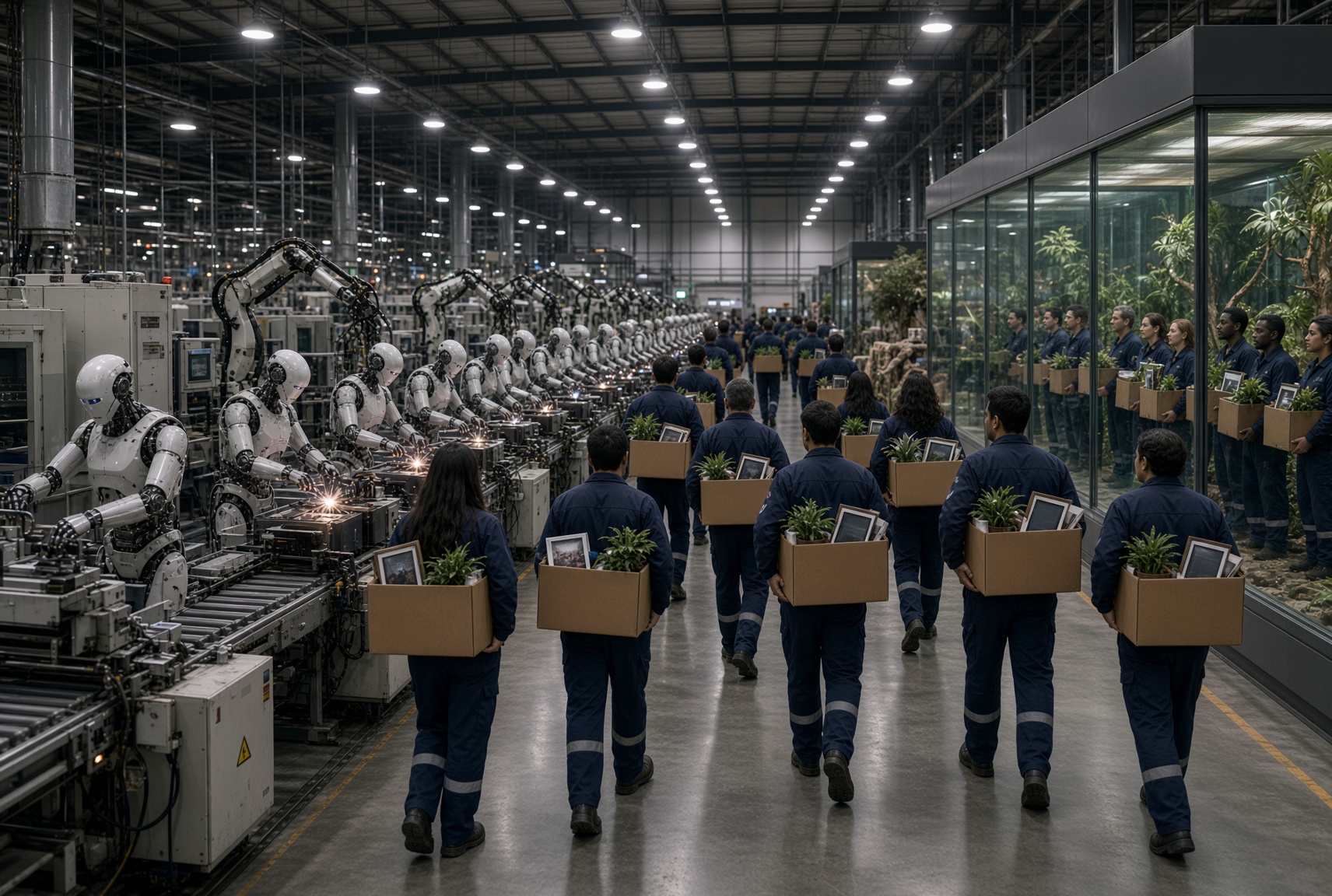
Workers leaving the factory floor for a life on UBI in the human zoo.

The primary concern for many Westerners may appear to be the demographic decline of White Europeans and their replacement by an amorphous global majority. The raw statistics do not lie. A century ago, the direct descendants of historic European peoples made up between 25 and 35% of the world's population. Today that figure has fallen to roughly 10 to 12%, a downward trend softened only slightly by steep drops in fertility across East Asia and Latin America. The descendants of Britain’s pre-1945 population face the prospect of becoming a minority in their own homeland, a threshold already crossed in several major urban centres. Yet while racial and demographic shifts dominate headline debates, the deeper civilisational catastrophe is one of total deculturation and cognitive estrangement. Across the board, settled native populations and newcomers alike find themselves uprooted from organic communities and absorbed into a placeless economic machine.

This marks an ironic reversal of the European colonial era, which displaced native populations across North America, Australasia and Southern Africa while projecting European cultural authority over vast empires. By the early twentieth century, that imperial centre of gravity crossed the Atlantic. Following the Second World War, American consumer capitalism established global dominance. The collapse of the Soviet Union sealed this triumph, though that victory rested largely on a temporary American technological edge financed by the petrodollar, a massive military-industrial apparatus and an insatiable consumer base. By the late 1980s, Warsaw Pact socialism could no longer conceal its industrial decrepitude and bureaucratic rot, which crushed the human spirit and suffocated genuine innovation. The fall of the Berlin Wall birthed neoliberal globalism, celebrated prematurely by Francis Fukuyama as "The End of History".

History had not ended. It merely pivoted into uncharted territory. In 1991, the overwhelming majority of the planet's five and a half billion inhabitants still led analog lives. Personal computers were rare luxuries. Printed newspapers, books and unmediated face-to-face contact remained the foundation of daily communication. All of that dissolved over the following three decades of hyper-accelerated technological, demographic and cultural disruption.

From Cultural Supremacy to Progressive Eugenics

On its surface, the neoliberal era promised liberation. Cheaper air travel, international mobility, fluid personal ties and constant digital novelties purported to universalise privileges once reserved for the wealthy. The new millennium married this debt-driven consumerism to an aggressive progressive orthodoxy, one obsessed with the competing and contradictory mantras of equality and diversity.

Yet beneath that egalitarian rhetoric, the economic realities of ordinary citizens collapsed along two divergent tracks. The price of permanent, foundational assets multiplied astronomically, while the price of disposable distractions plummeted. In the early 1990s, a skilled worker in the South East of England could buy a modest family house for three to four times their annual wage. By the 2020s, that relationship severed all ties to honest productive labour, exploding to between 10 and 15 times average household income. With median household earnings lingering below £50,000, even basic three-bedroom properties in commuter towns command upwards of £500,000, while London prices routinely exceed £1 million. An entire generation has been barred from the property ladder. In place of land and security, the neoliberal regime supplied cheap flat-screen televisions, disposable foreign electronics and £30 budget flights to southern holiday resorts. These are glittering digital beads handed out to pacify a dispossessed populace.

This economic transformation liquidated the generational gains of the post-war decades. That earlier period, anchored by a strong domestic manufacturing base, skilled industrial employment and defined-benefit pensions, fostered a confident, independent middle class capable of passing homes and capital down to their children. Globalisation dismantled that inheritance. Outside the sheltered corridors of the state bureaucracy, lifelong employment gave way to insecure contracts, gig-economy piecework and private pension funds exposed to the casino of international finance. Stripped of property and robbed of guaranteed retirements, younger generations face old age without an estate to sustain them, leaving them entirely dependent on corporate platforms and state handouts.

By 2020, this predatory extraction reached its natural limit. The generational inheritance of the post-war era had been exhausted and debt could no longer conceal the stagnation of real wages. Once automation, machine learning and algorithmic surveillance reached industrial maturity, the managerial oligarchy no longer required a vast, skilled domestic workforce to generate returns. The manufactured crises of 2020 served as the decisive turning point. The old debt-fuelled consumer model was abandoned in favour of a high-tech feudal order. Under this dispensation, an assetless population rents its shelter, survives on managerial subsidies and possesses no economic leverage against its technocratic masters.

The Collapse of Progressive Universalism

An ideology built on sentimental moralising cannot survive contact with physical reality. So long as the fashionable diversity preached by the professional classes remained safely cordoned off in working-class industrial hubs like Luton, Slough or Bradford, it served as an inexpensive badge of cosmopolitan virtue. The moment that demographic reality arrives on the doorsteps of the affluent, the universalist posture shatters.

In the Oxfordshire village of Piddington, a picturesque community of fewer than 400 residents, the liberal consensus fractured when the state earmarked a local military site to house over a thousand foreign asylum seekers. The affluent locals, who consistently supported open borders and membership in the European Union, united in fierce opposition. They quickly understood that mass migration represents an immediate threat to the peace, safety, coherence and property values of their quiet rural retreat. This reaction does not contradict their worldview. It lays bare its hypocrisy. They champion cosmopolitanism for the country, while reserving exclusive homogeneity for their private sanctuaries.

Territorial Reality

The retreat of Piddington’s residents confirms that there is no such thing as an abstract, borderless proposition nation. When pressed, even the most dedicated progressives instinctively recognise their home as physical territory that must be defended against outside disruption. They discovered that their wealth and voting records offered no immunity against the administrative state. When a technocratic regime decides a rural parish is surplus land, individual politics become irrelevant. The local community is simply reduced to logistical space for social engineering. The hypocrisy is blatant, but instructive. When the ruling class is forced to endure the consequences of its own social engineering, its universalist principles vanish in an afternoon.

The End of Consumerism and the Rise of the Zoo Economy

The post-war model of perpetual consumption has run headlong into physical and demographic realities. Rather than allowing a corrective reset that returns capital and productive power to families, the managerial elite has opted for steady-state confinement. Cloaked in the language of net-zero environmentalism and biomedical emergency, ordinary populations are no longer managed as sovereign citizens or productive producers. They are kept as specimens in a technological zoo.

Synthetic Multiculturalism as an Elite Transition Tool

Top-down multiculturalism was never designed to preserve genuine cultural variety. Instead, it operates as a solvent. By flooding historic nations with competing, unassimilated populations, the state deliberately erodes local solidarity, fractures the historic working class and eliminates common cultural resistance. An atomised, deracinated population is far easier to monitor, govern and replace.

Society no longer divides along outdated parliamentary party lines. The real division pits a compliant, managed public against those who retain independent thought and memory. A tiny technocratic elite, making up less than 1% of the population, maintains its hegemony through an expanding apparatus of compliance managers, diversity officers and human-resource administrators. This managerial tier coordinates corporate capital, state power and digital communication monopolies, exempting its own members from the housing precarity, economic insecurity and social decay it enforces upon everyone else.

Humanity as Surplus

As automated logistics, artificial intelligence and behavioural management reach full scale, the ruling class no longer views a self-reliant domestic workforce as an asset. Whether native-born or imported, ordinary working people are viewed as overhead costs to be automated away. The stage is set for a high-tech feudal regime where plebeians of every ethnic background are rendered obsolete, sustained only by state-issued digital tokens and tightly monitored consumption.

This development aligns with the theories of philosopher Peter Sloterdijk and historian Yuval Noah Harari. Both thinkers recognise that the traditional citizen-worker of the industrial era is an anachronism. Sloterdijk treats modern history through the concept of the human park, or Menschenpark, an ongoing civilisational project of domestication. In this model, self-appointed elites act as zookeepers, selecting, refining and governing human stock through education, culture and institutional discipline. Sloterdijk argues that traditional humanist institutions can no longer preserve social order. As a result, the management of human biology and behaviour will become direct, clinical and technocratic. Without explicit bio-cultural oversight, he contends, human populations risk sliding into unruly disorder.

Harari arrives at the same conclusion from the perspective of technological determinism. In previous centuries, rulers were compelled to invest in their common people, if only to secure factory hands for industry and soldiers for imperial armies. In the age of algorithmic automation, that bargain is obsolete. Harari warns that the unmanaged masses are fast becoming a useless class, a population that is not merely unemployed during an economic downturn, but permanently unemployable within an automated economy. Because algorithms can outperform humans in both administrative labour and cognitive processing, ordinary citizens have surrendered their historic bargaining power.

Taken together, these perspectives define the mechanics of the zoo economy. The managerial caste no longer needs a productive, property-owning public to sustain wealth or social order. The average citizen is demoted to a ward in a high-tech enclosure. Sedated by screens, medicated by the psychiatric establishment and fed on industrial calories, the public is managed via state transfers and corporate digital subscriptions. The ruling class has abandoned the exploitation of domestic labour in favour of absolute administrative surveillance. In this emergent feudal order, ordinary men and women are no longer stakeholders in a shared civilisation. They are treated as biological liabilities, to be curated, tranquillised and managed until the machine no longer requires them at all.

Categories
All in the Mind Power Dynamics

Deep State Denial

For some reason, we like to associate denial with mavericks, outcasts, non-conformist extremists and hatemongers, but right now the biggest deniers are mainstream journalists, news anchors and fact checkers who refuse to countenance the existence of the Deep State or insist on dismissing it as a mere conspiracy theory.

How on earth could Donald Trump’s decision to follow Israel’s lead into a destabilising war with Iran be either in the best interests of most Americans or consistent with his earlier denunciation of never-ending regime-change wars? The current best estimates for the Iraq and Afghanistan wars together run from around $5 to $8 trillion and that’s not including the huge outlay on military operations over Libya and Syria, bases in the Gulf states and funding of the Israeli armed forces. The simple question is: who’s calling the shots? Alas, I suspect the answer is not simple as Bibi Netanyahu.

The last month has resulted in immense destruction of strategic infrastructure in Iran, the UAE, Bahrain, Qatar and, last but not least, in Israel itself. On the first day, the USAF managed to destroy a girls’ elementary school killing around 180 girls and teachers in Minab in the Southern province of Hormozgan. The Iranian civilian death toll may range between 5000 and 8000 with many more military fatalities, with hundreds reported dead in the Gulf states and Israel because of retaliatory drone attacks. However, the economic fallout of much higher crude oil prices and supply chain disruption is likely to cause much greater human suffering over the coming months, exacerbating the cost-of-living crisis in Europe and Southern Asia, reliant on Middle Eastern oil. Perversely, higher oil prices have already boosted Russian exports and strengthened China’s economic and soft power on the world stage.

Rather than make America great again, Donald Trump’s exercise of Commander-in-Chief powers to join Israel’s war with Iran have alienated not only his European allies, but much of his base. Who would have guessed that neither higher gas prices nor an unwinnable war with the prospect of thousands of American body bags were popular with Trump’s MAGA base?

Back in Britain, Farage’s pro-Israel stance has seen a sudden drop in Reform’s popularity, with recent polls giving the challenger party around 25% closing the gap with other parties amid growing voter disillusionment with all the main options available. All of sudden, a Green-Labour-LibDem-SNP coalition, rather than a Reform landslide, seems a real possibility in 2029, such are the volatile mathematics of the first-past-the-post system. The point is, would a Green-themed administration change anything other than accelerate our demise? We only have to look to Germany to find the answer, where Green politicians not only supported covid authoritarianism and tech censorship, but also higher military spending to ward off the Russian threat.

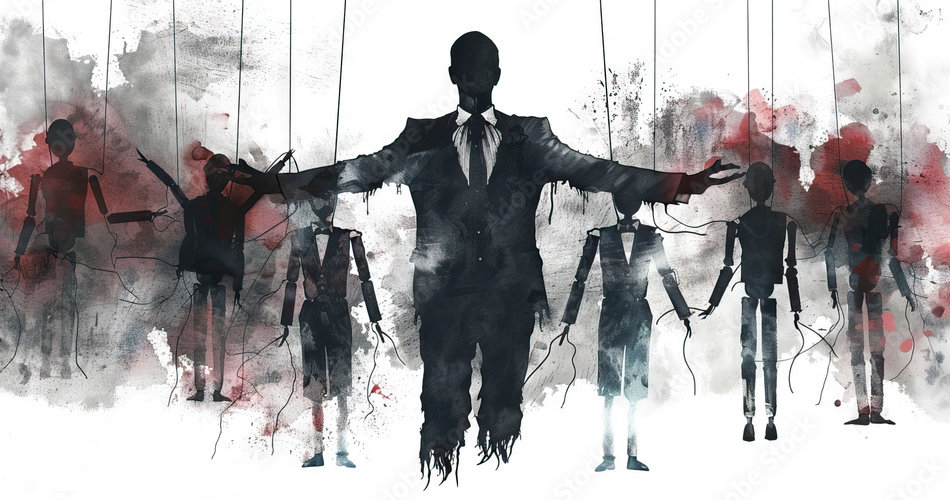
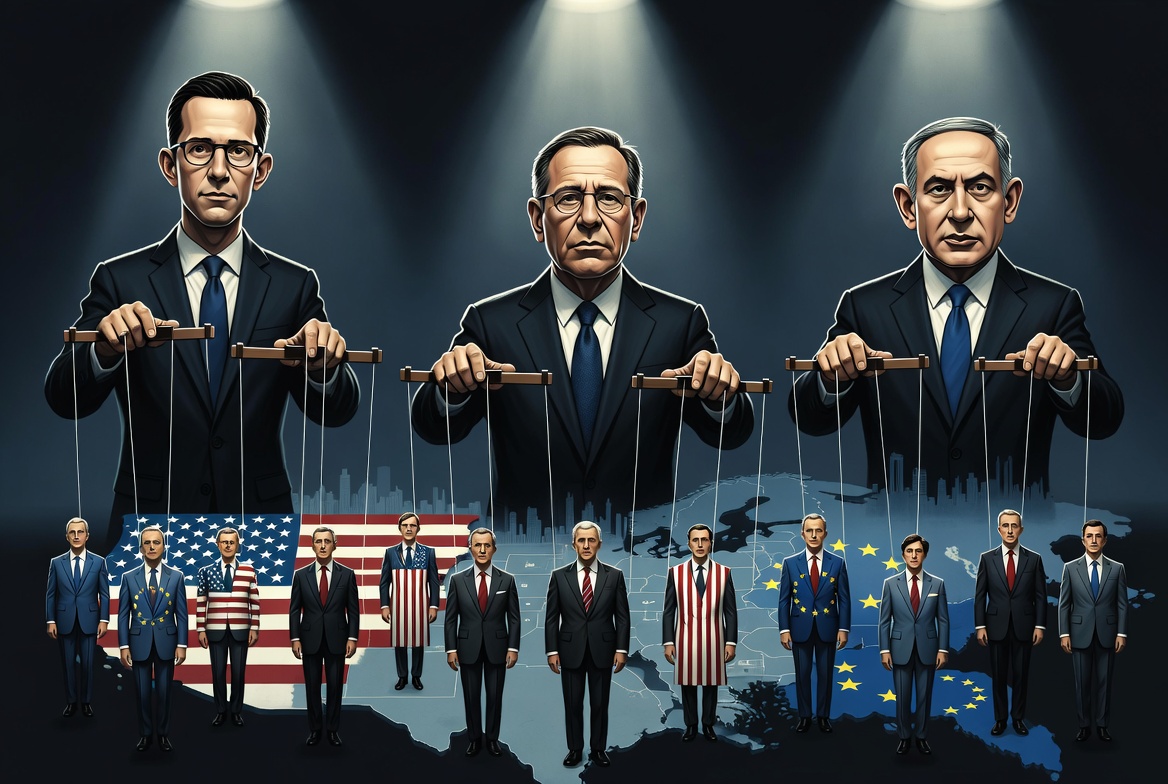
Oddly Farage’s new belligerent foreign policy stance is perfectly aligned with Tony Blair’s and Kemi Badenoch’s, but apparently at odds with Keir Starmer’s who has strategically ruled out direct involvement in the conflict, possibly to appease pro-Palestinian Labour MPs and align himself more with Macron and Merz, while covertly letting American warplanes use British bases. The apparent rift in the transatlantic alliance could be a symptom of shifting power dynamics from west to east, but also a sign of engineered systemic collapse with the ruling elites running for the hills before their AI-driven drones can build back better over the wreckage of the outgoing Fordist model. In this context, the settled working classes are not only critical of rapid migratory flows, transgender ideology or restrictions on automotive freedom, but of any destabilising policies likely to undermine their livelihoods. Wanting a better life for your family, higher pay, affordable housing, safe neighbourhoods and better working conditions used to be leftwing talking points, until the corporate left adopted identity politics and started to blame the lumpenproletariat for the lack of progress towards their vision of a harmonious borderless utopia. Then the populist right exploited widespread opposition to globalism to take back control from remote supranational bodies like the EU and prioritise home grown workers, at least in rhetoric if not in practice. Now the pendulum has swung again, but the same puppeteers remain firmly in control.

In its first four weeks, the war triggered an exodus of 1 to 2 million foreigners from the GCC states, almost totally dependent on desalination plants that Iranian drones have already hit. Iranian reprisals on Israeli targets and fear of deadlier strikes to come have likewise accelerated the departure of young, secular, educated and affluent Israelis, significantly reducing the tax base. The Times of Israel reports that 27% of Israelis are considering emigrating. That’s around 2.5 million people in a country of 9.5 million.

We may have a temporary ceasefire over the Strait of Hormuz and the spectacle of peace talks in Islamabad, but the goalposts have moved in a matter of days from angry social media posts demanding the Iranians “Open the fuckin’ Strait” to a proposed US naval blockade of the Strait to force Iran to give up its uranium enrichments rights. How can this make any sense? Why would the US administration spend 100s of billions on destroying critical infrastructure in the Middle East, weaken its international standing and impoverish the Western working classes through inflation? Why would the likes of Donald Trump and his European acolytes like Farage and Orban risk losing votes to appease the Israel lobby and beat the drums of war? We are witnessing the planned demolition of Western civilisation, not by Islam or through cultural decadence, but rather by the emerging planet-wide technocracy who thrive on chaos.

The only logical conclusion is that our leaders are mere careerist actors who would never have been allowed to grace the corridors of illusory power if they had any principles and exposed the machinations of Deep State operatives posing as neutral civil servants, investment bankers, philanthropic billionaires or dispassionate scientific advisers. The covid scam showed us that the real decision makers work behind the scenes in close liaison with the wider Biotech-Military-Industrial complex. If a few technocrats decide the only way to slow the spread of a flu variant is to close down small businesses and print trillions of Euros, dollars, yen and pounds, then governments will just have to comply, if they want to access loans from the World Bank or IMF. The Israel-Iran war is every bit as much a manufactured crisis as the covid scam. The environmental, economic and human fallout is very real, but the causes have been deliberately misattributed. In both cases, the cure was worse than the purported disease. And yet some politicians will shrug their shoulders and claim they had to do something. Otherwise, covid would have wiped out humanity or the mad mullahs would have nuked European cities, unless we had let experts override common sense.

We can only regain hope if we learn the lessons of the recent past and stop placing our trust in talking  heads at the mercy of BlackRock, Palantir or Lockheed Martin.

Categories
All in the Mind Power Dynamics

It’s one big club

... but you're not in it.

Connecting the dots of the wider Davos Class.

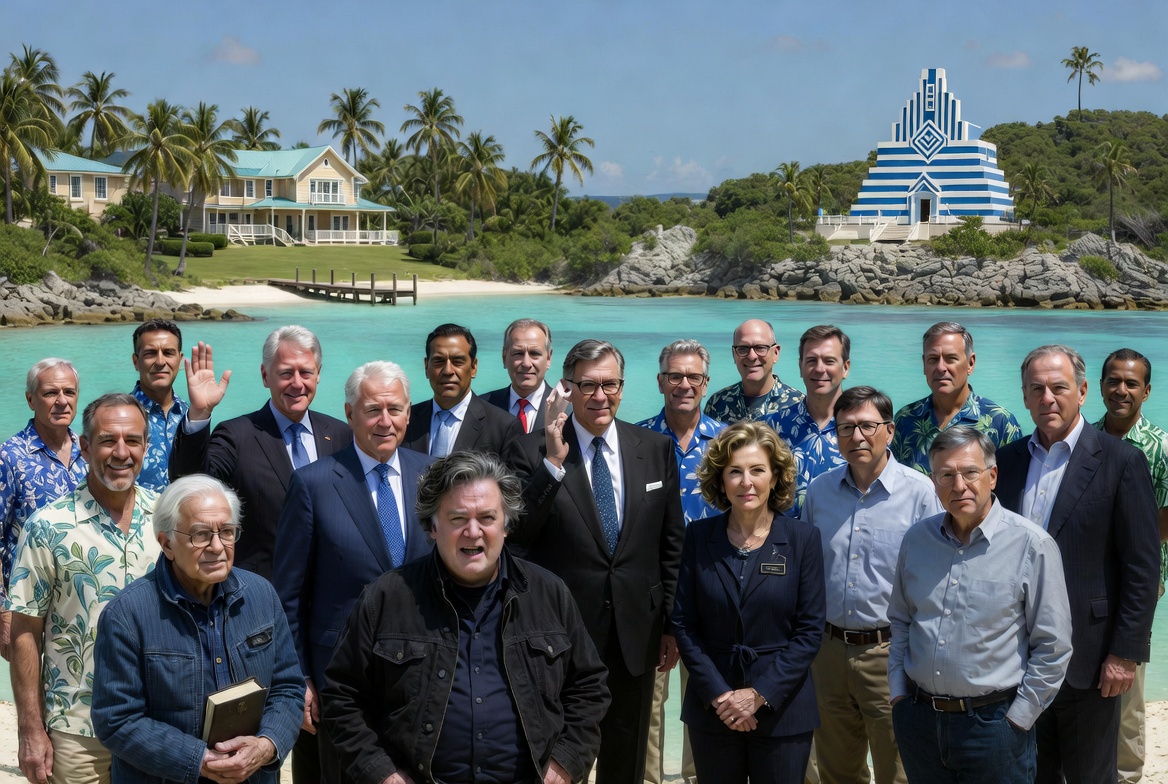
We're supposed to believe Jeffrey Epstein was an outlier, a playboy financier with a penchant for underage girls and a large network of easily corruptible politicians, entrepreneurs and luminaries. He also purportedly acted alone without the invisible hand of a much larger criminal syndicate that had, to paraphrase Klaus Schwab, embedded itself in governments and boardrooms around the world. How could Bill Gates have guessed that Jeffrey Epstein's interests may have extended beyond helping to reduce infant mortality through public health campaigns in Africa and India? Is it a mere coincidence that both shared an interest in overpopulation and biotechnology?

Bill may deny any involvement in Jeffrey's sex games, but that misses the point. Kevin Bass has dissected the Epstein files. The key relationships are all in one way or another linked to the covid psyop that unfolded six months after Epstein's alleged suicide. Let's take a look at the key players.

The Gates Circle

Boris Nikolic: a Croatian-born, Harvard-trained immunologist who became a biotech venture capitalist, co-founding Biomatics Capital. He served as chief scientific adviser to Bill Gates and the Gates Foundation. Most strikingly, Epstein named him as successor executor in his will detailing nearly $600 million in assets. The recently released DOJ files paint a much more textured picture of their relationship than Nikolic's professed surprise would suggest. In December 2009, just six months after Epstein's release from his Florida incarceration, Nikolic was helping him navigate Davos, offering to set up one-on-one meetings and describing his own "virtual currency" as access to powerful people. Epstein's response was characteristically revealing. He wrote back that they should first decide whether any of the waitresses or staff were attractive, adding not to forget priorities.

Other key players around the Gates orbit include:

  • Larry Cohen, who served as the CEO of Gates Ventures and before that as Microsoft's Corporate Vice President of Marketing, having joined the tech giant in 1995.
  • Larry Summers, who served as Chief Economist at the World Bank, as Clinton's Treasury Secretary from 1999 to 2001 and as Harvard's president from 2001 to 2006. His first known flight on Epstein's aircraft was in 1998, when he was deputy Treasury Secretary. In 2007, Summers joined the Gates Foundation's Global Development Program Advisory Panel, alongside figures such as former Mexican President Ernesto Zedillo and former McKinsey managing director Rajat Gupta.
  • Kathryn Ruemmler, a former White House counsel under Clinton who later became a Gates attorney before joining Goldman Sachs.
  • Melanie Walker, who maintained an address in an Epstein-owned New York apartment building. In 1998, Epstein hired her as his science adviser at Caltech, using her access to meet faculty there. After moving to Seattle with Microsoft executive Steven Sinofsky, Walker met Gates at a company barbecue and joined the Gates Foundation in 2006. There, she introduced Epstein to Gates' science adviser Boris Nikolic, ultimately facilitating the first Gates–Epstein meeting in 2010.
  • Connie Collingsworth, Gates Foundation General Counsel.
  • Thorbjørn Jagland, who served as Norwegian PM, as Nobel Committee chair and as Council of Europe Secretary General. He maintained a close relationship with Epstein from 2011 to 2019, receiving gifts, travel and stays at the financier's properties. Epstein privately called him "not bright" but valued his positions. In February 2026, Jagland was charged with aggravated corruption by Norwegian authorities and subsequently hospitalised.

The Epstein–Israel Nexus

Much more evidence points to Epstein's support for the Greater Israel Project, which also aligns with his views on eugenics as a member of the chosen people. DOJ-released tax filings show Epstein's foundations donated $25,000 to Friends of the Israel Defense Forces (FIDF) in 2005 and $15,000 to the Jewish National Fund (which funds West Bank settlement activities), and gave heavily to Jewish organisations including $500,000 to the Ramaz school, plus contributions to Hillel International, YIVO and multiple yeshivas over a 20-year period. In 2008, while facing US charges, Epstein personally toured Israeli military bases with FIDF.

His most significant Israeli connection was a close, long-running relationship with former PM Ehud Barak. Epstein invested in Barak-linked tech startup Carbyne, which had ties to Israeli security sectors, and advised Barak on firms including Palantir.

An FBI informant's account, documented in released files, claimed Epstein "belonged to both US and allied intelligence services" and was "trained as a spy" under Barak, though these claims remain unverified. Epstein also referenced Ghislaine Maxwell's father Robert Maxwell's alleged Mossad ties in a 2018 email and stated in 2012 correspondence that "Palestine has never historically existed."

Palantir

The Epstein connection here is significant: he was advising former Israeli PM Ehud Barak on Palantir, placing the company at the intersection of the intelligence, military and financial networks Epstein moved within.

Founded in 2003 with $2 million from the CIA's venture capital arm In-Q-Tel, Palantir opened a Tel Aviv office in 2015, after which co-founders Peter Thiel and Alex Karp met with Israeli military leaders regularly. They were keen on building targeting databases capable of converting data extracted from the occupied Palestinian territories (emails, call logs, mobile phone address books, WhatsApp messages, social media profiles and location stamps) into predictive targeting systems. Palantir had been providing tools to Israeli security agencies as early as 2014.

In January 2024, Palantir agreed a formal strategic partnership with the Israeli Ministry of Defence following a meeting between Israeli officials and co-founders Thiel and Karp in Tel Aviv. Under this agreement, Israel was set to buy an AI-based system called AIP, designed to assist decision-making on the basis of intelligence and capable of analysing enemy targets and proposing combat moves, with Palantir expecting revenue in the tens of millions of dollars.

Palantir also powers the Gaza Civil-Military Coordination Center, the US military compound in Kiryat Gat set up in October 2025 to execute the Trump administration's plan for Gaza. Israel reportedly used Palantir tools during multiple raids in the Gaza Strip and also relied on the company in its September 2024 attacks in Lebanon using exploding electronic pagers and radio devices.

More broadly, the company has secured contracts including an initial $480 million for Project Maven (the Pentagon's AI drone targeting system), now expanded to nearly $1.3 billion. CEO Alex Karp said in February 2026 that their "weapons software is in every combat situation I'm aware of."

Palantir has also secured at least 24 contracts across key UK public institutions and is now working with both the Israeli and British military. Its UK boss Louis Mosley, grandson of Oswald Mosley, head of the erstwhile British Union of Fascists, told BBC Newsnight the company was "proud of the work we do in Israel."

Norwegian fund Storebrand divested from Palantir over its Israeli military role. In July 2025, nearly 100 activists from Jewish Voice for Peace occupied Palantir's Seattle offices, carrying banners reading "First Palantir Surveils, then IDF Kills," with simultaneous protests at offices in New York, Washington DC, Palo Alto and Denver.

From Wexner to the Blair Administration

Epstein leveraged his position at Bear Stearns to build a network of wealthy and influential clients. Through his work, he met and formed relationships with billionaires like Leslie Wexner and Leon Black, closely associated with the Rockefeller and Rothschild dynasties.

The fake-progressive mainstream media has been quick to stress the well-publicised friendship between Epstein and Donald Trump, although the latter only appeared on flight logs on Epstein's private jet from New York City to Palm Beach, Florida, and not his infamous private island, Little St. James.

Peter Mandelson, however, the lead architect of the New Labour project, arranged for his friend Jeffrey Epstein to meet Tony Blair at 10 Downing Street in July 2001 and visited his private island on several occasions. Epstein's 2008 conviction for child prostitution did little to weaken their friendship. In the same year, after a four-year stint as EU Commissioner for Trade, Gordon Brown brought Mandelson back into government as Secretary of State for Business and Trade, sitting in the House of Lords. Although the Prince of Darkness had struggled to shake off his public image as a scandal-prone, devious backroom dealer, his 2010 book, The Third Man, not only earned him £500,000 in royalties but attracted much more interest among political analysts than the bland recollections of Gordon Brown and Tony Blair.

In just over two years Mandelson resigned twice: first for an undisclosed interest-free home loan from affluent Labour MP Geoffrey Robinson and then for fast-tracking Srichand Hinduja's passport application in exchange for £1 million for the Millennium Dome. Yet this was just the tip of the iceberg. Mandelson also promoted the Horizon IT system developed by Fujitsu that would over the next 15 years lead to countless bankruptcies of small post offices and at least thirteen suicides.

As Business Secretary he attended the secretive Bilderberg Meeting and let Epstein convince him to lobby Alistair Darling to change Labour's new policy on bankers' bonuses, and helped Epstein broker a deal for the £1 billion US-negotiated sale of a UK taxpayer-owned banking business. The following year he messaged Epstein that he had finally persuaded Gordon Brown to stand down and leave No. 10, five hours before it was announced.

Meanwhile, media commentators across the conventional political spectrum jumped on the bandwagon to condemn not only the sex offender's heinous acts but a handful of bad apples who had succumbed to the lure of his generosity and sexual philanthropy, bringing an abrupt end to the last vestiges of the neoliberal era. The rhetorical left highlighted Donald Trump's well-known friendship with Epstein, while the patriotic right pointed to his close links with Chomsky, Clinton and Mandelson. Most absurdly, some commentators tried to reframe Epstein as a Russian agent because of a few contacts he had with Russian oligarchs and his vain attempts to meet Vladimir Putin.

Big Tech Connections

The recent document releases reveal Epstein had remarkably deep ties throughout Silicon Valley.

Microsoft

  • Emails show Epstein was in contact with at least 20 prominent tech executives, investors and researchers.
  • An official from Gates' private office (Gates Ventures/bgC3) emailed Gates about a business plan which he then forwarded to Epstein, listing projects including one titled "Follow-up recommendations and/or technical specifications for Strain pandemic simulation."
  • Emails showed Gates informed Epstein of his most confidential projects, including in areas like biological defence and neurotechnology.

Google

  • Google co-founder Sergey Brin emailed Ghislaine Maxwell about meeting up with Epstein during a trip to New York in 2003.
  • Larry Page, Google's co-founder, appears in the files, including in a 2010 email where Page's personal pilot wanted to use Epstein's helicopter for a Caribbean holiday.
  • Epstein introduced JPMorgan executives to Brin to help the bank secure the billionaire as a customer.

Tech Investment Activity

  • Peter Thiel advised Epstein on potential investments in Palantir.
  • Epstein invested $40 million in Valar Ventures, a venture capital firm founded by Peter Thiel, in 2015 and 2016.
  • Epstein invested $5 million in Jawbone in 2012, increasing his holdings to $11.25 million by 2017.
  • Epstein became an early investor in Coinbase in 2014, investing $3 million when the company was still a two-year-old startup.
  • Epstein's financial adviser was pitched on backing Elon Musk's SpaceX.

Biotech Connections

Epstein had particularly strong connections to biotech, longevity research and eugenics-adjacent fields, positioning himself at the intersection of Big Tech wealth and cutting-edge biotech research. These connections continued well after his 2008 conviction, suggesting his network valued his connections and investment opportunities enough to overlook his criminal background.

Investments and Relationships

  • Boris Nikolic invited Epstein to join him for a Breakthrough Prize event at investor Yuri Milner's home in Silicon Valley in 2013.
  • Masha Bucher connected Bryan Johnson with Epstein in 2017 to discuss Kernel, Johnson's brain interface company.
  • Epstein proposed to fund Harvard's Personal Genome Project to discover if "beauty resides in DNA."

Transhumanism and Anti-Ageing

  • Jeff Bezos, who dined with a fresh-out-of-prison Epstein, made significant investments in the anti-ageing startup Altos Labs, developing "reprogramming technology" to rejuvenate cells.
  • Sergey Brin founded Calico, a secretive biotech outfit focused on solving the problem of ageing.
  • Recent emails unveiled by Bloomberg illuminate Epstein's interest in transhumanism, or neo-eugenics, a philosophy that has become commonplace among Big Tech oligarchs and ruling-class elites.

Academic and Research Funding

  • Epstein corresponded with Antonio Damasio, director of USC's Brain and Creativity Institute. In 2013, Damasio asked Epstein to fund a new line of robotics and neuroscience research.
  • Epstein provided patronage to German AI scientist and executive Joscha Bach.

Epstein could only act as a philanthropic wheeler-dealer as part of a much larger global network of the high and mighty with very different public and private opinions. One faction poses on the progressive woke left and the other as the new anti-woke but tech-savvy right. In February 2025 Jordan Peterson, Douglas Murray, Ayaan Hirsi Ali, historian Niall Ferguson; journalist and author David Brooks and Peter Thiel, and Louis Mosley joined Kemi Badenoch and Nigel Farage at the ARC (Alliance for Responsible Citizenship) conference at ExCeL London. They’re all staunch Zionists and in bed with Palantir while posing as free speech champions and protectors of conservative family values. It’s the same wolf in sheep’s clothing, endlessly reinventing itself to engineer public consent for the next phase of the Great Reset.

Global Oligarchs

Yet some will still shrug their shoulders and point out that many tech superbillionaires are conspicuously or only mentioned in passing the Epstein files. Let us consider Tony Blair's best mate and leading benefactor, Larry Ellison.

He only appears appears in 22 documents in the Epstein case files, but has zero flight log appearances and zero email references, no known direct connections in the files themselves. The indirect overlap comes through Ehud Barak, around the time Epstein and Barak were corresponding and Barak's intelligence aide was living at Epstein's house, Barak was separately holding meetings with Larry Ellison, not brokered by Epstein, but running in parallel.

His operation served several overlapping functions, as an intelligence-adjacent fixer, a social broker connecting people who couldn't easily reach each other through official channels, and most infamously, a kompromat collection system, with exclusive vacations and adult entertainment services as bribes. Ellison simply doesn't need any of that. He bought the entire island of Lanai. He has multiple superyachts. He funds his own racing teams. He can host heads of state, defence ministers and tech executives on his own terms, with no intermediary and no strings attached, or rather, no strings he didn't put there himself. The hospitality Epstein monetised as leverage, Ellison can provide as straightforward patronage.

The Israeli government connection is illustrative: Oracle's Safra Catz was directly embedded in Israeli political networks, emailing Israeli officials with phrases like "we believe that we have to embed the love and respect for Israel in the American culture," and personally setting up meetings between Israeli diplomats and US senators. Ellison didn't need a disgraced financier with a massage table to broker those introductions. He had his own executive doing it from within Oracle's C-suite.

This points to something structurally important about Epstein's actual role in the network. He was primarily useful to people who needed access they couldn't otherwise command, whether that was Ehud Barak needing a backchannel to Putin, or ambitious but not-yet-powerful figures needing introductions. The truly sovereign actors in these networks, with their own private islands, infrastructure contracts and close government relationships, have no need of Epstein's particular services. They're already upstream of where he operated. It comes as little surprise that Bill Gates and Larry Fink casually dropped into 10 Downing Street in October 2024. While Fink seems more aligned with the financial gerontocracy alongside Warren Buffett and Jamie Dimon. in contrast with Thiel's libertarian techno-accelerationism, BlackRock is deeply entangled with Thiel's empire. BlackRock held over 158 million shares, or about 7.4%, of Palantir as of late 2024 and was a direct investor even before its IPO, when the company provided software to ICE for immigration enforcement. Thiel's surveillance infrastructure and Fink's asset management are structurally intertwined regardless of their public ideological posturing.

The Epstein files are geared, as a mapping exercise of power, towards catching those in the middle tiers of the network. The Ellisons of this world are the kind of figures Epstein was trying to serve not accommodate.

The TikTok footnote is quietly revealing in this context: shortly after Oracle's Ellison-led consortium took over TikTok's US operations, users found themselves unable to send the word "Epstein" in direct messages NPR, a coincidence that generated considerable online attention. It was apparently a technical glitch, but the optics around a Trump-aligned billionaire now controlling a major social platform while Epstein adjacency swirls around the administration are hard to ignore.

The real nexus is emerging around AI data centre infrastructure. BlackRock formed the AI Infrastructure Partnership with Microsoft, Nvidia, and Abu Dhabi sovereign wealth fund MGX and its first major deal was a $40 billion acquisition of Aligned Data Centers. Elon Musk's xAI also joined as a participant. Meanwhile, the Stargate Initiative, the joint venture between OpenAI, SoftBank, Oracle and Microsoft, committed $100 billion scaling to $500 billion with BlackRock acting as the major capital provider.

While Epstein's depravity may shock us, the mainstream media has turned a blind eye to his oligarch handlers, who are still very much in power and consider over 90% of humanity as superfluous to their needs.

Categories
Iran Power Dynamics War Crimes

From Humanitarian Bombing to Imperial Implosion

If anyone had any lingering doubts about who’s really calling shots at the White House, on 28th February 2026 Donald Trump shattered any ambiguity by authorising the US Air Force to help Israel bomb the hell out of Iran. It pains me to admit that the conspiracy nutters have once again got it spot on: Benjamin Netanyahu and the NeoCon Deep State run the show. The Israeli Prime Minister has been making wild claims about Iran’s nuclear weapons programme for the best part of thirty years. He has stood before the UN Assembly with maps and charts to persuade gullible delegates that if we, as in Israel’s allies, do not stop Iran now, it will nuke Israel. Meanwhile the western MSM has been busy recycling the myth that the Iranian security forces killed tens of thousands of peaceful protesters unprovoked. The reality on the ground was very different. While hundreds of thousands peacefully took to the streets in January to protest the cost-of-living crisis in the wake of the steep devaluation of Iran’s currency, the rial, much smaller group of militants ran rampage setting fire to buildings, attacking vehicles and firing automatic weapons at police. These are the classic hallmarks of colour revolutions, instigated by foreign actors for the sole purpose of destabilisation before an impending invasion. In the days before Israel launched operation Roaring Lion, millions of Iranians from all walks of life and political allegiances lined the streets to oppose foreign intervention.

Some of us remember the propaganda that led to the invasion of Iraq and the destabilisation of Syria. The US supported Iraq for most of Iran-Iraq war and turned a blind eye to the infamous 1988 Halabja massacre of Kurdish peshmerga and Iranian Revolutionary Guards (aka Islamic Revolutionary Guard Corps or IRGC), while Iran flew in journalists to document and film the carnage before losing control. While this incident did not play a role in the propaganda for the first Gulf War, over the Iraqi invasion of Kuwait, it featured prominently in the progressive media after 9/11.

Yet the violent repression narrative served to justify the onset of a war that could kill millions of innocent civilians and plunge the global economy into a deep depression with spiralling fuel prices affecting critical supply chains. Worse still, it could well go nuclear. In less than a week the whole politico-rhetorical climate has shifted dramatically. To put things into perspective, unless the US backs out immediately, which given Trump's recent pronouncements seems unlikely, they will be in it for the long haul and it will much harder to conquer 93 million Iranians with as much as 7000 years of shared history and an unforgiving mountainous terrain than occupying Iraq or Afghanistan.

In the Punch and Judy show that it is British politics, Reform have ceased to play the good guys with the best interests of the native British working classes at heart. They have gone full ZioNeoCon. You could not put a cigarette paper between Lindsay Graham and Nigel Farage. Yet In 2014, Farage observed: "In almost every country in which the West has intervened or even implied support for regime change, the situation has been made worse and not better. This is true of Libya, Syria and of course Iraq." (Declassified UK). Trump, of course, made many similar claims about draining the swamp and bringing an end to forever wars to win over his MAGA base. Alas Kemi Badenoch’s Tories are singing from the same hymn sheet condemning Sir Keir Starmer for failing to join the Israeli-American military offensive. For a few short days, I began to loathe Keir Starmer less than the leaders of the alleged opposition parties. But what are they opposing, the UK government’s failure to follow Benjamin Netanyahu’s orders? Can anyone now seriously doubt that our political leaders are not in charge at all. They’re little more than teenagers in a high-school debating society recycling talking points about the dangers of antisemitism, while the people they purportedly serve face economic ruin as a result of reckless military interventionism. The closure of the Strait of Hormuz and the bombing of oil facilities across the Middle East and Iran only exacerbate the existing economic challenges of a small densely populated island over-reliant on imported resources. Gas and oil prices are already surging. The Gulf States, home to many affluent British expats, will become environmentally unviable with the destruction of their desalination plants.

The situation is very fluid, but I can already hear rumblings of boots on the ground from the usual suspects. With Peter Mandelson disgraced, Tony Blair has predictably come out in favour of Israeli foreign policy. We’re being primed for the prospect of a ground war, but I don’t see many youngsters volunteering, however bleak the prospect of life on the dole at home may seem. I don’t have any answers, but it’s little consolation to have one’s worst fears of societal collapse come true.

Categories
Power Dynamics War Crimes

One, two, three, four… What are we fighting for?

Saturday, 3 January 2026, marked the definitive end of the US-led World Order. The US President evoked the Monroe Doctrine of hemispheric dominance to justify intervening militarily in Venezuela to capture its elected president, Nicolás Maduro, under trumped-up charges of narco-trafficking. While some may doubt the integrity of the country’s 2024 presidential election, it is worth noting that corporate and state actors have long manipulated elections in allegedly liberal democracies. The Donald himself has cast doubt on the outcome of the 2020 US general election, which saw an uninspiring, senile candidate attract a landslide with over 15 million more votes than Hillary Clinton received in 2016.

The attempted oil grab came only a few weeks after Donald Trump had pardoned former Honduran President Juan Orlando Hernandez, convicted of helping drug traffickers import more than 400 tons of cocaine into the United States while accepting bribes to fuel his political career and protecting violent drug cartel leaders from prosecution.

Some may wonder if the Donroe Doctrine, as the Orange Man wants us to call it, is the first move in the repartition of the world into American, Russian and Chinese spheres of influence. Will China feel emboldened to annex Taiwan? Will NATO survive if the US annexes Greenland?

Among the first to congratulate Trump on his regime change operation was Benjamin Netanyahu, with hawkish allies embedded in the Departments of War and State eager to invade Iran on Israel’s behalf. It comes as little surprise that all of Trump’s closest allies in Latin America, from Javier Milei of Argentina to Nayib Bukele of El Salvador, are staunchly pro-Israel. By contrast, Maduro sided with the Palestinian cause. A week earlier, the Commander-in-Chief had authorised the USAF to bomb Islamic insurgents in the Bauni forest of Sokoto State, Northern Nigeria. This may be far from the oil-rich Niger Delta region, but it is conspicuously close to Niger and large phosphate, coal, gold and uranium reserves.

We now have a split between European and North American Neo-Cons. Both groups want war but cannot agree on the targets of their aggression. The Americans seem to prioritise control of strategic resources, and Venezuela has the world's largest oil reserves, around 17% of the world’s total, or over 300 billion barrels. They know they cannot defeat Russia without triggering WW3, rely on Saudi Arabia, or occupy Iran. On the other side of the Atlantic, the elites pursue the WEF’s Agenda 2030 with a much greater zeal to the detriment of their home-bred working classes. By seeking confrontation with Russia, they have denied European industry easy access to essential raw materials and cheap energy sources, just as Africa falls increasingly within China’s and Russia’s orbit, especially for new transport infrastructure and lucrative strategic minerals mining deals.

However, what if neither European nor American Deep State actors have the best interests of their citizens at heart? What if our leaders are well aware that their reckless military adventurism will destabilise their countries? Indeed, what if both Biden and Trump were mere puppets overseeing the demise of the American dream, alienating NATO allies on purpose and triggering uprisings against US commercial interests around the world? That is not as far-fetched as it seems. US oil companies have already demanded serious guarantees from the US administration before investing in Venezuela because they fear guerrilla warfare on a scale much larger than the Vietnam quagmire. Senior American oil analysts have described Venezuela as uninvestable, i.e. only feasible with a massive US military presence that could bankrupt North America’s biggest economy. The flamboyant POTUS is now calling for a massive boost to military spending in 2027 from $901 billion to $1.5 trillion.

While Chavistas, loyal to Hugo Chavez’s Modern Bolivarian Movement, may only be a minority of Venezuelans, they form a large enough critical mass to bring down any imposed administration through coordinated civil disobedience and greatly outnumber the still-wealthy comprador class, who are likely to benefit most from lucrative deals with American multinationals. In the middle are ordinary Venezuelans who are both patriotic and socially conservative. Despite suffering from harsh US sanctions for the best part of fifteen years, Venezuela has recently turned the corner and begun striking lucrative oil and mineral export deals with China. In short, US corporations need Venezuelan oil more than Venezuelans need US investment and oversight.

Some may believe that either the Donald has made a big miscalculation or that Americans think they own the world and all of its resources. There are two flaws in that analysis. First, I doubt the Donald is calling the shots. The alternation of Obama, Trump 1, Biden and Trump 2 looks increasingly stage-managed. Nobody has ever won the presidency unless they acquiesced to the demands of key lobbies in the Biotech-Military Industrial Complex. The second reason is that the same lobbies are indifferent to the plight of their compatriots. They owe their allegiance only to a tiny club that excludes 99.9% of us in any country.

The end of abundance

While annexing Canada, Greenland and Venezuela may theoretically provide plentiful resources to power shameless mass consumerism and revive the American Dream, that ain’t going to happen. The elites pulling Trump’s strings, pretty much the same oligarchs who controlled Obama and Biden, do not care about ordinary US citizens. That’s why they’ve been outsourcing skilled jobs for decades. They seem quite happy to engineer a low-level civil war over identity politics as we’ve seen on the streets on Minneapolis since immigration officers shot dead a middle class woke woman, whose car blocked their operations. If you support peaceful coexistence and self-determination, you may regulate migratory flows to maintain socio-economic stability. However, if your rulers ransack the rest of world for raw materials and destabilise their societies, you can hardly complain if millions flock to your country to get their share of wealth generated by exploiting remote resources. The point is our rulers do not want stability or the kind of widespread prosperity we’ve been accustomed to in the West over the last six or seven decades. It may once have seemed that everyone wanted to converge on the western way of life with a well-equipped house in a safe neighbourhood, one car per adult, holidays abroad, exciting career opportunities and generationally rising living standards. Life became a soap opera, but the illusion of plenty was built on debt. The bubble first burst in 2008 and ever since the billionaire and banking classes have been getting richer with government bailouts and oligopolistic practices to the detriment of the skilled working classes. Now our rulers no longer need most of us,. They want war as a as the only means to justify planned societal destruction, but who will fight it?

Honestly, I do not see many British, French, German or even American youngsters volunteering to fight for the likes of BlackRock, Haliburton, ExxonMobile, Microsoft or Pfizer. Why should we fight for governance teams that hate us? AI-enabled drones will fight the next and we will be mere bystanders locked down in our humble abodes checking social media for updates on power outages and nearby food banks.

Categories
All in the Mind Power Dynamics

Choreographed Chaos

Choreographed Chaos

Could establishment fearmongering about ethno-fascism usher in technofascism?

Honestly, I’m done with bombastic clowns in the mould of Donald Trump, Nigel Farage and Geert Wilders. They play to the patriotic family values of the disenfranchised Western working classes who feel let down by their faux-progressive mainstream politicians, obsessed with the WEF’s lofty sustainable development goals and overseeing cultural convergence on a global scale. The mask is off. In country after country, vast swathes of the electorate have finally cottoned onto the deceptive nature of counterproductive woke ideology that far from emancipating the underclasses delegates all power to a technocratic master race.

However, after seeing public spending splurges on lockdowns, war games, gender bending, social engineering and hair-brained net-zero initiatives, many will now switch their allegiance to another bunch of neocon-artists. But to whom do the new Thatcherite kids on the block calling themselves Reform owe their allegiance? They may parrot all the right soundbites about controlling borders and making the country great again, but they’re in bed with many of the same tech billionaires and lobby groups.

Don’t get me wrong. I’ve not suddenly swung back to the infantile left of my teenage years dreaming of a worldwide revolution against greedy capitalists, tearing down all borders and replacing families with communes. That’s what Aaron Bastani might call Fully Automated Luxury Communism. The book basically puts a neo-Marxian spin on Klaus Schwab’s vision of a Great Reset to accommodate the fourth industrial revolution.

The old left-right paradigm makes little sense when many establishment figures pose on the radical left and decry the working classes for being reactionary malcontents. But some factions within the global elites can pose on the faux-nationalist right too. The Donald’s focus has shifted from MAGA to MIGA (Make Israel Gruesome Again), while his associates plan new wars over control of Venezuelan and Nigerian oil reserves.

My main bone of contention has always been with the extreme concentration of power that undermines the self-determination of communities and families. With New Labour, we get collusion with BlackRock, Bill Gates and Larry Ellison for the construction of huge new AI data centres, new mRNA jab manufacturing plants and more clinical trials of dodgy therapeutics. With Reform we will probably see sweet deals with Elon Musk, the cultural left’s new bête noire.

In September we saw probably the largest politically incorrect demonstration this decade as a sea of flags from all four corners of the United Kingdom filled the streets of Central London, but they were ominously interspersed with Israeli Stars of David. While the mainstream media estimated only 150,000, aerial footage suggested a much larger number although the organisers’ claim of 3 million may be wide of the mark. It competes with the November 2023 Armistice Day march against the bombing of Gaza where the police estimated an attendance of around 300,000 and the organisers around 800,000.

More interesting was the reaction from left-branded TV talking heads concerned about foreign tech moguls like Elon Musk exerting undue influence on British politics, while turning a blind eye to the banksters and oligarchs closely aligned with the World Economic Forum and its plans to reimagine humanity in the fourth industrial revolution.

Hardly a day passes without an outburst of self-righteous indignation about the latest gaffe by a Reform or Tory MP, sometimes for merely stating the obvious about Britain’s rapidly changing demographics. The latest example saw a social media pile-on against Reform’s goody-two-shoes MP, Sarah Pochin, who claimed to be sick and tired of seeing so many black and brown actors in TV commercials. The context was the over-representation of darker-skinned people in British TV ads, as corroborated by a recent Channel 4 survey. Despite record levels of immigration in recent years, over 80% in the UK are still white, but this proportion is much lower in school-age children, often cited as around two thirds but declining. Numerous studies have also identified white working-class school leavers as the most disadvantaged group in terms of academic performance and earnings in early adulthood. This leads to the widespread perception that the ruling elites now discriminate against the direct descendants of the indigenous peoples of the British Isles in favour of newcomers, pitting rival ethnic communities against each other.

Local elections and opinion polls continue to show stronger support for Reform among the settled working classes with the LibDems and Greens doing best in the leafy suburbs, gentrified inner city neighbourhoods and market towns favoured by the affluent professional classes, while Labour struggles to hold onto its new strongholds in areas with large BAME communities and falls back on its army of public service professionals and high-profile opinion leaders favoured by the establishment media.

Politics has descended into spectacle with emotive rhetoric that serves only to name and shame rivals rather than speak truth to power and hold the decision-makers to account. A new brand of radical chic parliamentarians such as Zarah Sultana may boldly accuse the government of complicity in Israel’s genocidal war crimes in Gaza, sitting only a few yards away from Rupert Lowe MP who has repeatedly complained about anti-white racism, but it’s all theatre as neither will get anywhere near levers of power. Genocide is a highly emotive term. While Israel may have killed hundreds of thousands of Palestinians over the years, many millions more survive in the West Bank, Gaza, Jordan and a wider global diaspora, in part thanks to a high fertility rate. By contrast, the ethnic displacement of English natives from many urban areas is just as significant statistically but has happened peacefully as many inner-city dwellers moved to the suburbs in an endogenous process that later morphed into white flight. Differential fertility rates also have played a key role in Britain’s changing demographics. Yet in different ways Ms Sultana and Mr Lowe may have more in common than meets the eye. For a start, they both oppose Digital ID as favoured by the Blairite centre.

Although Zarah has succumbed to chameleonic compliance in her performative advocacy of faux-progressive causes such as transgender rights, deep down she cares mainly about her Muslim community and the Palestinian cause. Likewise, Rupert is probably just an old-school Tory concerned about Great Britain’s rapid moral and cultural decline, trying to defend his people and finding himself increasingly at odds with the new globalist establishment. That makes both Rupert and Zarah critical thinkers, prepared to speak their minds, in a chamber chock-a-block with unquestioning conformists who like to parrot well-rehearsed lines about countering Russian disinformation or saving our BBC or our NHS from Big Bad Trump.

Who’s really in charge?

When the economy fails, the ruling classes resort to war. Opposition to imperialism has historically come from socialists and libertarians alike. Adam Smith once opined: “War and imperialism are detrimental to economic prosperity and undermine the principles of liberty and prosperity”. Historically in the West, the biggest warmongers have always posed as moderates. The likes of Macron, Starmer and Merz all serve the interests of the most powerful lobbies on earth. They provide temporary public faces for policies decided behind closed doors and sold to the general population under false pretences. Just like the covid psyop, the prospect of war with Russia, Iran or Venezuela empowers the state to rush through emergency legislation in the same vein as the infamous Coronavirus Act 2020 with 300 pages of special measures restricting the basic freedoms of assembly, family life and bodily autonomy we had cherished for centuries. Only the pretext changes. If the authorities can suspend civil liberties and stifle dissent in the name of public health, they can do the same to fight perceived threats to our freedom and democracy, a catchphrase that has become as hollow in the public mind as safe and effective.

As the American Empire crumbles, we may be witnessing growing rifts within the Western World. The unpopular Starmer administration is distancing itself from the US-Israeli axis, just as American grassroots liberals and conservatives, from Candace Owens, Tucker Carlson, Marjorie Taylor-Greene and Thomas Massie are now openly condemning Israeli interference in American politics and NYC elected a Muslim Mayor who has turned down offers to visit Jerusalem. However, many failed to notice Zohran Mamdani’s close relationship with Alexander Soros. One way or another, the tide is turning against the kingpins of US foreign policies. As political alliances shift, new divides emerge between regime loyalists and critical thinkers as well as between the European and American wings of the Western Alliance

Categories
All in the Mind Power Dynamics

Your Life in their Hands

How progressive middle managers want you to place your trust in official experts

The Labour-dominated Westminster parliament approved the third reading of The Terminally Ill Adults Bill (commonly known as the Assisted Dying Bill) by only 314 to 291 votes after defeating amendments that could have offered some minimal safeguards, such as forbidding doctors from pre-emptively presenting assisted suicide as a care pathway, which could be dangerous with patients in a deep state of melancholy or suffering from mild dementia. Only the unelected House of Lords may now revise the legislation before it becomes law. It comes as little surprise the French Parliament also recently passed analogous legislation. Contrary to media portrayals, the policy does not come from a large grassroots movement, but straight out of the World Economic Forum playbook via a spider’s web of NGOs and charities. Just as the technophile professional classes look forward to extending their lives through AI-guided medicine, epigenome reprogramming, somatic and cognitive augmentation, they seem happy to relieve plebeians of their suffering through end-of-life ceremonies.

Some may argue that we already have euthanasia in all but name, leaving millions of atomised commoners to while their time on a cocktail of audiovisual entertainment, comfort food and risky medications, which in combination often have undisclosed side effects. With a reduced quality of life and limited personal independence, especially with long-term medical conditions such as obesity, diabetes, hypertension, angina, atrial fibrillation and most ominously dementia, sooner or later we’ll end up in hospital at the mercy of medics who may decide whether to keep us alive or give us life-shortening palliative care.

As early as the 1990s the Liverpool Care Pathway provided a framework for the triage of worthy and unworthy patients, by prioritising different approaches depending on the perceived quality of a patient’s remaining life, which in the case of lonely dementia patients is likely to be very diminished. While a public outcry led health authorities to phase out the Liverpool Care Pathway in 2013, only seven years later, tens of thousands of covid patients were given high doses of midazolam, which Dr Luke Evan MP described as essential to a good death and asked the then Secretary of State for Health, Matt Hancock, to check if supplies would suffice.

Groupthink

In her many prime-time TV appearances promoting her Assisted Dying Bill, Kim Leadbeater MP exuded her complete deference to the medical establishment. While Labour politicians often like to appeal to our compassion for the weakest in society, their underlying assumption is that we all share the same belief system, espoused by the progressive mainstream media. They look on the experts behind the covid lockdowns as tech deities whose conflicting logic must never be questioned. They worship the likes of Anthony Fauci and Chris Whitty with a quasi-religious zeal. To question these messianic figures provokes not just unease, but accusations of betrayal, as though one has violated a moral or spiritual covenant. I know from dealing with my extended family of past and present Labour activists which subjects and celebrities to avoid in polite conversation. It’s seldom a good idea to question Greta Thunberg’s saintliness. However, judging from books I’ve seen on prominent display in the houses of Labour-activist relatives, the likes of Bill Gates are also held in great esteem, despite his obsession with overpopulation. Unlike many on the cultural left, I’ve swung from a position of population pessimism in the early 2000s, when I believed the expansion of consumer affluence could not scale to the projected peak population of 10 billion human beings, to a more optimistic stance. Yet the peak oil event came and went in 2008 as living standards, by common metrics such as access to electricity, clean water and life-expectancy, continued to improve across the former third world. Not only did obesity become a bigger health challenge than undernourishment, but policymakers began to worry more about an ageing population with fertility rates dropping way below replacement level.

Sacred Cows

Nothing compares with the biggest sacred cow of them all, the NHS. Labour activists will typically blame all its failings on Tory cuts and creeping privatisation, while turning a blind eye to its one-size-fits-all attitude to healthcare as well as its growing obsession with mental health surveillance. While we once hoped our public health service could save us, the onus is now on us to save the NHS through our compliance with public health edicts, namely to put the common good before narrow self-interest.

It does not take a huge leap of imagination to see how public health groupthink could persuade civic-minded but atomised individuals to make the ultimate sacrifice for the common good of younger generations. Online influencers and soap opera storylines could subtly lionise assisted dying volunteers as symbols of virtue doing their bit to help combat climate change or free up valuable healthcare resources.

End of Life Ceremonies

Once planned life termination is normalised, funeral companies or social services could organise celebration-of-life events to let relatives and old friends say their last goodbyes. While farewell ceremonies may seem a good way to end your life if you’re a well-connected high-achiever suffering from a terminal illness, other prospects loom for the lonely with limited financial means and whose only social life is online, a cohort that’s likely to grow over the coming years.

Is it completely beyond the realms of possibility that community care coordinators, with a little help from AI agents, could first identify lonely individuals with decreased autonomy and then invite them to a celebration-of-life event with all their favourite music and food as well as long lost friends and distant relatives contacted after trawling through social media. In their absence, creative community care coordinates could recruit people from a similar cultural background or reach out to occasional online acquaintances to wish farewell to someone about to transition to the next world. The scary bit is that the prospect of one last party with old and new friends could persuade many to agree to high-tech euthanasia.

Categories
All in the Mind Power Dynamics Uncategorized

Turning Nasty

Killing you softly with condescending compassion

The good old days of universal love for all human beings irrespective of colour, creed or caste are coming to an end with a cruel twist. The new breed of eugenicists, allied with the world’s tech giants, like to appeal to an illusory kind of environmentally friendly boutique progressivism that delivers a carefree green utopia for the chosen few and planned obsolescence for everyone else. Deceptive advertising entertains us with visions of shiny happy multicoloured people sharing a post-industrial paradise of luxuriant college campuses and theme parks, interspersed with pristine nature reserves, solar and wind farms powering hyperactive underground data-centres connecting and monitoring all sentient human beings. It lures the trendy professional classes into a false sense of moral superiority over the reactionary great unwashed whose failure to adapt will quietly consign them to the history books.

In the meantime, the managerial classes have resorted to time-honoured divide-and-rule tactics by guilt-tripping the settled working classes for their intolerance of newfangled rival underclasses, whether defined by ethnicity, migration status, sexual identity or disability. In times of plenty with opportunities galore for most resourceful citizens to thrive as valued members of cohesive communities, there was no need to obsess with diversity, equality and inclusion, only to care for the unlucky few who fell by the wayside owing to significant social and physiological handicaps. As the current debt-driven economic model becomes more unsustainable by the day with diminishing returns on unfunded government expenditure, something will have to give way with the weakest inevitably bearing the brunt as more and more workers fail to find a niche in the era of smart automation. If you cannot grasp the logic behind AI-assisted solutions, your paid job may soon become superfluous, further raising the IQ bar in the cognitive professions. You may stay in the new Garden of Eden the techno-patrician class has planned for you on universal basic income, but only if you know your place and do not rock the boat. It’s very much a case of one rule for thee and one rule for me.

The priorities of regional governance teams only make sense once you realise their end goal is to phase most of us out with plausible deniability over the next two natural generations, which explains the authorities’ focus on shaping young minds. While Sir Keir Starmer grandstands on the world stage striking deals with his Davos chums, at home his team neutralises discontent by throwing shiny baubles or cheap gimmicks to the masses while failing dismally to provide the infrastructure and social framework people need. He trades fishing rights for faster passport checks for British citizens at European airports because policy advisors think the plebs care more about inexpensive holidays in the Sun than keeping alive rooted multigenerational concerns. Likewise, his team believe you care more about getting new subsidised obesity injections on the overrated NHS than keeping family farms safe from predatory investment bankers, biotech multinationals, renewable energy giants and property developers. They want obedient consumers with limited autonomy or critical thinking skills, but happy to receive social credits in the form of universal welfare in exchange for their acquiescence with a new form of digital feudalism.

Engineered Hostilities

As the world as we knew it falls apart, different sets of opinion leaders can stir up trouble by scapegoating rival groups of commoners for heinous crimes and degeneracy. The liberal intelligentsia may take pride in their tolerance of ethnic diversity, but they openly belittle the native working classes with accusations of intolerance, lack of education and bigotry, blaming some of the most underprivileged in society for their own misery. By contrast, another set of populist influencers both on the fringes of the mainstream media like Fox News in the States or GB News on his side of the Big Pond as well as well-funded alternative media outlets like Rebel News, tap into growing nativist resentment by highlighting the criminality, incompatible customs and corruption of identifiable ethno-religious groups. The narrow focus on Muslims endears the captive audience of Western malcontents to the Israeli cause for an Arab-free Jewish homeland. Yet behind the scenes we see many of the same movers and shakers pulling the strings of political actors on both sides of the Palestinian and mass migration debates.

In late 2023, Benjamin Netanyahu reportedly expressed intentions to facilitate the voluntary migration of Gazans, stating, "Our problem is [finding] countries that are willing to absorb Gazans, and we are working on it." Other Knesset members urged Western nations to accept Gazan refugees, drawing parallels to Europe's acceptance of refugees during the Yugoslav and Syrian civil wars. Finance Minister, Bezalel Smotrich, supported this idea, describing it as a humanitarian solution for Gaza's residents. In short, Netanyahu wants to offload his country’s Arab problem on Europe despite fostering alliances with critics of mass immigrations such as Viktor Orbán. The plot thickens further when we look at the close collaboration between the various Soros foundations, championing both open borders and the Palestinian cause, and refugee charities. David Miliband had few qualms about supporting the 2003 UK/US occupation of Iraq, largely an extension of Israeli foreign policy objectives, as junior minister and later as Foreign Secretary before accepting a job as CEO of the International Rescue Committee. This well-funded NGO came later into the public eye at the height of Syrian refugee crisis, triggered by a civil war between allies of Al Qaeda and ISIS and the Syrian government. Israel, the US, UK and other Western administrations were not neutral this conflict. They armed and trained the head-chopping rebels via their spurious rescue workers, the White Helmets. Indeed in 2018, Israel helped evacuate fleeing ISIS-allied militants. This seems a very odd move from a government that wants to protect its citizens from the excesses of Islamic fundamentalism, unless you believe depopulation through endless fragmented proxy wars is in the long-term interests of the chosen few or rather your survival strategy is to let your adversaries kill each other.

Many may prefer to believe in a rift between the pro-Palestinian left, supported by the likes of George Soros, and the pro-Israel right. In reality, the Israel lobby practically owns nearly all key Democrat and Republican politicians in the US, but outside North America and guilt-ridden Germany, Israel has lost the battle of hearts and minds. The aim was never to create a secure Jewish homeland living in peace with its neighbours, but to trigger a series of destabilising proxy wars and unsustainable migratory flows, raising tensions on the ground among indigenous Europeans and newcomers and requiring higher levels of surveillance.

It comes as little surprise that the Tony Blair Institute has finally got its way with digital ID in the form of the proposed BritCard mobile app.  It aims to integrate various identifiers such as passports, driving licenses, biometric data and national insurance numbers, allowing users to prove their identity for government services, work, renting and accessing benefits. It is already being marketed as a tool to clamp down on illegal immigration and unauthorised workers. In all likelihood, while not initially mandatory for UK citizens, banks, public venues and online services will require it.

The authorities may often seem incompetent, but they know how to play on contradictory fears to justify greater surveillance for the common good.

Categories
All in the Mind Power Dynamics

On the Brink of Civil War?

Social unrest in an age of hyper-surveillance and hypersensitivity

The Labour-branded government has announced sweeping cutbacks in social welfare and core public services at a time of rising unemployment and on the cusp of an artificial intelligence revolution. You could hardly choose a worse time to wean the most vulnerable in society off welfare dependence. With hundreds of billions squandered in recent years on lockdowns, military misadventures, hairbrained energy transition schemes and accommodating record levels of net immigration, something had to give. One week the government announces cuts in winter fuel payments with savings of up to £1.5 billion, but the next it announces £3 billion more to help Ukraine’s war effort. After years of championing the disabled, the Labour administration is telling a million incapacity benefit claimants to get a job, inadvertently admitting that the UK’s watered-down definition of disability has hidden the true scale of worklessness. No wonder, many Labour supporters are angry, but the pipe dream of endless state generosity could not go on forever. The old arguments that Keynesian economics can boost growth and equality no longer holds sway when many WEF-endorsed policies aim to fast-track the transition away from the carefree mass consumerism of 1990s and early 2000s to the new virtual economy offering abstract services we never used to need.

On the surface, away from overseas conflict zones and inner-city crime blackspots, all seems quiet in the suburbs and small towns where most British people live. The homicide rate has declined since its postwar peak around the turn of the millennium. People have by and large retreated to their humble abodes, preferring to binge-watch Netflix movies than head out for a night on the town. More people die through substance abuse and personal neglect at home than in pub brawls or street fights. In Scotland alone deaths attributed to alcohol or recreational drugs has hovered around 2500 since 2020, while the total homicide rate for 2023-24 was just 57 with 36 outside the home. The lockdowns of 2020 and 21 only accelerated this trend. Yet emotional insecurity and underlying internecine tensions may have hit an all-time high, at least since records began, due to a breakdown in trust and social cohesion. Low-level crime remains rampant among the Island’s diverse communities. The police have given up trying to stop burglars, drug-dealers, grooming gangs and money-launderers. They also apply very different standards to different parallel communities, but always seem to have time to monitor social media activity and arrest critical thinkers for daring to contradict official narratives. In 2023 over 3,300 UK residents were arrested for social media posts alone and that was before the infamous Online Safety Act had time to kick in.

Just in case you were under the mistaken impression that laws against alleged hate speech and misinformation only affected xenophobes, antivaxxers and transphobes, London’s Metropolitan Police dispatched 20 armed officers to handcuff and arrest six women at a Quaker meeting house in London during a peaceful gathering on the ongoing slaughter in Gaza, because they were planning  non-violent direct action against fossil fuel companies and arms manufacturers. This comes after Hertfordshire Police dispatched 6 officers to arrest a couple for daring to criticise the appointment of a new head teacher at their daughter’s primary school.

Slowly but surely, the post-millennial social contract between the self-styled progressive managerial classes and the atomised consumer classes is coming apart. The sheer hypocrisy of the condescending illiberal intelligentsia has never been more undeniable. The exact details hardly matter, but affluent trendy lefties are now blaming the selfish misbehaviour and perceived ignorance of the settled working classes for all our societal and environmental problems. A toxic mix of woke identity politics and green zealotry has succeeded only in sowing the seeds of distrust and widening the gap between haves and have-nots by creating rival groups of impoverished strivers and welfare dependents.

One week the prime minister affirms his support for Israel’s counter-insurgency operations as it resumes bombing civilian targets in Gaza. The next week the deputy PM, Angela Rayner, joins public celebrations of Ramadan and promises stronger laws against Islamophobia. Come June, woke officialdom will be promoting Pride Month again and yet schools and businesses are busy downgrading Easter for fear of offending non-Christians. Meanwhile much parliamentary time is devoted to Kim Leadbeater’s Assisted Dying Bill, despite the opposition of all traditional religions. The sanctity of life is the one thing Christian, Muslim and Jewish clerics could agree on. Nobody dare mention that these policies conspire mainly to destabilise social cohesion and empower the surveillance state to suppress rational critique, inviting us only to express our emotions.

In a complex world with competing demands, it’s almost impossible to keep everyone happy. One person’s concept of emancipation or self-expression may harm someone else’s privacy, dignity, safety and livelihood. As a victim of teenage bullying myself, I can empathise with confused adolescent boys identifying as girls because they fail to meet classic male stereotypes. I had a different kind of identity crisis, which thankfully did not lead me to believe I may have been born in the body, but I can understand how gullible troubled teenagers can succumb to the trans cult and blame their alienation on reactionary transphobes. But what about shy teenage girls who feel threatened by the presence of a biological male undressing next to them in the changing rooms?

In times of plenty with boundless opportunities for expansion, it may be easy to open your heart to the plight of refugees fleeing extreme poverty or tyranny and welcome them into your land. It’s not so easy when newcomers not only compete with the settled population over access to services, affordable housing and jobs, but transform the cultural landscape limiting everyone’s freedom. Numerous social attitudes surveys across Europe have found a distinct pattern, the more affluent you are, the more relaxed you are about the consequences of rapid demographic change. However, among the lower classes, settled communities tend to be more critical of mass migration and ethnic minorities more socially conservative on family issues.

Fear of Islamic or Zionist Fundamentalism

Two divergent critiques of global imperialism compete to explain the growing powerlessness of the working classes. One blames radical Islam and the other blames Israel for the destabilisation of viable societies. Nigel Farage’s Reform in the UK and Marine Le Pen’s Rassemblement National (National Rally) in France are both fiercely pro-Israel. GBNews talking heads, with the honourable exception of Neil Oliver relegated to weekly online videos, regularly conflate the Muslim role in the grooming gang scandal with animated protests featuring Hamas flags against Israeli war crimes with sporadic reports of antisemitic hate crimes. Pro-Israel lobbies have succeeded in winning over much of the European nationalist right, with Netanyahu receiving a warm welcome from Hungarian leader, Viktor Orban, amid calls from other European leaders for his arrest. Yet Israel would never have gotten away with such a scale of death and destruction in Gaza without the logistical support of the United States and EU and our collective wilful blindness to a grotesque imbalance of power. In theory, a truly independent European superstate could break ranks with the US and demand an immediate ceasefire, enforced by a naval blockade and trade sanctions. However, they did no such thing. Frightened politicians, wary of the Muslim vote, distanced themselves from the excesses of Israeli military operations, but were powerless to stop the slaughter.

Hundreds of thousands of mainly white working-class girls would not have fallen prey to mainly Pakistani and Bangladeshi grooming gangs if they had grown up in stable two parent families in tight-knit communities able to defend themselves against predators who could easily take advantage of vulnerable and gullible girls with flashy cars, drugs and booze. While many victims could recount vile ordeals with unspeakable levels of depravity, it’s easy to fall into the trap of blaming a literal interpretation of ancient Quranic teachings, such as "...who guard their chastity except with their wives or those whom their right hands possess..." (Quran 23:5–6 and 70:29–30) for the behaviour of sexually frustrated men from South Asian communities transposed to the British Isles. Most Islamic scholars condemn concubinage today. More scandalous were the coordinated efforts by the police, social workers and local councils to suppress crimes committed against one atomised group to placate another community, setting the stage for a turf war with one community screaming rape and the other playing the race card, usually in the guise of Islamophobia. In this spat, the morally superior managerial and media classes have tended to downplay the scale of the grooming gang phenomenon either to further their careers or signal their repudiation of xenophobia. Often, they rely on counter-narratives to blame the settled working classes for their own demise. In recent weeks Labour politicians and their allies in the establishment media have been at pains to promote the Netflix series, Adolescence, about a white teenager, Jamie Miller, from a stable family obsessed with incel culture and the Tate brothers, charged with killing his female classmate, Katie Leonard. The only trouble is that it is complete fiction and was only inspired by a real world of an emotionally disturbed Ugandan-born Hassan Sentamu who killed 15-year-old, Elianne Andam, after his ex-girlfriend had dumped him. Sentamu stems largely from a chaotic upbringing marked by alleged abuse, family breakdown, time in foster care and fatherlessness from an early age. His violent behaviour appears rooted in personal trauma and instability rather than falling prey to online radicalisation or incel culture. If anything, the real-world teenage murder in Croydon, South London, highlights the challenges of cultural integration rather than its success.

Officialdom’s reaction to last July’s Southport stabbing spree followed a similar pattern of deflection. Rather than address people’s very real concerns about societal breakdown amid rapid demographic change and arrest the perpetrators of violence, the establishment doubled down by jailing social media activists and angry protesters. True to form, high-profile self-righteous opinion leaders kept pushing the line that the government needed to take swift and tough action against far-right rioters. Yet objective reality on the ground revealed a very different picture. As rival ethno-religious groups battled it out on the streets over unrelated grievances in Harehills, Leeds and Tower Hamlets, the police adopted a posture of strategic disengagement and stood by and watched, leading to accusations of two-tier policing.

Skewed Moral Compass

A form of subconscious identity-driven bias causes people to minimise or magnify wrongdoing based on the group affiliation of the perpetrators or victims, leading to a skewed moral compass. The antiwar left, often aligned with Jeremy Corbyn in Britain or Jean-Luc Melanchon in France, may have a clear conscience over their opposition to the ongoing slaughter in Gaza, but they downplay the deskilling and disempowerment of the settled working classes and the higher levels of violent and sexual crime prevalent in some immigrant communities. By the same token, working-class nationalists often side with Israel over Palestine, while blaming Islam as a whole for the destruction of Western civilisation. Their conscience may be clear over the victims of grooming gangs, but they choose to ignore the innocent victims of military adventurism in far-off lands.

Both groups often fail to see how different kinds of evil, whether perpetrated by state actors, manipulated militias or degenerate commoners, may all be side effects of global destabilisation orchestrated by powerful vested interest groups. Yet we are encouraged to discount such a possibility as a wild conspiracy theory, preferring instead the Punch and Judy spectacle of Trump versus Harris or Labour versus Tories or Reform. Many on the cultural left are up in arms about the Trump administration’s expulsion of foreign students who have protested Israeli war crimes because their actions allegedly intimidate Jewish Americans and lend support to Hamas, which the US considers a terrorist organisation. Yet they were dutifully silent about Big Tech’s censorship of social conservative and naturopathic (i.e. critical of Big Pharma) viewpoints. Indeed, many on the left gave the Biden administration a free pass on its unflinching financial, military and diplomatic support for Israeli war crimes, preferring to believe a Harris administration might set a different tone.

In the past the radical wing of the US Democratic Party, embodied by Senators Bernie Sanders (although not technically a party member) and Alexandria Ocasio-Cortez, have voiced passionate critiques of US foreign policy, but have always stopped short of calling for an end to US military aid to Israel, which averaged $3- to 5 billion in the decade before 2023 and has been estimated $17.9 billion since, in addition to other military adventures that serve Israeli interests much more than US priorities focused on national defence, world peace and trading relationships.

As elements within Big Tech, most notably Elon Musk and Peter Thiel, have shifted their support to the Trump team, Sanders and Cortez, both big lockdown cheerleaders, have started a campaign against the oligarchy, which fits the theme of Russian interference in American politics. The growing concentration of wealth in a tiny cabal of tech entrepreneurs and financiers is beyond dispute. Yet the radical corporate left turns a blind eye to the toxic influence of the likes of Bill Gates and Larry Fink of BlackRock, who cleverly steer clear of pronouncements on geopolitical controversies while working in close liaison with the US military industrial complex. At a rally at the Ford Idaho Center on 14 April this year, marshals acted swiftly to expel attendees who unfurled a large banner with the Palestinian flag and the words Free Palestine. Senator Sanders later reiterated his support for Israel’s right to defend itself, despite his critique of its excesses and the verifiable fact that Israel broke the January ceasefire deal.

Narrative Dissonance

Recent news viewership trends reveal a marked shift away from traditional TV news bulletins, often consumed passively, to a wider range of corporate and indie online channels. One way or another a large section of general population has lost all trust in official sources, often completely at odds with their lived experiences. In 2020 the Behavioural Insights Team, aka the Nudge Unit, worked alongside broadcasters, newspapers, advertisers and online influencers to change some of the most basic human behaviours and perceptions. Overnight neighbours and strangers alike became bio-hazards and previously low-key scientific functionaries became deities. Big Tech stepped in to suppress counternarratives. While YouTube still tolerated flat earthers and Israel firsters, it censored dissident scientists and medics who contradicted the official WHO line. While possibly only 10-15% of Westerners openly disputed the covid narrative, with most preferring to comply in the hope of getting back to normal, they sowed the seeds of doubt in many more. If the MSM can lie so brazenly over flu variants to drive hidden agendas, goodness knows what other mistruths it has told us over the years.

In periods of stability, media narratives go largely unquestioned by the public. But as lived experience begins to contradict official messaging, a growing number of critical observers, once limited to a small subset of the population, begin to seek out independent or dissenting sources of information. Alas such dissenting sources can be easily manipulated and lead critical thinkers to scapegoat the wrong people or place their trust in controlled opposition.

Millions of Americans voted Trump because they hoped his team would reign in the Deep State behind the Biden administration’s authoritarian overreach and lack of empathy with the plight of settled citizens outside their metropolitan bubbles, as expressed so passionately in Oliver Anthony’s Rich Men North of Richmond. Early on the Trump team reversed course on covid-era biotech tyranny and gender-bending with the appointment of Robert F Kennedy Junior, heralded the end of US involvement in the Ukrainian quagmire and tightened border controls with some well publicised deportations to win favour with his base. Yet within weeks, his administration threw its full weight behind the resumption of Israeli military operations in Gaza and started bombing Houthi targets directly in Yemen allegedly to defend traffic through the Gulf of Aden and Red Sea, while threatening war with Iran and simultaneously launching a tariff war against the US’s leading trading partners. The Western progressive media, outside the USA itself, is now overwhelmingly hostile to this shift in foreign and domestic policies, while Europeans are losing faith in the core institutions of the post-cold-war settlement. Some call this beginning of the end for globalism as an ideological goal, but others see it either as war by other means or as part of a coordinated implosion of mass consumerism in the next phase of the Great Reset. With high tariffs, China could lose a large chunk of its high-profit-margin exports while Americans would have to adapt to higher retail prices. In all likelihood, the move will only speed up the development of alternative high-tech hubs especially in nanotech and AI, boost bilateral trade relationships between China and other leading geopolitical blocks such as India, Russia, Africa and South America. Until recently, US-based companies had a monopoly on the development of operating systems, but this could end soon with the next generation of microkernel operating systems along the lines of Huawei’s new HarmonyOS. As the Chinese DeepSeek project proved, AI could accelerate the development of new computing ecosystems independent of US tech giants, stripping the American superpower of its last unassailable advantage following the collapse of the dollar as the world’s reserve currency. Combined with supply-chain disruption from the US-China trade war, this could have catastrophic consequences for the United Kingdom’s service-oriented economy, already suffering from high energy prices and the eclipse of its industrial legacy.

Will we descend into Urban Warfare?

David Betz, Professor of War at King’s College London, argues that the West, including the UK, is increasingly vulnerable to civil conflict due to collapsing social trust, rising economic hardship, extreme political polarisation and fragmented national identities. He critiques the complacency of Western elites and notes that traditional assumptions, like wealth and democratic stability shielding nations from civil war, may no longer hold. Betz warns that civil strife may resemble past internecine wars, marked by factional violence and systemic decay, as ideologically radicalised groups on all sides exploit digital and societal fault lines in a struggle over identity, survival and sovereignty.
The country that built its fortune on plentiful coal and gas reserves could soon experience rolling power cuts, as Spain and Portugal witnessed recently. While the chattering classes like to blame Brexit and ageing population for malfunctioning services, the working classes are increasingly blaming the mindboggling incompetence of the wishful thinking chattering classes. Why should commoners struggling to afford utility bills and essential groceries follow the advice of NetZero zealots who wasted countless billions of £ promoting transgenderism in schools? Sooner or later, when the shit hits the proverbial fan, the great unwashed may take the streets.

However, we may not see English skinheads running rampage through Muslim neighbourhoods seeking revenge for the rape of mainly white working-class girls, as a Netflix drama might portray. They are much more likely to target the posh neighbourhoods of the managerial classes only to discover the real decision makers have retreated to their secluded villas in the Mediterranean or Caribbean. While some urban blackspots may see street violence between rival ethnic communities, such as Pakistanis and Indians, a more general trend may be open defiance against incompetent law-enforcers seeking to criminalise dissent.