Categories
All in the Mind Computing Power Dynamics

The Great Tech Replacement

Could robots replace plebeians of all ethnic backgrounds?
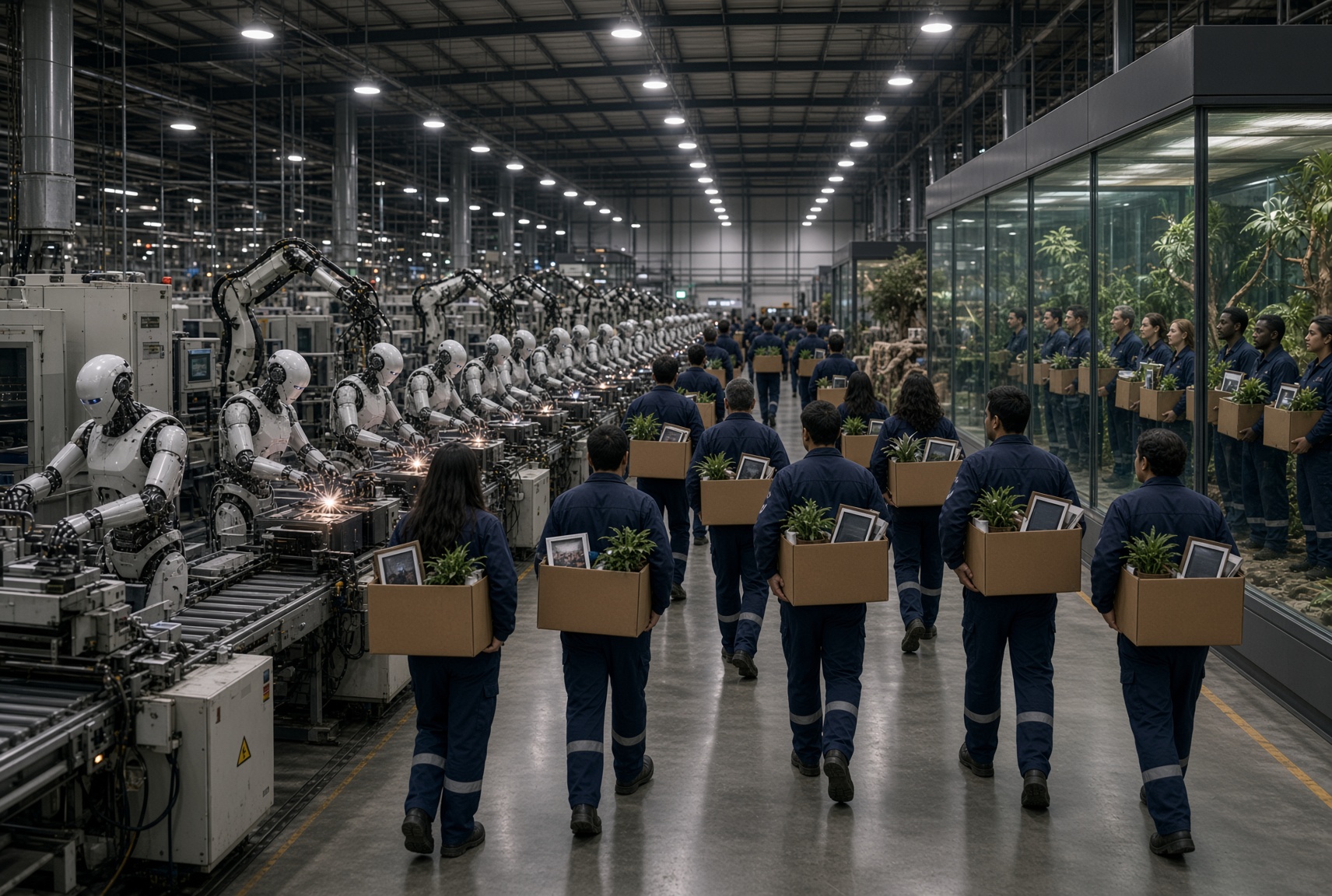
Workers leaving the factory floor for a life on UBI in the human zoo.

The primary concern for many Westerners may appear to be the demographic decline of White Europeans and their replacement by an amorphous global majority. The raw statistics do not lie. A century ago, the direct descendants of historic European peoples made up between 25 and 35% of the world's population. Today that figure has fallen to roughly 10 to 12%, a downward trend softened only slightly by steep drops in fertility across East Asia and Latin America. The descendants of Britain’s pre-1945 population face the prospect of becoming a minority in their own homeland, a threshold already crossed in several major urban centres. Yet while racial and demographic shifts dominate headline debates, the deeper civilisational catastrophe is one of total deculturation and cognitive estrangement. Across the board, settled native populations and newcomers alike find themselves uprooted from organic communities and absorbed into a placeless economic machine.

This marks an ironic reversal of the European colonial era, which displaced native populations across North America, Australasia and Southern Africa while projecting European cultural authority over vast empires. By the early twentieth century, that imperial centre of gravity crossed the Atlantic. Following the Second World War, American consumer capitalism established global dominance. The collapse of the Soviet Union sealed this triumph, though that victory rested largely on a temporary American technological edge financed by the petrodollar, a massive military-industrial apparatus and an insatiable consumer base. By the late 1980s, Warsaw Pact socialism could no longer conceal its industrial decrepitude and bureaucratic rot, which crushed the human spirit and suffocated genuine innovation. The fall of the Berlin Wall birthed neoliberal globalism, celebrated prematurely by Francis Fukuyama as "The End of History".

History had not ended. It merely pivoted into uncharted territory. In 1991, the overwhelming majority of the planet's five and a half billion inhabitants still led analog lives. Personal computers were rare luxuries. Printed newspapers, books and unmediated face-to-face contact remained the foundation of daily communication. All of that dissolved over the following three decades of hyper-accelerated technological, demographic and cultural disruption.

From Cultural Supremacy to Progressive Eugenics

On its surface, the neoliberal era promised liberation. Cheaper air travel, international mobility, fluid personal ties and constant digital novelties purported to universalise privileges once reserved for the wealthy. The new millennium married this debt-driven consumerism to an aggressive progressive orthodoxy, one obsessed with the competing and contradictory mantras of equality and diversity.

Yet beneath that egalitarian rhetoric, the economic realities of ordinary citizens collapsed along two divergent tracks. The price of permanent, foundational assets multiplied astronomically, while the price of disposable distractions plummeted. In the early 1990s, a skilled worker in the South East of England could buy a modest family house for three to four times their annual wage. By the 2020s, that relationship severed all ties to honest productive labour, exploding to between 10 and 15 times average household income. With median household earnings lingering below £50,000, even basic three-bedroom properties in commuter towns command upwards of £500,000, while London prices routinely exceed £1 million. An entire generation has been barred from the property ladder. In place of land and security, the neoliberal regime supplied cheap flat-screen televisions, disposable foreign electronics and £30 budget flights to southern holiday resorts. These are glittering digital beads handed out to pacify a dispossessed populace.

This economic transformation liquidated the generational gains of the post-war decades. That earlier period, anchored by a strong domestic manufacturing base, skilled industrial employment and defined-benefit pensions, fostered a confident, independent middle class capable of passing homes and capital down to their children. Globalisation dismantled that inheritance. Outside the sheltered corridors of the state bureaucracy, lifelong employment gave way to insecure contracts, gig-economy piecework and private pension funds exposed to the casino of international finance. Stripped of property and robbed of guaranteed retirements, younger generations face old age without an estate to sustain them, leaving them entirely dependent on corporate platforms and state handouts.

By 2020, this predatory extraction reached its natural limit. The generational inheritance of the post-war era had been exhausted and debt could no longer conceal the stagnation of real wages. Once automation, machine learning and algorithmic surveillance reached industrial maturity, the managerial oligarchy no longer required a vast, skilled domestic workforce to generate returns. The manufactured crises of 2020 served as the decisive turning point. The old debt-fuelled consumer model was abandoned in favour of a high-tech feudal order. Under this dispensation, an assetless population rents its shelter, survives on managerial subsidies and possesses no economic leverage against its technocratic masters.

The Collapse of Progressive Universalism

An ideology built on sentimental moralising cannot survive contact with physical reality. So long as the fashionable diversity preached by the professional classes remained safely cordoned off in working-class industrial hubs like Luton, Slough or Bradford, it served as an inexpensive badge of cosmopolitan virtue. The moment that demographic reality arrives on the doorsteps of the affluent, the universalist posture shatters.

In the Oxfordshire village of Piddington, a picturesque community of fewer than 400 residents, the liberal consensus fractured when the state earmarked a local military site to house over a thousand foreign asylum seekers. The affluent locals, who consistently supported open borders and membership in the European Union, united in fierce opposition. They quickly understood that mass migration represents an immediate threat to the peace, safety, coherence and property values of their quiet rural retreat. This reaction does not contradict their worldview. It lays bare its hypocrisy. They champion cosmopolitanism for the country, while reserving exclusive homogeneity for their private sanctuaries.

Territorial Reality

The retreat of Piddington’s residents confirms that there is no such thing as an abstract, borderless proposition nation. When pressed, even the most dedicated progressives instinctively recognise their home as physical territory that must be defended against outside disruption. They discovered that their wealth and voting records offered no immunity against the administrative state. When a technocratic regime decides a rural parish is surplus land, individual politics become irrelevant. The local community is simply reduced to logistical space for social engineering. The hypocrisy is blatant, but instructive. When the ruling class is forced to endure the consequences of its own social engineering, its universalist principles vanish in an afternoon.

The End of Consumerism and the Rise of the Zoo Economy

The post-war model of perpetual consumption has run headlong into physical and demographic realities. Rather than allowing a corrective reset that returns capital and productive power to families, the managerial elite has opted for steady-state confinement. Cloaked in the language of net-zero environmentalism and biomedical emergency, ordinary populations are no longer managed as sovereign citizens or productive producers. They are kept as specimens in a technological zoo.

Synthetic Multiculturalism as an Elite Transition Tool

Top-down multiculturalism was never designed to preserve genuine cultural variety. Instead, it operates as a solvent. By flooding historic nations with competing, unassimilated populations, the state deliberately erodes local solidarity, fractures the historic working class and eliminates common cultural resistance. An atomised, deracinated population is far easier to monitor, govern and replace.

Society no longer divides along outdated parliamentary party lines. The real division pits a compliant, managed public against those who retain independent thought and memory. A tiny technocratic elite, making up less than 1% of the population, maintains its hegemony through an expanding apparatus of compliance managers, diversity officers and human-resource administrators. This managerial tier coordinates corporate capital, state power and digital communication monopolies, exempting its own members from the housing precarity, economic insecurity and social decay it enforces upon everyone else.

Humanity as Surplus

As automated logistics, artificial intelligence and behavioural management reach full scale, the ruling class no longer views a self-reliant domestic workforce as an asset. Whether native-born or imported, ordinary working people are viewed as overhead costs to be automated away. The stage is set for a high-tech feudal regime where plebeians of every ethnic background are rendered obsolete, sustained only by state-issued digital tokens and tightly monitored consumption.

This development aligns with the theories of philosopher Peter Sloterdijk and historian Yuval Noah Harari. Both thinkers recognise that the traditional citizen-worker of the industrial era is an anachronism. Sloterdijk treats modern history through the concept of the human park, or Menschenpark, an ongoing civilisational project of domestication. In this model, self-appointed elites act as zookeepers, selecting, refining and governing human stock through education, culture and institutional discipline. Sloterdijk argues that traditional humanist institutions can no longer preserve social order. As a result, the management of human biology and behaviour will become direct, clinical and technocratic. Without explicit bio-cultural oversight, he contends, human populations risk sliding into unruly disorder.

Harari arrives at the same conclusion from the perspective of technological determinism. In previous centuries, rulers were compelled to invest in their common people, if only to secure factory hands for industry and soldiers for imperial armies. In the age of algorithmic automation, that bargain is obsolete. Harari warns that the unmanaged masses are fast becoming a useless class, a population that is not merely unemployed during an economic downturn, but permanently unemployable within an automated economy. Because algorithms can outperform humans in both administrative labour and cognitive processing, ordinary citizens have surrendered their historic bargaining power.

Taken together, these perspectives define the mechanics of the zoo economy. The managerial caste no longer needs a productive, property-owning public to sustain wealth or social order. The average citizen is demoted to a ward in a high-tech enclosure. Sedated by screens, medicated by the psychiatric establishment and fed on industrial calories, the public is managed via state transfers and corporate digital subscriptions. The ruling class has abandoned the exploitation of domestic labour in favour of absolute administrative surveillance. In this emergent feudal order, ordinary men and women are no longer stakeholders in a shared civilisation. They are treated as biological liabilities, to be curated, tranquillised and managed until the machine no longer requires them at all.


Categories
All in the Mind Power Dynamics

On the Brink of Civil War?

Social unrest in an age of hyper-surveillance and hypersensitivity

The Labour-branded government has announced sweeping cutbacks in social welfare and core public services at a time of rising unemployment and on the cusp of an artificial intelligence revolution. You could hardly choose a worse time to wean the most vulnerable in society off welfare dependence. With hundreds of billions squandered in recent years on lockdowns, military misadventures, hairbrained energy transition schemes and accommodating record levels of net immigration, something had to give. One week the government announces cuts in winter fuel payments with savings of up to £1.5 billion, but the next it announces £3 billion more to help Ukraine’s war effort. After years of championing the disabled, the Labour administration is telling a million incapacity benefit claimants to get a job, inadvertently admitting that the UK’s watered-down definition of disability has hidden the true scale of worklessness. No wonder, many Labour supporters are angry, but the pipe dream of endless state generosity could not go on forever. The old arguments that Keynesian economics can boost growth and equality no longer holds sway when many WEF-endorsed policies aim to fast-track the transition away from the carefree mass consumerism of 1990s and early 2000s to the new virtual economy offering abstract services we never used to need.

On the surface, away from overseas conflict zones and inner-city crime blackspots, all seems quiet in the suburbs and small towns where most British people live. The homicide rate has declined since its postwar peak around the turn of the millennium. People have by and large retreated to their humble abodes, preferring to binge-watch Netflix movies than head out for a night on the town. More people die through substance abuse and personal neglect at home than in pub brawls or street fights. In Scotland alone deaths attributed to alcohol or recreational drugs has hovered around 2500 since 2020, while the total homicide rate for 2023-24 was just 57 with 36 outside the home. The lockdowns of 2020 and 21 only accelerated this trend. Yet emotional insecurity and underlying internecine tensions may have hit an all-time high, at least since records began, due to a breakdown in trust and social cohesion. Low-level crime remains rampant among the Island’s diverse communities. The police have given up trying to stop burglars, drug-dealers, grooming gangs and money-launderers. They also apply very different standards to different parallel communities, but always seem to have time to monitor social media activity and arrest critical thinkers for daring to contradict official narratives. In 2023 over 3,300 UK residents were arrested for social media posts alone and that was before the infamous Online Safety Act had time to kick in.

Just in case you were under the mistaken impression that laws against alleged hate speech and misinformation only affected xenophobes, antivaxxers and transphobes, London’s Metropolitan Police dispatched 20 armed officers to handcuff and arrest six women at a Quaker meeting house in London during a peaceful gathering on the ongoing slaughter in Gaza, because they were planning  non-violent direct action against fossil fuel companies and arms manufacturers. This comes after Hertfordshire Police dispatched 6 officers to arrest a couple for daring to criticise the appointment of a new head teacher at their daughter’s primary school.

Slowly but surely, the post-millennial social contract between the self-styled progressive managerial classes and the atomised consumer classes is coming apart. The sheer hypocrisy of the condescending illiberal intelligentsia has never been more undeniable. The exact details hardly matter, but affluent trendy lefties are now blaming the selfish misbehaviour and perceived ignorance of the settled working classes for all our societal and environmental problems. A toxic mix of woke identity politics and green zealotry has succeeded only in sowing the seeds of distrust and widening the gap between haves and have-nots by creating rival groups of impoverished strivers and welfare dependents.

One week the prime minister affirms his support for Israel’s counter-insurgency operations as it resumes bombing civilian targets in Gaza. The next week the deputy PM, Angela Rayner, joins public celebrations of Ramadan and promises stronger laws against Islamophobia. Come June, woke officialdom will be promoting Pride Month again and yet schools and businesses are busy downgrading Easter for fear of offending non-Christians. Meanwhile much parliamentary time is devoted to Kim Leadbeater’s Assisted Dying Bill, despite the opposition of all traditional religions. The sanctity of life is the one thing Christian, Muslim and Jewish clerics could agree on. Nobody dare mention that these policies conspire mainly to destabilise social cohesion and empower the surveillance state to suppress rational critique, inviting us only to express our emotions.

In a complex world with competing demands, it’s almost impossible to keep everyone happy. One person’s concept of emancipation or self-expression may harm someone else’s privacy, dignity, safety and livelihood. As a victim of teenage bullying myself, I can empathise with confused adolescent boys identifying as girls because they fail to meet classic male stereotypes. I had a different kind of identity crisis, which thankfully did not lead me to believe I may have been born in the body, but I can understand how gullible troubled teenagers can succumb to the trans cult and blame their alienation on reactionary transphobes. But what about shy teenage girls who feel threatened by the presence of a biological male undressing next to them in the changing rooms?

In times of plenty with boundless opportunities for expansion, it may be easy to open your heart to the plight of refugees fleeing extreme poverty or tyranny and welcome them into your land. It’s not so easy when newcomers not only compete with the settled population over access to services, affordable housing and jobs, but transform the cultural landscape limiting everyone’s freedom. Numerous social attitudes surveys across Europe have found a distinct pattern, the more affluent you are, the more relaxed you are about the consequences of rapid demographic change. However, among the lower classes, settled communities tend to be more critical of mass migration and ethnic minorities more socially conservative on family issues.

Fear of Islamic or Zionist Fundamentalism

Two divergent critiques of global imperialism compete to explain the growing powerlessness of the working classes. One blames radical Islam and the other blames Israel for the destabilisation of viable societies. Nigel Farage’s Reform in the UK and Marine Le Pen’s Rassemblement National (National Rally) in France are both fiercely pro-Israel. GBNews talking heads, with the honourable exception of Neil Oliver relegated to weekly online videos, regularly conflate the Muslim role in the grooming gang scandal with animated protests featuring Hamas flags against Israeli war crimes with sporadic reports of antisemitic hate crimes. Pro-Israel lobbies have succeeded in winning over much of the European nationalist right, with Netanyahu receiving a warm welcome from Hungarian leader, Viktor Orban, amid calls from other European leaders for his arrest. Yet Israel would never have gotten away with such a scale of death and destruction in Gaza without the logistical support of the United States and EU and our collective wilful blindness to a grotesque imbalance of power. In theory, a truly independent European superstate could break ranks with the US and demand an immediate ceasefire, enforced by a naval blockade and trade sanctions. However, they did no such thing. Frightened politicians, wary of the Muslim vote, distanced themselves from the excesses of Israeli military operations, but were powerless to stop the slaughter.

Hundreds of thousands of mainly white working-class girls would not have fallen prey to mainly Pakistani and Bangladeshi grooming gangs if they had grown up in stable two parent families in tight-knit communities able to defend themselves against predators who could easily take advantage of vulnerable and gullible girls with flashy cars, drugs and booze. While many victims could recount vile ordeals with unspeakable levels of depravity, it’s easy to fall into the trap of blaming a literal interpretation of ancient Quranic teachings, such as "...who guard their chastity except with their wives or those whom their right hands possess..." (Quran 23:5–6 and 70:29–30) for the behaviour of sexually frustrated men from South Asian communities transposed to the British Isles. Most Islamic scholars condemn concubinage today. More scandalous were the coordinated efforts by the police, social workers and local councils to suppress crimes committed against one atomised group to placate another community, setting the stage for a turf war with one community screaming rape and the other playing the race card, usually in the guise of Islamophobia. In this spat, the morally superior managerial and media classes have tended to downplay the scale of the grooming gang phenomenon either to further their careers or signal their repudiation of xenophobia. Often, they rely on counter-narratives to blame the settled working classes for their own demise. In recent weeks Labour politicians and their allies in the establishment media have been at pains to promote the Netflix series, Adolescence, about a white teenager, Jamie Miller, from a stable family obsessed with incel culture and the Tate brothers, charged with killing his female classmate, Katie Leonard. The only trouble is that it is complete fiction and was only inspired by a real world of an emotionally disturbed Ugandan-born Hassan Sentamu who killed 15-year-old, Elianne Andam, after his ex-girlfriend had dumped him. Sentamu stems largely from a chaotic upbringing marked by alleged abuse, family breakdown, time in foster care and fatherlessness from an early age. His violent behaviour appears rooted in personal trauma and instability rather than falling prey to online radicalisation or incel culture. If anything, the real-world teenage murder in Croydon, South London, highlights the challenges of cultural integration rather than its success.

Officialdom’s reaction to last July’s Southport stabbing spree followed a similar pattern of deflection. Rather than address people’s very real concerns about societal breakdown amid rapid demographic change and arrest the perpetrators of violence, the establishment doubled down by jailing social media activists and angry protesters. True to form, high-profile self-righteous opinion leaders kept pushing the line that the government needed to take swift and tough action against far-right rioters. Yet objective reality on the ground revealed a very different picture. As rival ethno-religious groups battled it out on the streets over unrelated grievances in Harehills, Leeds and Tower Hamlets, the police adopted a posture of strategic disengagement and stood by and watched, leading to accusations of two-tier policing.

Skewed Moral Compass

A form of subconscious identity-driven bias causes people to minimise or magnify wrongdoing based on the group affiliation of the perpetrators or victims, leading to a skewed moral compass. The antiwar left, often aligned with Jeremy Corbyn in Britain or Jean-Luc Melanchon in France, may have a clear conscience over their opposition to the ongoing slaughter in Gaza, but they downplay the deskilling and disempowerment of the settled working classes and the higher levels of violent and sexual crime prevalent in some immigrant communities. By the same token, working-class nationalists often side with Israel over Palestine, while blaming Islam as a whole for the destruction of Western civilisation. Their conscience may be clear over the victims of grooming gangs, but they choose to ignore the innocent victims of military adventurism in far-off lands.

Both groups often fail to see how different kinds of evil, whether perpetrated by state actors, manipulated militias or degenerate commoners, may all be side effects of global destabilisation orchestrated by powerful vested interest groups. Yet we are encouraged to discount such a possibility as a wild conspiracy theory, preferring instead the Punch and Judy spectacle of Trump versus Harris or Labour versus Tories or Reform. Many on the cultural left are up in arms about the Trump administration’s expulsion of foreign students who have protested Israeli war crimes because their actions allegedly intimidate Jewish Americans and lend support to Hamas, which the US considers a terrorist organisation. Yet they were dutifully silent about Big Tech’s censorship of social conservative and naturopathic (i.e. critical of Big Pharma) viewpoints. Indeed, many on the left gave the Biden administration a free pass on its unflinching financial, military and diplomatic support for Israeli war crimes, preferring to believe a Harris administration might set a different tone.

In the past the radical wing of the US Democratic Party, embodied by Senators Bernie Sanders (although not technically a party member) and Alexandria Ocasio-Cortez, have voiced passionate critiques of US foreign policy, but have always stopped short of calling for an end to US military aid to Israel, which averaged $3- to 5 billion in the decade before 2023 and has been estimated $17.9 billion since, in addition to other military adventures that serve Israeli interests much more than US priorities focused on national defence, world peace and trading relationships.

As elements within Big Tech, most notably Elon Musk and Peter Thiel, have shifted their support to the Trump team, Sanders and Cortez, both big lockdown cheerleaders, have started a campaign against the oligarchy, which fits the theme of Russian interference in American politics. The growing concentration of wealth in a tiny cabal of tech entrepreneurs and financiers is beyond dispute. Yet the radical corporate left turns a blind eye to the toxic influence of the likes of Bill Gates and Larry Fink of BlackRock, who cleverly steer clear of pronouncements on geopolitical controversies while working in close liaison with the US military industrial complex. At a rally at the Ford Idaho Center on 14 April this year, marshals acted swiftly to expel attendees who unfurled a large banner with the Palestinian flag and the words Free Palestine. Senator Sanders later reiterated his support for Israel’s right to defend itself, despite his critique of its excesses and the verifiable fact that Israel broke the January ceasefire deal.

Narrative Dissonance

Recent news viewership trends reveal a marked shift away from traditional TV news bulletins, often consumed passively, to a wider range of corporate and indie online channels. One way or another a large section of general population has lost all trust in official sources, often completely at odds with their lived experiences. In 2020 the Behavioural Insights Team, aka the Nudge Unit, worked alongside broadcasters, newspapers, advertisers and online influencers to change some of the most basic human behaviours and perceptions. Overnight neighbours and strangers alike became bio-hazards and previously low-key scientific functionaries became deities. Big Tech stepped in to suppress counternarratives. While YouTube still tolerated flat earthers and Israel firsters, it censored dissident scientists and medics who contradicted the official WHO line. While possibly only 10-15% of Westerners openly disputed the covid narrative, with most preferring to comply in the hope of getting back to normal, they sowed the seeds of doubt in many more. If the MSM can lie so brazenly over flu variants to drive hidden agendas, goodness knows what other mistruths it has told us over the years.

In periods of stability, media narratives go largely unquestioned by the public. But as lived experience begins to contradict official messaging, a growing number of critical observers, once limited to a small subset of the population, begin to seek out independent or dissenting sources of information. Alas such dissenting sources can be easily manipulated and lead critical thinkers to scapegoat the wrong people or place their trust in controlled opposition.

Millions of Americans voted Trump because they hoped his team would reign in the Deep State behind the Biden administration’s authoritarian overreach and lack of empathy with the plight of settled citizens outside their metropolitan bubbles, as expressed so passionately in Oliver Anthony’s Rich Men North of Richmond. Early on the Trump team reversed course on covid-era biotech tyranny and gender-bending with the appointment of Robert F Kennedy Junior, heralded the end of US involvement in the Ukrainian quagmire and tightened border controls with some well publicised deportations to win favour with his base. Yet within weeks, his administration threw its full weight behind the resumption of Israeli military operations in Gaza and started bombing Houthi targets directly in Yemen allegedly to defend traffic through the Gulf of Aden and Red Sea, while threatening war with Iran and simultaneously launching a tariff war against the US’s leading trading partners. The Western progressive media, outside the USA itself, is now overwhelmingly hostile to this shift in foreign and domestic policies, while Europeans are losing faith in the core institutions of the post-cold-war settlement. Some call this beginning of the end for globalism as an ideological goal, but others see it either as war by other means or as part of a coordinated implosion of mass consumerism in the next phase of the Great Reset. With high tariffs, China could lose a large chunk of its high-profit-margin exports while Americans would have to adapt to higher retail prices. In all likelihood, the move will only speed up the development of alternative high-tech hubs especially in nanotech and AI, boost bilateral trade relationships between China and other leading geopolitical blocks such as India, Russia, Africa and South America. Until recently, US-based companies had a monopoly on the development of operating systems, but this could end soon with the next generation of microkernel operating systems along the lines of Huawei’s new HarmonyOS. As the Chinese DeepSeek project proved, AI could accelerate the development of new computing ecosystems independent of US tech giants, stripping the American superpower of its last unassailable advantage following the collapse of the dollar as the world’s reserve currency. Combined with supply-chain disruption from the US-China trade war, this could have catastrophic consequences for the United Kingdom’s service-oriented economy, already suffering from high energy prices and the eclipse of its industrial legacy.

Will we descend into Urban Warfare?

David Betz, Professor of War at King’s College London, argues that the West, including the UK, is increasingly vulnerable to civil conflict due to collapsing social trust, rising economic hardship, extreme political polarisation and fragmented national identities. He critiques the complacency of Western elites and notes that traditional assumptions, like wealth and democratic stability shielding nations from civil war, may no longer hold. Betz warns that civil strife may resemble past internecine wars, marked by factional violence and systemic decay, as ideologically radicalised groups on all sides exploit digital and societal fault lines in a struggle over identity, survival and sovereignty.
The country that built its fortune on plentiful coal and gas reserves could soon experience rolling power cuts, as Spain and Portugal witnessed recently. While the chattering classes like to blame Brexit and ageing population for malfunctioning services, the working classes are increasingly blaming the mindboggling incompetence of the wishful thinking chattering classes. Why should commoners struggling to afford utility bills and essential groceries follow the advice of NetZero zealots who wasted countless billions of £ promoting transgenderism in schools? Sooner or later, when the shit hits the proverbial fan, the great unwashed may take the streets.

However, we may not see English skinheads running rampage through Muslim neighbourhoods seeking revenge for the rape of mainly white working-class girls, as a Netflix drama might portray. They are much more likely to target the posh neighbourhoods of the managerial classes only to discover the real decision makers have retreated to their secluded villas in the Mediterranean or Caribbean. While some urban blackspots may see street violence between rival ethnic communities, such as Pakistanis and Indians, a more general trend may be open defiance against incompetent law-enforcers seeking to criminalise dissent.

Categories
All in the Mind Computing

GIGO: Garbage In, Garbage Out 

Or is that BIBO: Bias In, Bias Out? 

The rapid evolution of artificial intelligence raises profound ethical questions with far-reaching implications for our autonomy as human beings. However, today, I want to focus on a more immediate challenge: workplace displacement and its impact on the job market.  

Some argue that AI assistants will usher in a new era of hyper-creativity, while others fear mass layoffs as intelligent automation outperforms well-paid professionals. Why pay a solicitor £250 an hour to resolve a business dispute when an AI-driven consultancy can handle the same task at a fraction of the cost? With the latest AI models, web services can parse mountains of Kafkaesque legislation in seconds and recommend a course of action just a few clicks away. Yet, when it comes to non-verbal human interaction, we are still a long way from reaching the singularity.  

Over the last six months, I’ve tested various AI coding companions with mixed results. Many analysts suggest that programmers may soon follow in the footsteps of typesetters. While code-completion tools like TabNine, GitHub Copilot, and Codeium can significantly boost productivity, they cannot replace a solid understanding of data architecture and software design principles. Developers who rely too heavily on AI without mastering the fundamentals risk introducing performance bottlenecks, reliability issues, and unintended side effects. More importantly, they must remain aware of machine learning’s limitations—an AI-generated suggestion may be well-structured yet fail to align with the intended logic, merely predicting what a developer might type next rather than intelligently reusing custom helper functions. 

Just as we transitioned from hand-coding assembly to higher-level languages like C, C++, Java, and C#, and later to more accessible scripting languages like Python and JavaScript, we may soon rely on large language models (LLMs) to translate technical requirements into robust, high-performance code. Instead of manually debugging thousands of lines of poorly documented code, we could focus on defining validation criteria, running unit and integration tests, benchmarking performance, and instructing AI assistants to refactor inefficient algorithms. As always, the devil is in the details. 

 Why, then, would anyone invest the extra time and effort to learn lower-level languages like C, with manual memory management, or grapple with Rust’s borrow checker when they could be far more productive using simpler, untyped interpreted languages like Lua? The short answer has traditionally been performance. Easier scripting languages, with their higher levels of abstraction, are generally more beginner-friendly, whereas strongly typed, compiled languages offer fine-grained control over data structures and memory management but come with a steep learning curve and greater attention to detail. 

 Historically, we have traded the faster development times of scripting languages for the raw performance of compiled ones, particularly when building minimum viable products (MVPs) for startups. Companies as diverse as Twitter and Facebook initially relied on frameworks like Ruby on Rails and the HipHop PHP compiler. Once they had viable businesses with millions of users and advertising revenue, they could invest in scalable solutions and hire top-tier systems programmers and infrastructure engineers. This allowed more creative frontend and mid-tier developers to focus on the rapidly evolving details of customer-facing UX and UI. 

However, with AI coding assistants, hard languages like Rust become compelling choices outside their niche of systems programming for anything from rapid API development to Web apps, not because developers need to master their intricacies, but because they do not or, more accurately, only at a conceptual level. AI can handle the minutiae of lifetime management or the boilerplate of defining custom structs and enums with generics. A language like Rust could then act as an intermediary representation, precise and performant enough for machines, yet intelligible to skilled developers for oversight or debugging.  

Unlike higher-abstraction languages, Rust’s fine-grained control, smoothed over by AI, ensures safety and efficiency without sacrificing flexibility. The result? APIs that are fast, reliable, and future-proof, with AI bridging the gap between human intent and Rust’s low-level power.  

AI can also help with cross-compilation and migration. Let us suppose your lead mobile developer is most comfortable within the Apple eco-system with a strong preference for Swift and X-Code, but you need to support Android and desktop users too. Until recently, you may have weighed the pros and cons of hiring an experienced Android developer or choosing a cross-platform suboptimal framework like Flutter or React Native, often resulting in larger app download sizes and a greater drain on battery life. Coding assistants can not only port your code base, but they can also advise you on how to make the best use of inbuilt platform services. 

In data science and language model training, where Python still reigns supreme, there has been much hype about Mojo and its potential to combine pythonic simplicity with C-level performance.  I foresee that with coding assistants, developers may choose the flow-code representation they feel most comfortable with and then drill down to the native source code when necessary, boosting productivity and letting us focus on functionality, data integrity and efficiency. 

What does this mean for the millions working in software development, whether in programming, design or data analysis? Essentially, the days of needing an army of narrowly focused coders churning out repetitive lines of code are coming to an end. Instead, the future belongs to adaptable, big-picture thinkers, sometimes called lazy programmers, who focus on the whole system rather than isolated fragments. Success in this new landscape will be less about grinding out code and more about mastering the key pillars of software development: thoughtful architecture, intelligent use of design patterns, robust data modelling and a sharp performance optimisation. Demand will remain high for those who can weave these elements together to build efficient, scalable systems. However, if your primary strengths lie in rote learning, fast typing and syntactical perfection, you may soon find your skillset redundant in an AI-assisted world.