Categories
All in the Mind Computing Power Dynamics

The Great Tech Replacement

Could robots replace plebeians of all ethnic backgrounds?
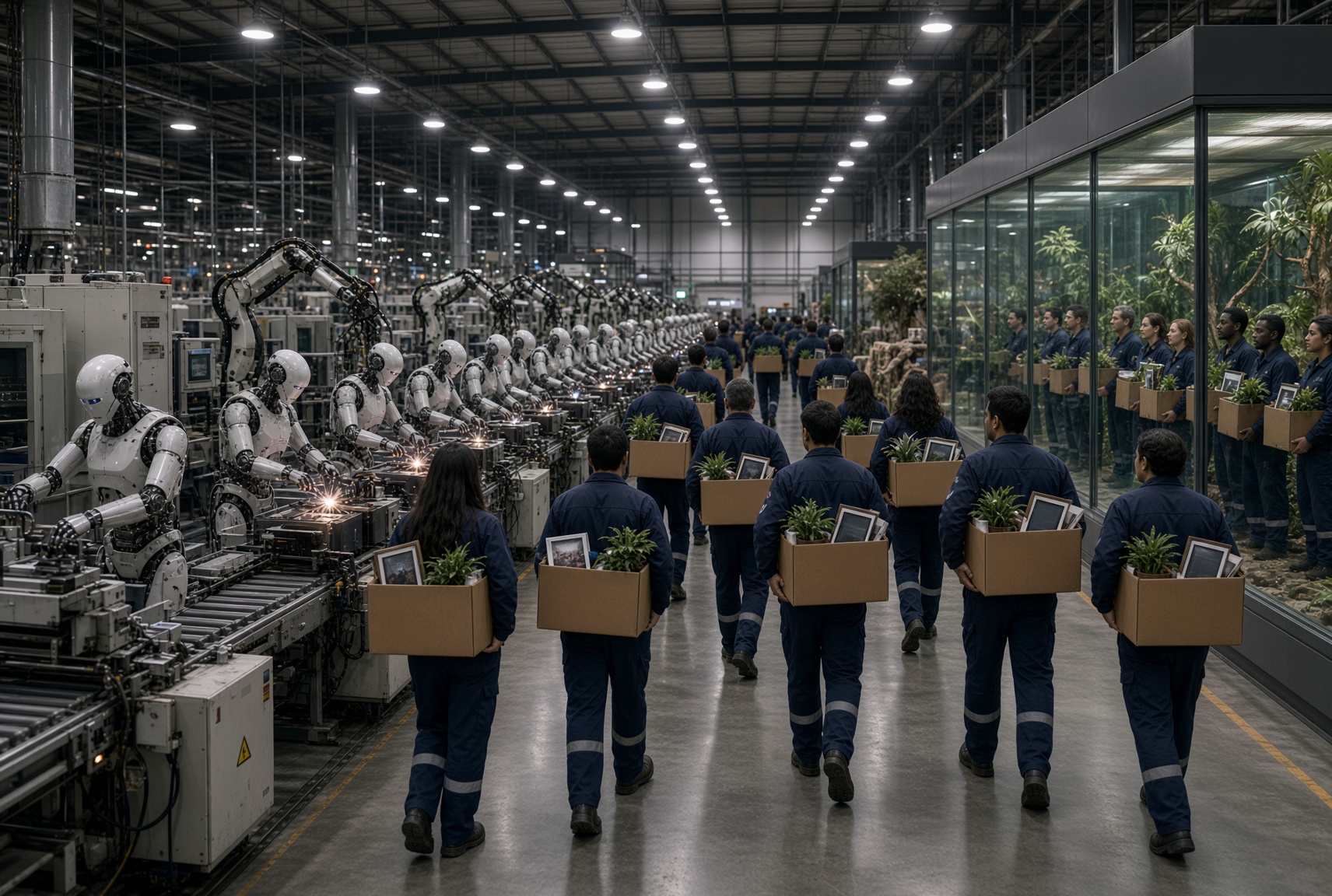
Workers leaving the factory floor for a life on UBI in the human zoo.

The primary concern for many Westerners may appear to be the demographic decline of White Europeans and their replacement by an amorphous global majority. The raw statistics do not lie. A century ago, the direct descendants of historic European peoples made up between 25 and 35% of the world's population. Today that figure has fallen to roughly 10 to 12%, a downward trend softened only slightly by steep drops in fertility across East Asia and Latin America. The descendants of Britain’s pre-1945 population face the prospect of becoming a minority in their own homeland, a threshold already crossed in several major urban centres. Yet while racial and demographic shifts dominate headline debates, the deeper civilisational catastrophe is one of total deculturation and cognitive estrangement. Across the board, settled native populations and newcomers alike find themselves uprooted from organic communities and absorbed into a placeless economic machine.

This marks an ironic reversal of the European colonial era, which displaced native populations across North America, Australasia and Southern Africa while projecting European cultural authority over vast empires. By the early twentieth century, that imperial centre of gravity crossed the Atlantic. Following the Second World War, American consumer capitalism established global dominance. The collapse of the Soviet Union sealed this triumph, though that victory rested largely on a temporary American technological edge financed by the petrodollar, a massive military-industrial apparatus and an insatiable consumer base. By the late 1980s, Warsaw Pact socialism could no longer conceal its industrial decrepitude and bureaucratic rot, which crushed the human spirit and suffocated genuine innovation. The fall of the Berlin Wall birthed neoliberal globalism, celebrated prematurely by Francis Fukuyama as "The End of History".

History had not ended. It merely pivoted into uncharted territory. In 1991, the overwhelming majority of the planet's five and a half billion inhabitants still led analog lives. Personal computers were rare luxuries. Printed newspapers, books and unmediated face-to-face contact remained the foundation of daily communication. All of that dissolved over the following three decades of hyper-accelerated technological, demographic and cultural disruption.

From Cultural Supremacy to Progressive Eugenics

On its surface, the neoliberal era promised liberation. Cheaper air travel, international mobility, fluid personal ties and constant digital novelties purported to universalise privileges once reserved for the wealthy. The new millennium married this debt-driven consumerism to an aggressive progressive orthodoxy, one obsessed with the competing and contradictory mantras of equality and diversity.

Yet beneath that egalitarian rhetoric, the economic realities of ordinary citizens collapsed along two divergent tracks. The price of permanent, foundational assets multiplied astronomically, while the price of disposable distractions plummeted. In the early 1990s, a skilled worker in the South East of England could buy a modest family house for three to four times their annual wage. By the 2020s, that relationship severed all ties to honest productive labour, exploding to between 10 and 15 times average household income. With median household earnings lingering below £50,000, even basic three-bedroom properties in commuter towns command upwards of £500,000, while London prices routinely exceed £1 million. An entire generation has been barred from the property ladder. In place of land and security, the neoliberal regime supplied cheap flat-screen televisions, disposable foreign electronics and £30 budget flights to southern holiday resorts. These are glittering digital beads handed out to pacify a dispossessed populace.

This economic transformation liquidated the generational gains of the post-war decades. That earlier period, anchored by a strong domestic manufacturing base, skilled industrial employment and defined-benefit pensions, fostered a confident, independent middle class capable of passing homes and capital down to their children. Globalisation dismantled that inheritance. Outside the sheltered corridors of the state bureaucracy, lifelong employment gave way to insecure contracts, gig-economy piecework and private pension funds exposed to the casino of international finance. Stripped of property and robbed of guaranteed retirements, younger generations face old age without an estate to sustain them, leaving them entirely dependent on corporate platforms and state handouts.

By 2020, this predatory extraction reached its natural limit. The generational inheritance of the post-war era had been exhausted and debt could no longer conceal the stagnation of real wages. Once automation, machine learning and algorithmic surveillance reached industrial maturity, the managerial oligarchy no longer required a vast, skilled domestic workforce to generate returns. The manufactured crises of 2020 served as the decisive turning point. The old debt-fuelled consumer model was abandoned in favour of a high-tech feudal order. Under this dispensation, an assetless population rents its shelter, survives on managerial subsidies and possesses no economic leverage against its technocratic masters.

The Collapse of Progressive Universalism

An ideology built on sentimental moralising cannot survive contact with physical reality. So long as the fashionable diversity preached by the professional classes remained safely cordoned off in working-class industrial hubs like Luton, Slough or Bradford, it served as an inexpensive badge of cosmopolitan virtue. The moment that demographic reality arrives on the doorsteps of the affluent, the universalist posture shatters.

In the Oxfordshire village of Piddington, a picturesque community of fewer than 400 residents, the liberal consensus fractured when the state earmarked a local military site to house over a thousand foreign asylum seekers. The affluent locals, who consistently supported open borders and membership in the European Union, united in fierce opposition. They quickly understood that mass migration represents an immediate threat to the peace, safety, coherence and property values of their quiet rural retreat. This reaction does not contradict their worldview. It lays bare its hypocrisy. They champion cosmopolitanism for the country, while reserving exclusive homogeneity for their private sanctuaries.

Territorial Reality

The retreat of Piddington’s residents confirms that there is no such thing as an abstract, borderless proposition nation. When pressed, even the most dedicated progressives instinctively recognise their home as physical territory that must be defended against outside disruption. They discovered that their wealth and voting records offered no immunity against the administrative state. When a technocratic regime decides a rural parish is surplus land, individual politics become irrelevant. The local community is simply reduced to logistical space for social engineering. The hypocrisy is blatant, but instructive. When the ruling class is forced to endure the consequences of its own social engineering, its universalist principles vanish in an afternoon.

The End of Consumerism and the Rise of the Zoo Economy

The post-war model of perpetual consumption has run headlong into physical and demographic realities. Rather than allowing a corrective reset that returns capital and productive power to families, the managerial elite has opted for steady-state confinement. Cloaked in the language of net-zero environmentalism and biomedical emergency, ordinary populations are no longer managed as sovereign citizens or productive producers. They are kept as specimens in a technological zoo.

Synthetic Multiculturalism as an Elite Transition Tool

Top-down multiculturalism was never designed to preserve genuine cultural variety. Instead, it operates as a solvent. By flooding historic nations with competing, unassimilated populations, the state deliberately erodes local solidarity, fractures the historic working class and eliminates common cultural resistance. An atomised, deracinated population is far easier to monitor, govern and replace.

Society no longer divides along outdated parliamentary party lines. The real division pits a compliant, managed public against those who retain independent thought and memory. A tiny technocratic elite, making up less than 1% of the population, maintains its hegemony through an expanding apparatus of compliance managers, diversity officers and human-resource administrators. This managerial tier coordinates corporate capital, state power and digital communication monopolies, exempting its own members from the housing precarity, economic insecurity and social decay it enforces upon everyone else.

Humanity as Surplus

As automated logistics, artificial intelligence and behavioural management reach full scale, the ruling class no longer views a self-reliant domestic workforce as an asset. Whether native-born or imported, ordinary working people are viewed as overhead costs to be automated away. The stage is set for a high-tech feudal regime where plebeians of every ethnic background are rendered obsolete, sustained only by state-issued digital tokens and tightly monitored consumption.

This development aligns with the theories of philosopher Peter Sloterdijk and historian Yuval Noah Harari. Both thinkers recognise that the traditional citizen-worker of the industrial era is an anachronism. Sloterdijk treats modern history through the concept of the human park, or Menschenpark, an ongoing civilisational project of domestication. In this model, self-appointed elites act as zookeepers, selecting, refining and governing human stock through education, culture and institutional discipline. Sloterdijk argues that traditional humanist institutions can no longer preserve social order. As a result, the management of human biology and behaviour will become direct, clinical and technocratic. Without explicit bio-cultural oversight, he contends, human populations risk sliding into unruly disorder.

Harari arrives at the same conclusion from the perspective of technological determinism. In previous centuries, rulers were compelled to invest in their common people, if only to secure factory hands for industry and soldiers for imperial armies. In the age of algorithmic automation, that bargain is obsolete. Harari warns that the unmanaged masses are fast becoming a useless class, a population that is not merely unemployed during an economic downturn, but permanently unemployable within an automated economy. Because algorithms can outperform humans in both administrative labour and cognitive processing, ordinary citizens have surrendered their historic bargaining power.

Taken together, these perspectives define the mechanics of the zoo economy. The managerial caste no longer needs a productive, property-owning public to sustain wealth or social order. The average citizen is demoted to a ward in a high-tech enclosure. Sedated by screens, medicated by the psychiatric establishment and fed on industrial calories, the public is managed via state transfers and corporate digital subscriptions. The ruling class has abandoned the exploitation of domestic labour in favour of absolute administrative surveillance. In this emergent feudal order, ordinary men and women are no longer stakeholders in a shared civilisation. They are treated as biological liabilities, to be curated, tranquillised and managed until the machine no longer requires them at all.
Categories
All in the Mind

The Woke Emperor’s Clothes

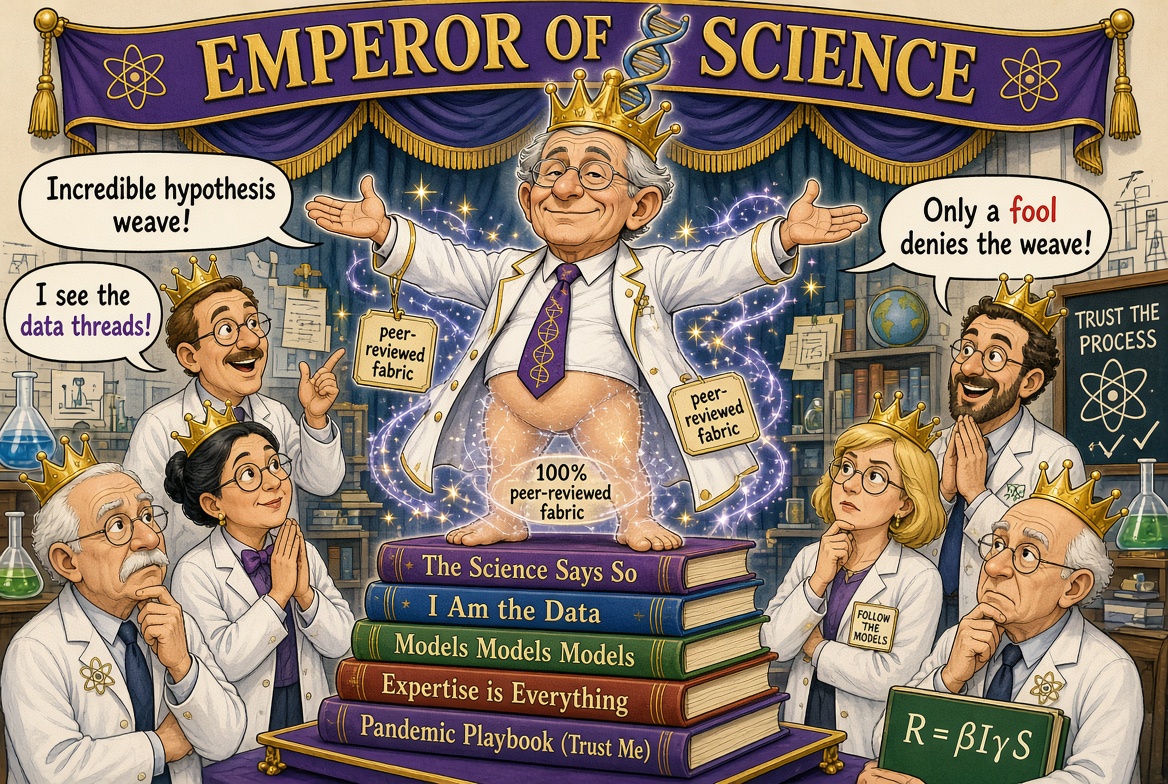
Fauci's New Clothes

and the roots of creative confabulation in a culture of false narratives

Choreography:

Jason Arday is dead and the people who built him have arranged their faces into expressions of grief.

He was appointed professor of the sociology of education at Cambridge in 2023, at the age of 38, and was reported everywhere as the youngest Black professor in the institution's 800-year history. The story travelled around the world without a single editor asking to see the workings.

It took three years to unravel the claims and it did not begin with an ideologue. Jack Grove, a reporter at Times Higher Education, had assembled a 63-page report documenting how large sections of Arday's work appeared to have been taken, without proper citation, from a thesis written by another student in 2009. Grove has said the Metropolitan Police contacted him and asked him to stop approaching Arday because of the effect on his mental health. On 21 July 2026 the philosopher Nathan Cofnas published his own findings on Substack, having run Arday's 2015 dissertation through Copyleaks: many passages are lifted with minimal editing, sometimes retaining copy-editing mistakes. Cofnas was candid about wanting to discredit the university's ideology of DEI. Both of those things are true at once and the second is now being used to bury the first.

Arday denied the accusations, attributed the errors to his purported autism and said his accusers were motivated by racism. His publisher, Simon & Schuster, stood by him and praised his professionalism and integrity. Note what was offered as a defence to a charge of unattributed copying: a diagnosis. The label was still doing its work right up to the end.

He resigned from Cambridge and Jesus College on 5 August 2026, writing that what he had experienced had gone far beyond scholarly disagreement. He was found dead at his home in London on 14 August, nine days later.

Then the choreography began. The Chancellor of Cambridge condemned a racist feeding frenzy. On 20 August, Ghent University suspended Cofnas pending an investigation into his conduct. Within a fortnight the affair had been pressed into a shape that everyone with a reputation to protect could live with: a Black academic hounded to death by racists.

Notice who is absent from that shape. Not Cofnas, who is in it as the villain, nor Grove, whose three years of documentary work have been folded into the frenzy and forgotten. The people missing are the ones who appointed him, profiled him, published him, booked him, funded him and showcased him for three years without ever once asking whether the story was true. They appear nowhere, not as villains, not as fools, not even as witnesses.

The emperor's new clothes were always described in the same terms: finer than anything that had come before and visible only to the worthy. What we are invited to admire today is a brighter, healthier, fairer and more inclusive future for all. Instead, the managerial classes seek to re-organise society by deciding who may think and who counts as fully human.

Nobody in the crowd is embarrassed. That is the part of the story we tend to forget. The courtiers who praised the cloth on Monday do not hang their heads on Tuesday. They simply turn and praise the next thing, at the same volume and in the same voice.

What he was made into:

Cambridge University lies at the heart of the globally oriented woke establishment. Unsurprisingly, the Greens and LibDems do amazingly well in one of England's most prosperous counties, home not only to a prestigious educational institution, but also to leading IT and life science players, including Arm Holdings, Amazon R&D, Microsoft Research, Apple, Roku and Broadcom as well as AstraZeneca, Illumina, CRISPR Therapeutics, Danaher (Abcam), Gilead Sciences and Lonza. Big Tech bankrolls the University, either directly or via intermediaries like the Bill and Melinda Gates Foundation with its Gates Cambridge Scholarship.

The big brains at the tech giants know all too well that in the near future they will need only a top tier of highly intelligent engineers and scientists to drive the fourth industrial revolution, but a much larger army of middle managers and engagement catalysts to keep tabs on the rest of natural humanity. Only the best and brightest get to work at Cambridge, unless their professional role serves purposes other than academic or scientific excellence.

This is what I have elsewhere called progressive eugenics: a selective impulse that has dropped race and class in favour of perceived educability and ideological alignment and sorts people through diagnosis and medicalisation rather than through breeding programmes. I will not rehearse the whole argument again here. Jason Arday is what it looks like applied to one man.

He excelled as a motivational speaker and a poster boy for the victimhood-industrial complex on the back of his skin colour and his disability status. Those diagnoses were not incidental to his rise. They were his qualification. He was elevated as the representative of a category.

What's a label for anyway?

I have worked with severely learning disabled adults, which is not a qualification, but it is a view of these questions from underneath rather than from a lectern.

One man I worked with had been diagnosed with Asperger's despite barely being able to make himself understood. He spoke in mumbled metaphors: "My dad builds bad houses" meant that his father was an architect who had once been sued. He had been on strong epilepsy medication all his life. He could solder capacitors onto a circuit board without having any idea what the board was for and draw basic shapes on a computer screen. He had real neurological deficits that his label did little to help.

No two of the adults I worked with presented remotely alike. One could kick a ball around the courtyard and swim a length, but could not dress himself, needed help in the toilet and would lash out at staff who touched him the wrong way. Another could walk only when the mood took her, shuffling along on someone's arm for weeks and then striding off into town on her own. Nothing in either case was described by a diagnosis, because a diagnosis was never there to describe them. It was there to determine funding, placement and eligibility and, in Jason Arday's case, publicity. There are thousands like them across the UK and the labels fit none of them any better.

It's not so much that the labels are too readily given out, it's that they are administrative instruments dressed as medical findings. They sort people into castes for institutional convenience while telling you almost nothing about the person in front of you.

What nobody checked:

Jason's backstory affirmed a narrative of overcoming the handicaps of neurodivergence and racial prejudice. In many ways it validated a Guardianesque worldview in which social services and public healthcare had somehow failed him in his early years, while framing the beloved NHS as central to everyone's lives. It was a story that a great many institutions wanted to be true and not one of them appears to have spent an afternoon establishing whether it was.

Start with the therapy. Jason claimed to have received ten hours of speech therapy six days a week before he finally uttered his first word just before his twelfth birthday. That is sixty hours a week. No NHS speech and language service has ever provided anything remotely like it, to anyone, at any time. This is not a claim that required investigative journalism to test. It required arithmetic.

As for his childhood itself, his classmates Jonathan Stewart and Magnus Okuonghae remember a chatterbox and neither of them can reasonably be accused of anti-black racism. They were not hard to find. They were findable in 2023, when he was being profiled, by anyone who picked up a telephone.

Then the marathons. He first reached a large national audience on ITV's Surprise Surprise! in 2012, when he highlighted his celebrated feat of running 30 marathons in 35 days back in 2010 to raise money for Shelter and Shooting Star Children's Hospice, despite suffering a seizure and a hairline leg fracture. Reports in the Richmond & Twickenham Times and Your Local Guardian describe a finish at Piccadilly Circus with friends joining segments of the route, but record no formal validation of all 30 runs. The Guardian reported uncritically on Arday's meeting with tennis champion Andy Murray, billing him as an epileptic marathon runner who had carried the Olympic torch through Merton and been mute until the age of 11.

And then the work. Arday's own memoir revealed that one of his examiners struggled to see any original contributions in his work. That examiner did his job. Nobody above him did.

I make no claim about what Jason Arday believed about his own childhood. The epilepsy is documented, and periods of selective mutism following seizures are entirely plausible; a real and modest difficulty could have been inflated into a miracle of recovery by people who needed the better version. What is not in doubt is that basic old-school fact-checking was trivial and that it was never done because nobody in a position to do it wanted the answer.

The same machine, six years earlier:

None of this was invented for Jason Arday. Six years after the techno-elites locked down much of the world's population for our own good and coerced billions into accepting genetic injections, one of their superstar scientists has been publicly humiliated. Not only did Anthony Fauci plead the fifth on most questions about the inconsistencies of his covid-era edicts, taking advantage of his constitutional right to remain silent rather than accept responsibility for his actions or explain the blatant contradictions between his private correspondence and his public pronouncements, but former President Joe Biden had already given him a preemptive pardon. Fauci remained calmly seated as Senator Ron Johnson revealed admissions in Fauci's diaries about the known link between mRNA injections and miscarriages, as well as about urging colleagues to suppress such information for fear of encouraging vaccine hesitancy. "I asked around a bit more and another issue came up that you need to be aware of. Since many people have significant cytokines storm and fever after the 2nd dose, this theoretically could be associated with miscarriage in the 1st trimester."

It turns out the guardians of covid truth were wrong both ethically and scientifically and dissident voices in the wilderness whom the former experts denounced so vociferously had the correct instincts.

Now all the celebrity scientists, fake-progressive opinion leaders and mediagenic influencers who waxed lyrical about the covid jabs and shouted down sceptics are trying to rewrite history. Did they really want to send the unvaccinated to modern-day leper colonies or put us under house arrest until we complied with their biotech mandates? Did they really urge pregnant women to get jabbed and repeatedly dismiss any side effects such as myocarditis as deranged conspiracy theories? Now they're backtracking and the truth seeps into the mainstream thanks to the tenacity of a few whistleblowers. Not one of them has explained how they came to be so certain, so loudly, for so long.

Even if we assume the mRNA injections had a neutral effect on most recipients, the billions squandered on promotion, distribution and enforcement could have been better invested in essential infrastructure such as water treatment, sanitation, transport links and sports facilities that could have saved far more lives. If the government were so concerned with people's health, why did it not invest in new reservoirs to meet growing demand for clean water or ensure that all children have easy access to safe and clean parks untarnished by the artefacts of urban decay? Yet the health-and-safety experts chose to keep people idle at home, glued to electronic devices, inhaling stale air in tiny bedrooms and bingeing on processed snacks. No wonder millions, including many who complied with covid edicts, have lost their trust in officialdom. Why would you accept medical advice from someone who cannot define what a woman is?

I tried to reinvent my past too:

There are aspects of my own childhood that I wanted to adapt in my late teens and early twenties, for reasons others may not understand. I tried to hide my association with Luton because of high-school bullying. People have different ways of dealing with peer rejection. If your peers reject you because you do not fit in with the in-crowd, you can either try to adapt to their anti-intellectual culture of kitsch consumerism that clashed with your family's quasi-religious devotion to the Labour Party (something I might call proto-wokeism) or identify with an alternative culture that may better accommodate your idiosyncrasies or at least give you another chance to prove your worth. I chose the latter course in two ways. First I hung out with local iconoclasts in their late teens and early twenties often identifying as Trotskyists or anarchists within an intellectualised adjunct to the punk counterculture prevalent at the time. Next, I invented multiple variations of my past that might appeal to a crowd who revered victims of oppression and marginalisation.

I had to remember which story I had told to which people and hope that the different groups I met later in life would never compare notes on the embarrassing details of my teenage years, including my dealings with psychiatric services. My aim was only to build a new identity and still be judged on merit. I found creative confabulation much easier abroad in Germany and Italy than in provincial England, where occasional Freudian slips and inconsistent accents may reveal my true identity.

Luckily I never made a career out of it. It all happened long before the social media era removed anonymity, although for some reason leading politicians have gotten away with deceptive fabrications to win favour with voters. In his 1988 presidential campaign, Joe Biden claimed to have graduated in the top half of his law school class and earned three undergraduate degrees. He later admitted he graduated 76th in a class of 85 and earned a single BA with a double major. More recently Rachel Reeves embellished her customer relations role at HBOS, claiming she had worked as an economist. Neither of them was destroyed by it, because neither of them had been made into a symbol that could be withdrawn.

It is technically easier than ever to verify a wild claim. But verification only happens when it suits those with the means to commission it. When it does not, when government, corporate or NGO interests have an agenda to push, the same resources go into refuting inconvenient real-world evidence and maintaining an alternate reality, at a cost of billions. Powerful lobbies go out of their way to defend the honour of key influencers and useful innocents, and ditch them the moment they stop serving elite interests.

This is precisely what happened to Jason Arday. He built a small career on his athletic achievements and his victim status, and could only get away with fanciful exaggerations because enablers in key places wanted to exploit his naivety. Had someone challenged him early on, he might never have become a Cambridge professor. He could have been a good sports teacher, and he would still be alive to be one.

Why is nobody embarrassed?

While some may question the motives of the race realist Nathan Cofnas, the real blame lies with the multibillion-pound DEI industry. True to form, leading illiberal woke politicians, like Diane Abbott MP and Green leader Zack Polanski, have called for tighter regulation of the press and social media to stop the spread of malinformation. Veracity is no longer a valid defence.

None of this should surprise us in a culture that rewards false identities, such as attributing your emotional challenges to wrong body syndrome, and punishes authenticity and common sense. The categories are handed out from above because somebody upstairs needs the sorting done.

In the story, a child says the obvious thing and the spell breaks. That is the one detail Andersen got wrong. Here the exposure changes nothing at all: the cloth is quietly withdrawn, the tailors are paid, the crowd turns to face the next procession, and the only person who pays anything is the one who was dressed up and marched down the street.