Could robots replace plebeians of all ethnic backgrounds?
The primary concern for many Westerners may appear to be the demographic decline of White Europeans and their replacement by an amorphous global majority. The raw statistics do not lie. A century ago, the direct descendants of historic European peoples made up between 25 and 35% of the world's population. Today that figure has fallen to roughly 10 to 12%, a downward trend softened only slightly by steep drops in fertility across East Asia and Latin America. The descendants of Britain’s pre-1945 population face the prospect of becoming a minority in their own homeland, a threshold already crossed in several major urban centres. Yet while racial and demographic shifts dominate headline debates, the deeper civilisational catastrophe is one of total deculturation and cognitive estrangement. Across the board, settled native populations and newcomers alike find themselves uprooted from organic communities and absorbed into a placeless economic machine.
This marks an ironic reversal of the European colonial era, which displaced native populations across North America, Australasia and Southern Africa while projecting European cultural authority over vast empires. By the early twentieth century, that imperial centre of gravity crossed the Atlantic. Following the Second World War, American consumer capitalism established global dominance. The collapse of the Soviet Union sealed this triumph, though that victory rested largely on a temporary American technological edge financed by the petrodollar, a massive military-industrial apparatus and an insatiable consumer base. By the late 1980s, Warsaw Pact socialism could no longer conceal its industrial decrepitude and bureaucratic rot, which crushed the human spirit and suffocated genuine innovation. The fall of the Berlin Wall birthed neoliberal globalism, celebrated prematurely by Francis Fukuyama as "The End of History".
History had not ended. It merely pivoted into uncharted territory. In 1991, the overwhelming majority of the planet's five and a half billion inhabitants still led analog lives. Personal computers were rare luxuries. Printed newspapers, books and unmediated face-to-face contact remained the foundation of daily communication. All of that dissolved over the following three decades of hyper-accelerated technological, demographic and cultural disruption.
From Cultural Supremacy to Progressive Eugenics
On its surface, the neoliberal era promised liberation. Cheaper air travel, international mobility, fluid personal ties and constant digital novelties purported to universalise privileges once reserved for the wealthy. The new millennium married this debt-driven consumerism to an aggressive progressive orthodoxy, one obsessed with the competing and contradictory mantras of equality and diversity.
Yet beneath that egalitarian rhetoric, the economic realities of ordinary citizens collapsed along two divergent tracks. The price of permanent, foundational assets multiplied astronomically, while the price of disposable distractions plummeted. In the early 1990s, a skilled worker in the South East of England could buy a modest family house for three to four times their annual wage. By the 2020s, that relationship severed all ties to honest productive labour, exploding to between 10 and 15 times average household income. With median household earnings lingering below £50,000, even basic three-bedroom properties in commuter towns command upwards of £500,000, while London prices routinely exceed £1 million. An entire generation has been barred from the property ladder. In place of land and security, the neoliberal regime supplied cheap flat-screen televisions, disposable foreign electronics and £30 budget flights to southern holiday resorts. These are glittering digital beads handed out to pacify a dispossessed populace.
This economic transformation liquidated the generational gains of the post-war decades. That earlier period, anchored by a strong domestic manufacturing base, skilled industrial employment and defined-benefit pensions, fostered a confident, independent middle class capable of passing homes and capital down to their children. Globalisation dismantled that inheritance. Outside the sheltered corridors of the state bureaucracy, lifelong employment gave way to insecure contracts, gig-economy piecework and private pension funds exposed to the casino of international finance. Stripped of property and robbed of guaranteed retirements, younger generations face old age without an estate to sustain them, leaving them entirely dependent on corporate platforms and state handouts.
By 2020, this predatory extraction reached its natural limit. The generational inheritance of the post-war era had been exhausted and debt could no longer conceal the stagnation of real wages. Once automation, machine learning and algorithmic surveillance reached industrial maturity, the managerial oligarchy no longer required a vast, skilled domestic workforce to generate returns. The manufactured crises of 2020 served as the decisive turning point. The old debt-fuelled consumer model was abandoned in favour of a high-tech feudal order. Under this dispensation, an assetless population rents its shelter, survives on managerial subsidies and possesses no economic leverage against its technocratic masters.
The Collapse of Progressive Universalism
An ideology built on sentimental moralising cannot survive contact with physical reality. So long as the fashionable diversity preached by the professional classes remained safely cordoned off in working-class industrial hubs like Luton, Slough or Bradford, it served as an inexpensive badge of cosmopolitan virtue. The moment that demographic reality arrives on the doorsteps of the affluent, the universalist posture shatters.
In the Oxfordshire village of Piddington, a picturesque community of fewer than 400 residents, the liberal consensus fractured when the state earmarked a local military site to house over a thousand foreign asylum seekers. The affluent locals, who consistently supported open borders and membership in the European Union, united in fierce opposition. They quickly understood that mass migration represents an immediate threat to the peace, safety, coherence and property values of their quiet rural retreat. This reaction does not contradict their worldview. It lays bare its hypocrisy. They champion cosmopolitanism for the country, while reserving exclusive homogeneity for their private sanctuaries.
Territorial Reality
The retreat of Piddington’s residents confirms that there is no such thing as an abstract, borderless proposition nation. When pressed, even the most dedicated progressives instinctively recognise their home as physical territory that must be defended against outside disruption. They discovered that their wealth and voting records offered no immunity against the administrative state. When a technocratic regime decides a rural parish is surplus land, individual politics become irrelevant. The local community is simply reduced to logistical space for social engineering. The hypocrisy is blatant, but instructive. When the ruling class is forced to endure the consequences of its own social engineering, its universalist principles vanish in an afternoon.
The End of Consumerism and the Rise of the Zoo Economy
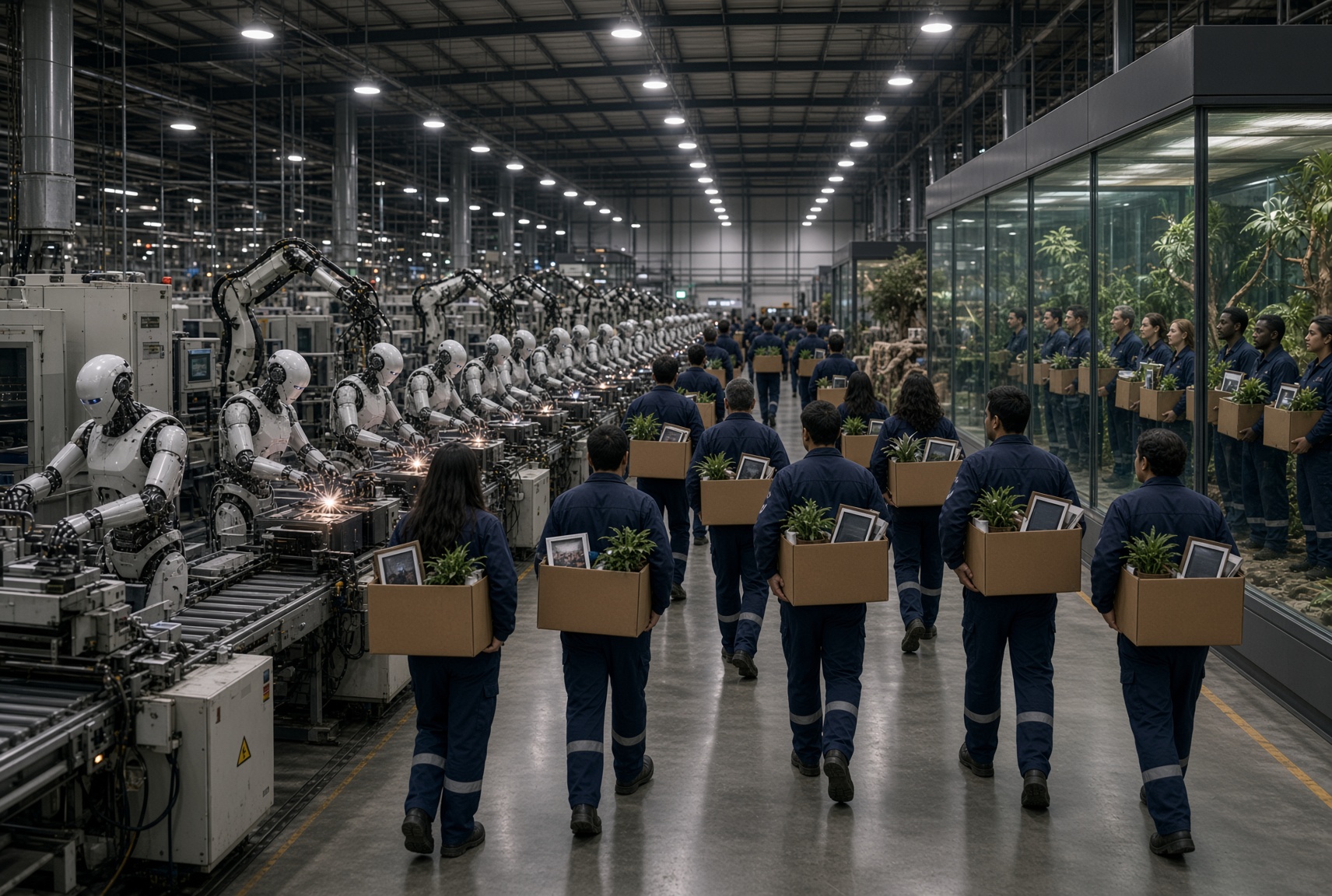
The post-war model of perpetual consumption has run headlong into physical and demographic realities. Rather than allowing a corrective reset that returns capital and productive power to families, the managerial elite has opted for steady-state confinement. Cloaked in the language of net-zero environmentalism and biomedical emergency, ordinary populations are no longer managed as sovereign citizens or productive producers. They are kept as specimens in a technological zoo.
Synthetic Multiculturalism as an Elite Transition Tool
Top-down multiculturalism was never designed to preserve genuine cultural variety. Instead, it operates as a solvent. By flooding historic nations with competing, unassimilated populations, the state deliberately erodes local solidarity, fractures the historic working class and eliminates common cultural resistance. An atomised, deracinated population is far easier to monitor, govern and replace.
Society no longer divides along outdated parliamentary party lines. The real division pits a compliant, managed public against those who retain independent thought and memory. A tiny technocratic elite, making up less than 1% of the population, maintains its hegemony through an expanding apparatus of compliance managers, diversity officers and human-resource administrators. This managerial tier coordinates corporate capital, state power and digital communication monopolies, exempting its own members from the housing precarity, economic insecurity and social decay it enforces upon everyone else.
Humanity as Surplus
As automated logistics, artificial intelligence and behavioural management reach full scale, the ruling class no longer views a self-reliant domestic workforce as an asset. Whether native-born or imported, ordinary working people are viewed as overhead costs to be automated away. The stage is set for a high-tech feudal regime where plebeians of every ethnic background are rendered obsolete, sustained only by state-issued digital tokens and tightly monitored consumption.
This development aligns with the theories of philosopher Peter Sloterdijk and historian Yuval Noah Harari. Both thinkers recognise that the traditional citizen-worker of the industrial era is an anachronism. Sloterdijk treats modern history through the concept of the human park, or Menschenpark, an ongoing civilisational project of domestication. In this model, self-appointed elites act as zookeepers, selecting, refining and governing human stock through education, culture and institutional discipline. Sloterdijk argues that traditional humanist institutions can no longer preserve social order. As a result, the management of human biology and behaviour will become direct, clinical and technocratic. Without explicit bio-cultural oversight, he contends, human populations risk sliding into unruly disorder.
Harari arrives at the same conclusion from the perspective of technological determinism. In previous centuries, rulers were compelled to invest in their common people, if only to secure factory hands for industry and soldiers for imperial armies. In the age of algorithmic automation, that bargain is obsolete. Harari warns that the unmanaged masses are fast becoming a useless class, a population that is not merely unemployed during an economic downturn, but permanently unemployable within an automated economy. Because algorithms can outperform humans in both administrative labour and cognitive processing, ordinary citizens have surrendered their historic bargaining power.
Taken together, these perspectives define the mechanics of the zoo economy. The managerial caste no longer needs a productive, property-owning public to sustain wealth or social order. The average citizen is demoted to a ward in a high-tech enclosure. Sedated by screens, medicated by the psychiatric establishment and fed on industrial calories, the public is managed via state transfers and corporate digital subscriptions. The ruling class has abandoned the exploitation of domestic labour in favour of absolute administrative surveillance. In this emergent feudal order, ordinary men and women are no longer stakeholders in a shared civilisation. They are treated as biological liabilities, to be curated, tranquillised and managed until the machine no longer requires them at all.